My favorite Houston Chronicle editorial writer and columnist for the Houston Chronicle’s opinion desk is Regina Lankenau.
The surname Lankenau is of German origin, likely a habitational or geographical surname derived from a place name. Regina could be Hispanic, but I used to date a very white American young woman with the first name of Regina when I was at Oklahoma State University.
Based on the photos posted online, she appears to be a typical gabacha. However, she is from Mexico, and I assume she speaks Spanish, thus identifying her as Latina; however, she would definitely fit the Mexican-American category.
In today’s Houston Chronicle, there is an article from Regina Lankenau worth reading. I don’t like the Chronicle, but they had a special, and I took it, figuring I would keep it for a year, as that is the most value I would put on the Chronicle. The special was for half a year, and then the regular price applied.
Ms. Lankenau’s article, but not in its entirety. Want to read it all? Get a subscription.
Today’s slate of bayou discoveries could have been an opportunity for HPD and the city’s leaders to show Houstonians why they should be trusted now – by offering concrete responses to public anxiety: more patrols, better lighting, clear timelines. Instead, leaders only offer vague assurances.
While Mayor Whitmire, in his press conference, said that even one death is too many, he also seemed all too quick to attribute the high numbers to the mere presence of people living underneath bridges,
…For Brandeis University sociology professor, Sarah Mayorga, the real question then is, “Why do we kind of accept that their lives have less value, or that this kind of gruesome death is something that is tolerable or explainable?”
It’s no surprise that online, people weren’t persuaded. It doesn’t help that the city seems reluctant to release details or engage basic questions. I tried to learn the forensic reasoning behind ruling out targeted foul play – after all, a serial killer could prey on people without housing. My calls and emails to the Houston Forensic Science Center and the Harris County Institute of Forensic Sciences went nowhere. When I asked to speak with an HPD officer about bayou-trail safety, I was only sent back to the mayor’s press conference.
That’s the problem. People’s theories behind the deaths may be completely unfounded, but their fear? That’s absolutely real. At a time of heightened uncertainty and dismally low trust in institutions, “a lot of people right now are feeling powerlessness or helplessness,” Korver-Glenn, the sociologist, said. TikTok may be a sort of “lever for folks to exert some sense of agency” by demanding transparency from local officials in a way they can’t as easily at the national level.
When institutions dismiss those worries as a silly social-media trend, the message is: Your fears aren’t a priority.
…It’s why, when I spoke to a group of young Hispanic women at 10 p.m. on a Thursday last month, they were hanging out on the bed of their truck beneath the fluorescent lights of a downtown parking lot. The people nearby, zipping around on e-scooters and walking in Discovery Green park, made them feel safe.
“When the scooters started, we used to ride along [the bayou],” Jackie, 21, told me, “but then recently with all the deaths and the bodies, that’s making it more scary for us.” They now avoid it.
Perhaps the great fear gripping Houston isn’t a monster in the dark, but the familiar dread that the city will look away as bodies – disproportionately Black and some Hispanic – surface again and again. If leaders want to quash rumors, they have to fill the vacuum that feeds them: release information quickly, explain forensic findings plainly, answer questions, show patrols and lights on the ground and treat every life as equally worth the effort.
Do that – and the bayou reads as a true public space, not a crime scene. Don’t – and people will redraw their own maps, avoiding the very places meant to connect us.
Whitemire is not doing the community any favors by obfuscating what is happening in Houston’s bayous.
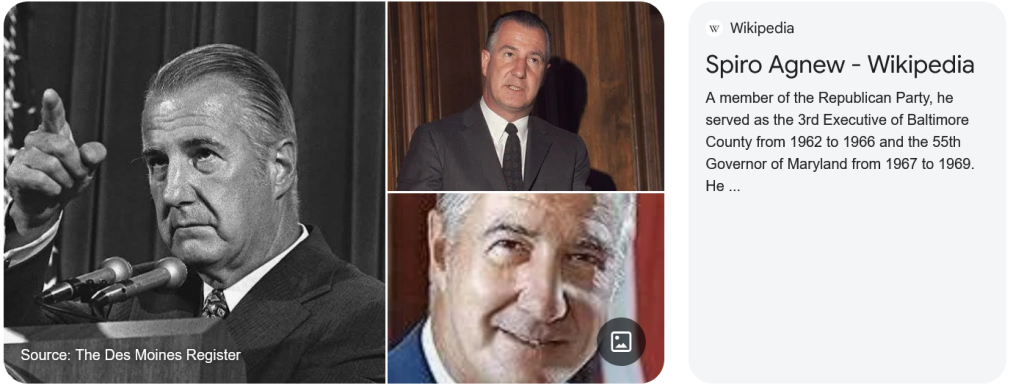
I first encountered the word ‘obfuscate’ when Richard Nixon was president, and his vice president, Spiro Agnew, used it. I still remember looking it up in the dictionary. That was before the internet.
Spiro Agnew attempted to obfuscate, or cover up, his criminal corruption charges through multiple strategies in 1973. Facing an investigation into bribery and extortion, the sitting Vice President claimed innocence, attacked the media for leaking information, and asserted that a sitting vice president could not be indicted.
Despite his concerted effort, Agnew’s obfuscation failed, mainly due to overwhelming evidence and pressure from within the Nixon administration itself.
- The evidence was undeniable: Federal prosecutors had gathered extensive evidence of Agnew’s long-running bribery and extortion schemes, which began during his time as Baltimore County Executive and Maryland Governor and continued into his vice presidency.
Does Spiro Agnew remind you of someone who is presently in the White House?