
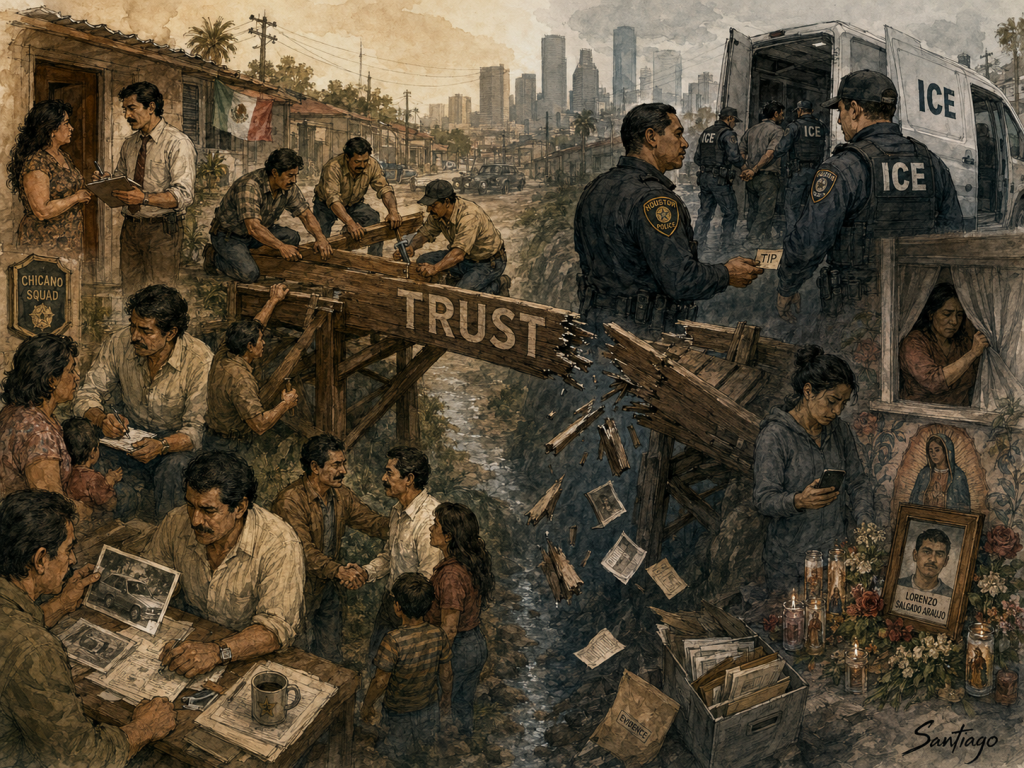
There is a question that the newspapers and news media have not asked: who supplied the tip and why? Who can the community trust? HPD and Constable 6 need to step up and tell the community if they gave the tip to ICE.
Houston Learned This Lesson Before
Houston already knows what happens when the Latino community stops trusting the police.
Witnesses stop talking. Crimes go unreported. Homicides remain unsolved. Everyone becomes less safe.
That breakdown in trust is one reason the Houston Police Department created the Chicano Squad decades ago. Mexican-American officers were brought in because Latino families would speak to them when they would not speak to other detectives. The squad helped solve cases that had gone cold—not because its officers possessed some secret investigative power, but because the community finally believed someone was listening.
Now Houston may be throwing that lesson away.
ICE agents recently killed Lorenzo Salgado Araujo after stopping a white van carrying Mexican construction workers while searching for two Guatemalan immigrants. Salgado Araujo was not the person named in the administrative warrant. Neither was his brother. Neither were the other men in the van.
The Department of Homeland Security says agents acted after receiving a “credible tip” from an unnamed law-enforcement agency. According to DHS, officers had been watching an address in southeast Houston and had seen two white vans there weeks earlier. On July 7, agents approaching the address spotted another white van and decided that one of the men inside resembled their target.
That decision ended with the wrong man dead.
DHS has not identified the agency that supplied the tip. It has not publicly shown the target’s photograph, the license plates of the vans observed during surveillance or the information connecting Salgado Araujo’s vehicle to the two Guatemalan men ICE was seeking.
The agents were not wearing body cameras.
DHS blamed “back-to-back Democrat shutdowns,” saying the purchase and distribution of cameras had been delayed. That may explain why the cameras were missing. It does not explain why armed federal agents were sent into Houston neighborhoods without them.
Now the government asks the public to accept its account of the shooting without independent video from the agents involved.
Trust us, they say.
Houston has heard that before.
The first question should be simple: Which law-enforcement agency gave ICE the tip?
Was it the Houston Police Department? Harris County Constable Precinct 6? Another local department? A state agency? A different federal agency?
Perhaps neither HPD nor Precinct 6 was involved. If so, they should say so plainly.
Perhaps DHS is protecting the agency because naming it would make a bad situation worse. Perhaps the information was connected to a legitimate criminal investigation. Perhaps the “credible tip” was far thinner than that phrase suggests.
We do not know because DHS will not tell us.
But Houstonians have a right to know whether their local police are voluntarily supplying information that helps ICE conduct civil immigration arrests. An administrative warrant is not the same as a criminal warrant, which is reviewed and signed by a judge. It authorizes immigration officers to arrest the person named. It should not become a roving license to stop every Latino man in a similar vehicle.
Local police departments may believe that cooperating with ICE helps law enforcement. History tells us it can do the opposite.
When people fear that speaking to the police may bring immigration agents to their homes, they stop calling.
A woman being abused may remain silent because she fears what will happen to her husband, her parents, or herself.
A witness to a shooting may decide that saying nothing is safer than giving police a name and address.
A worker who sees a serious crime may keep walking because he does not know where HPD ends and ICE begins.
Eventually, officials complain that the community will not cooperate.
They forget to ask why.
Houston once faced that same wall of silence. Latino families believed crimes against them were not being taken seriously. Language barriers mattered, but distrust went deeper than language. People did not believe the police valued their lives or would protect them after they spoke.
The Chicano Squad began breaking through that wall because its officers understood the people they were questioning and because the people trusted them enough to answer.
That trust took years to build.
It can be destroyed in a morning.
DHS says unnamed law-enforcement partners helped lead ICE to a neighborhood, a white van and men who were not the targets. One man is now dead. The agents had no body cameras, and the public is being asked to accept the government’s version while important evidence remains hidden.
This is not only an immigration story. It is a public-safety story.
HPD and Precinct 6 should publicly disclose whether either agency supplied the tip. Houston officials should demand that DHS identify the unnamed partner and release the records showing how ICE went from searching for two Guatemalan men to stopping four Mexican workers.
Then Houston must decide whether voluntary cooperation with civil immigration enforcement is worth the price.
The city already knows what that price can be.
Unreported crimes.
Missing witnesses.
Unsolved murders.
A community afraid to call the police.
Houston created the Chicano Squad because distrust was making the city more dangerous. It should not now help ICE rebuild the same wall the squad was formed to tear down.
You cannot protect a community that is afraid to speak to you