
After heavy rains receded, another body appeared along Buffalo Bayou. Was it a new death—or an old secret the water finally gave back?
Did Houston Find Another Body—or Did the Receding Bayou Finally Surrender One It Had Been Hiding?
After days of heavy rain sent Houston’s waterways rising and running faster, another body appeared in Buffalo Bayou. Investigators do not yet know where the person entered the water, how long the body had been there—or whether the recent storms helped carry it into view.
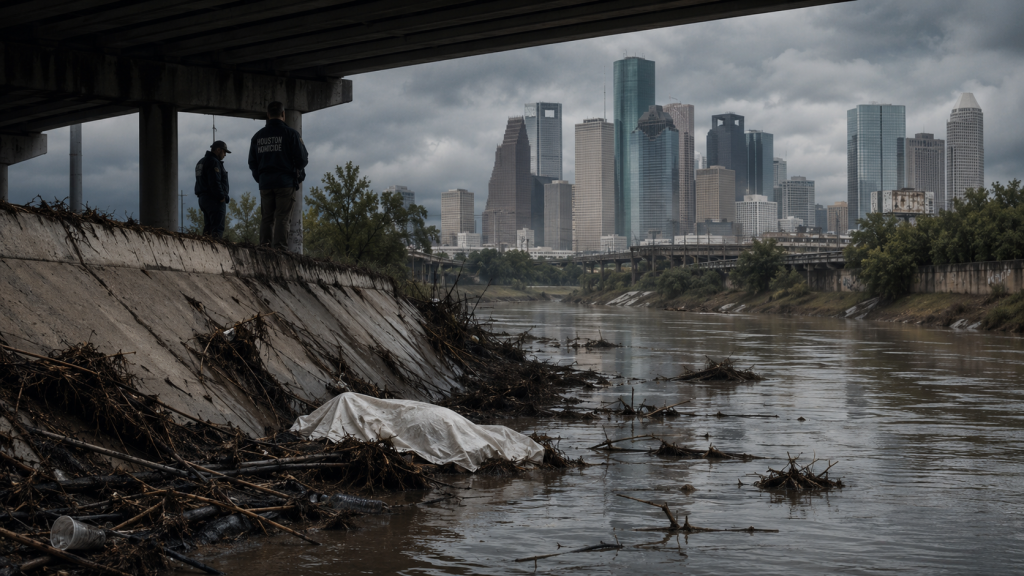
HOUSTON — The call came shortly after 7 Monday morning.
People aboard a boat had spotted what appeared to be a body in Buffalo Bayou near J.W. Peavy Drive in Houston’s East End. Police officers entered private property to reach the water. Homicide investigators began checking nearby surveillance cameras while the Harris County medical examiner took custody of the remains. The person had not been publicly identified, and the cause and manner of death remained undetermined.
For the moment, the dead person is not a name.
It is a time, a location and another pending autopsy.
The discovery came exactly one week after emergency crews recovered another body near Industrial Road, close to where Greens Bayou meets Buffalo Bayou and the Houston Ship Channel. Severe thunderstorms complicated that recovery. The current was strong enough to delay responders, and an alligator was reportedly seen near the remains. Authorities said they did not know how long that person had been in the water.
Houston had been soaked by repeated slow-moving storms. Many parts of the metropolitan area received between 1 and 3 inches of rain on July 13, while isolated areas received more than 3 inches. Forecasters warned that additional storms could produce another 1 to 3 inches, with substantially higher totals in places repeatedly struck by downpours.
Then the rain eased.
The water began to fall.
And another body was found.
That sequence does not prove the storms had anything to do with Monday’s discovery. Police have not said where the person entered the water, whether the death occurred in the bayou or whether the body traveled from somewhere upstream. Investigators have not established when the person died.
But the sequence raises a legitimate question.
Did Houston find another body—or did the receding bayou finally surrender one it had been hiding?
Floodwater does not merely rise vertically and then settle back into place. Fast-moving water can lift and transport trees, trash and other heavy debris. As the water falls, material may be left tangled against fences, vegetation, bridge supports and other obstructions. The U.S. Geological Survey uses these deposits to identify how high floodwater reached; the Harris County Flood Control District routinely removes debris left behind after major storms.
A human body in that current could also move.
It could be carried past the place where the person fell—or was placed—into the water. It could become trapped below the surface in branches or accumulated debris. Rising water could conceal it. Falling water could expose it. By the time it is recovered, the body may be miles from the location that holds the evidence explaining what happened.
That possibility matters because the location where a body is found is not necessarily the location where the person died.
A body recovered from land may still be surrounded by footprints, blood, clothing, weapons, tire impressions or witnesses. Moving water can separate a body from those clues. Heat, decomposition and immersion can erase still more. Investigators may eventually determine who died without ever determining precisely where or how.
By the accounting in a July 15 article on this site, Harris County medical-examiner records showed 208 bodies recovered from Houston-area bayous between 2017 and February 2026. Later recoveries in April, May and on July 13 brought that running total to at least 211. Monday’s discovery would make it at least 212—although Houston still has no single public, continuously updated list allowing residents to verify every recovery and its final disposition.
The number alone does not establish a common cause. The dead include accident victims, people who drowned, people who died by suicide and people who were murdered. Police have repeatedly said investigators have found no evidence that one killer is responsible for the pattern.
But Monday’s body has its own story.
Somewhere there may be a family that does not yet know the search has ended. There may be a missing-person report waiting to be matched. There may be surveillance video showing where the person was last seen. There may be injuries that survived the water—or evidence that did not.
There may also be nothing conclusive left.
That is the cruel advantage the bayou holds over the dead and over those trying to explain their deaths. The water can move the body while removing the story around it.
For now, police have a body, a stretch of Buffalo Bayou and another unanswered death.
The recent rain may prove irrelevant.
Or the bayou may have been carrying the answer downstream all along.