
Why Is Channel 2 Still Giving Hate a Comment Section?
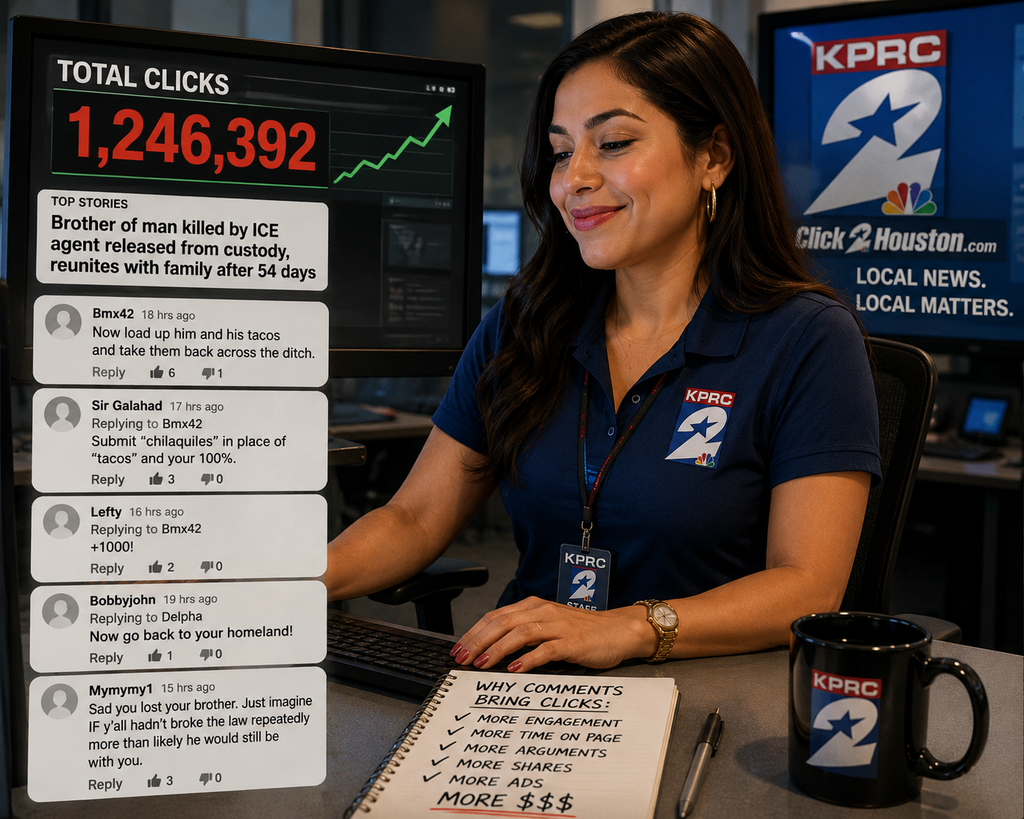
Houston’s major television stations all compete for the same thing: viewers, clicks, and attention. But one thing separates KPRC Channel 2’s Click2Houston website from the other major local television news sites: it still allows readers to post comments directly beneath news stories.
That may sound harmless. Sometimes it is. Readers correct mistakes, add information, argue about politics, or simply react to what happened.
But then there are stories like the one Channel 2 published about Victor Salgado Araujo, the brother of Lorenzo Salgado, who was killed by an ICE agent. Victor spent 54 days in immigration custody before being released and reunited with his family.
Under that story, readers wrote things such as:
“Now load up him and his tacos and take them back across the ditch.”
Another reader corrected the ethnic insult:
“Submit ‘chilaquiles’ in place of ‘tacos’ and you’re 100%.”
Another added:
“Now go back to your homeland!”
And another blamed the family:
“Just imagine IF y’all hadn’t broke the law repeatedly more than likely he would still be with you.”
These are not abstract disagreements over immigration policy. “Tacos,” “chilaquiles,” “across the ditch,” and “go back to your homeland” are being used to identify people as Mexican and tell them that they do not belong here.
That should sound familiar.
A century ago, American newspapers did the same thing much more openly. During the Skinning War, newspapers described Mexicans as “greasers,” “banditti by instinct,” “ignorant and lazy,” and “the filth and scum of a demoralized nation.”
The newspaper itself supplied the hatred.
Modern journalism usually works differently. A respectable television station would probably never publish an editorial saying Mexican Americans should be loaded up with their tacos and sent “across the ditch.”
But Channel 2 provides the page where somebody else can say it.
There is an important distinction. KPRC did not write those comments, and holding a newspaper or television station responsible for every stupid or hateful thing one reader types would be unreasonable.
But that defense becomes weaker when the behavior is predictable.
Channel 2 knows it has a comment section. It knows immigration stories generate vicious comments. It has moderators and a “report” button. And readers have complained about the comments. I have personally written to Channel 2 asking it to stop allowing them.
Yet the comments remain.
Why?
I cannot tell you what Channel 2 executives are thinking. They have not told me. But I have a suspicion.
Clicks.
Comments create engagement. A reader posts something offensive. Somebody replies. The original reader returns to see the reply. Three more people join the argument. Somebody sends the story to a friend and says, “Look what this idiot wrote.” People refresh the page. They stay longer. They see more advertising.
An ugly argument can be very good for traffic.
That does not prove Channel 2 keeps comments because they make money. It is my opinion. But we know the economics of the internet: attention has value, and anger is very good at producing attention.
Channel 2 itself provides ways for viewers to contact its web team and even maintains a viewer comment line. It therefore cannot reasonably claim that there is no way for the public to communicate with the station without maintaining an open comment section beneath individual stories. (Click2Houston Help Desk)
The other Houston television news websites appear to have largely moved away from this model. Their viewers can argue on Facebook, X and other social-media platforms, but the stations do not generally provide the same open reader-comment forum directly beneath their news articles.
That distinction matters.
Facebook owns its comments.
X owns its comments.
But when hateful comments appear directly under a Click2Houston article, they appear inside Channel 2’s house.
And Channel 2 controls the house.
There is another irony. Houston television journalists themselves know what this kind of speech looks like. Earlier this summer, ABC13 anchor Erica Simon publicly exposed a racist message comparing her and her mother to monkeys. Other Houston journalists immediately condemned it. (Chronicle)
We recognize racism immediately when somebody sends it directly to a journalist.
Why should it become acceptable when it is aimed at the people in the story?
Channel 2 does not have to eliminate disagreement. It does not have to protect politicians, police officers, immigrants, or anyone else from criticism.
But there is a large distance between:
“I think immigration laws should be enforced.”
and
“Load up him and his tacos and take them back across the ditch.”
One is political speech.
The other is contempt for people because of who they are perceived to be.
We recently looked at nineteenth-century newspapers and asked how respectable publications helped create hatred against Mexicans. Back then, editors sometimes printed the slurs themselves.
Today the mechanism can be more convenient.
Publish the story. Open the comment section. Let the readers provide the hate. Collect the clicks.
I cannot prove that is why Channel 2 continues doing it.
But Channel 2 can answer a very simple question:
Why is Houston’s Channel 2 still providing a home for comments that Houston’s other major television news outlets decided they could live without?
And perhaps an even simpler one:
What does Houston gain from keeping them?