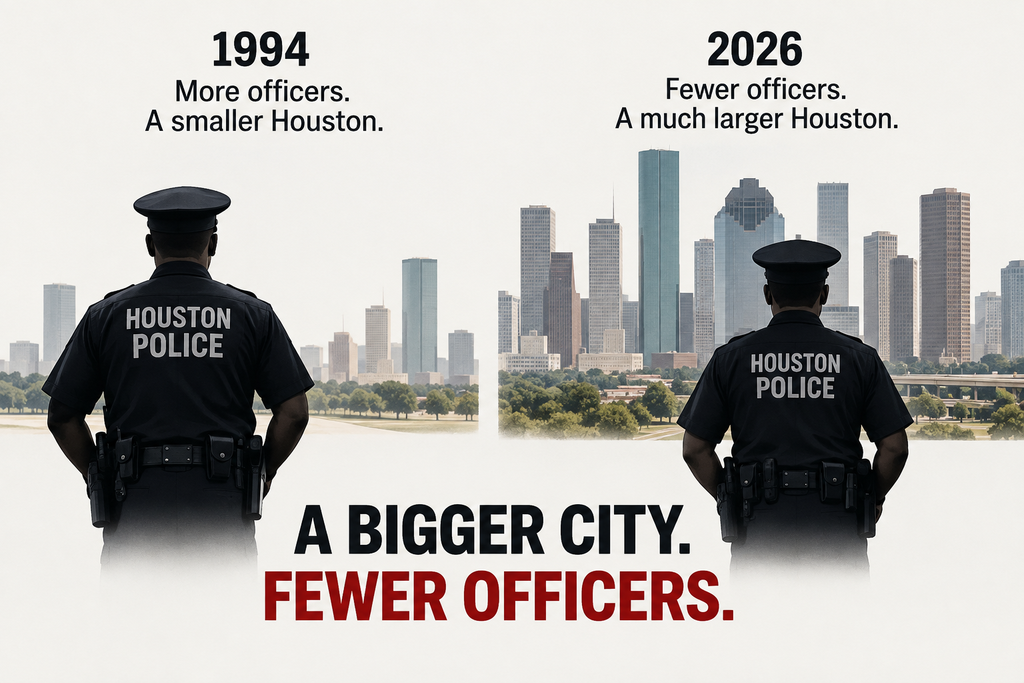
Houston is spending hundreds of millions more on police, but the number of officers has barely moved.
The Chronicle calls today’s staffing a 20-year high. Look at the longer history, and the picture is much less impressive.
When less is more
| Fiscal year | Actual classified officers |
|---|---|
| 2014 | 5,301 |
| 2015 | 5,200 |
| 2016 | 5,207 |
| 2017 | 5,112 |
| 2018 | 5,152 |
| 2019 | 5,232 |
| 2020 | 5,282 |
| 2021 | 5,185 |
| 2022 | 5,122 |
| 2023 | 5,147 |
| 2024 | 5,211 |
| 2025 | 5,238 |
So in 2025, after all the talk about rebuilding HPD, Houston had 44 fewer classified officers than it had in 2020 and 63 fewer than it had in 2014.
And the longer comparison is even more revealing. HPD itself says it had 5,470 classified officers in 1998, compared with 5,238 in 2025—a decline of 232 officers while Houston’s population grew by about 562,000 people, or 31%.
The Houston Chronicle says HPD now has its “biggest numbers in 20 years.”
That sounds impressive until you look at what happened before those 20 years.
Houston had more police officers in the late 1990s than it has today, even though the city had hundreds of thousands fewer residents. The Chronicle’s comparison starts after HPD had already begun losing officers.
That makes the “20-year high” technically true while leaving out the more important history.
One major reason for the decline was the change in Houston’s DROP pension program. DROP gave experienced officers a financial incentive to remain on the force longer. Changes to the program altered those retirement incentives and eventually contributed to large numbers of veteran officers leaving.
So if you start your chart after those losses began, today’s modest rebound suddenly looks like a historic achievement.
It is not necessarily a false statistic.
It is a carefully chosen statistic.
The better question is not whether HPD has more officers than it had at the low points of the last 20 years.
The better question is why Houston has fewer officers than it had decades ago, despite a much larger population, and why taxpayers had to commit nearly $1 billion in additional police compensation just to move the number back upward.
That is what the Chronicle’s chart does not show.