
I read the news and the headlines; over the last few days, I noticed many more articles about how Flock Cameras help find someone or a stolen car. I don’t believe in coincidences, so I decided to do some research. It turns out it is true, both the police and Flock want to keep the cameras, the policee like their little toy and I imagine that the company makes and sells the Flock cameras wants to keep making money. But it is not as good as they claim, and with their use of AI, they can become much more dangerous.
If police suspect a criminal is driving a vehicle flagged by Flock Cameras, they are more likely to see it as high risk and stop it with guns drawn.
n the real world, the gap between what the law dictates and how officers behave on the street can be significant. Statistically and tactically, police draw their weapons far more frequently in real-world encounters than the legal threshold of “imminent threat” suggests. [1, 2]
The reality of how and why this happens comes down to several real-world factors:
1. “Precautionary” Drawing is Standard Practice
In the real world, officers rarely wait until they see a weapon to draw theirs. Under the concept of “action beats reaction,” a suspect can pull a hidden gun and fire faster than an officer can react, draw, and return fire. Because of this, officers routinely draw their weapons proactively during what they perceive as high-risk or unpredictable scenarios, including: [1, 2]
- High-risk traffic stops (e.g., a vehicle matching the description of a stolen car or a felony suspect).
- Approaching a building during a reported burglary or domestic disturbance.
- Ordering a suspect out of a car if they refuse to show their hands or keep reaching out of sight. [1, 2, 3]
In these moments, the officer may have no proof the suspect is a violent criminal, but they draw their weapon to gain an immediate psychological and tactical advantage.
Flock Safety cameras can help police catch criminals. Nobody needs to deny that. A stolen vehicle passes a camera, an alert goes out, officers find the car and sometimes make an arrest. Those are the stories police departments and Flock Safety understandably like to publicize.
But there is another number that gets far less attention.
In Columbia, Missouri, Flock generated 5,521 alerts in 2025. Police tracked 217 case outcomes connected to those alerts, and 69 resulted in arrests. That works out to about one arrest for every 80 alerts — roughly one percent. (Como)
Meanwhile, the cameras are not just photographing suspects. They photograph everybody.
Conroe’s police chief recently defended his department’s Flock cameras by revealing that during one month the system recorded 894,000 license plates. Police actually investigated only 642 of them. In other words, more than 893,000 plate observations were collected while police were interested in fewer than one-tenth of one percent. (Houston Chronicle)
That is what gets lost when the public sees another headline saying “Flock camera helps police catch suspect.” The success may be real. The other 893,000 motorists usually disappear from the story.
Flock is no longer a little collection of cameras scattered around a few cities. More than 7,000 law-enforcement agencies use its systems, according to the company, and there are roughly 140,000 automated license-plate readers of various brands operating nationally. Harris County alone reportedly has more than 4,000 readers, the largest concentration identified in one recent national mapping effort. (Flock Safety)
And Harris County is spending real money on them. Commissioners Court renewed a Flock contract this year for about $869,000, after approving additional expenditures including $225,000 in January and a $2 million amendment in March for additional license-plate readers and related equipment. (Harris County Legistar)
Flock also has a strong financial reason to convince governments that the cameras are indispensable. Police have an equally obvious reason to defend a tool that lets an officer at a computer search where a vehicle has appeared, instead of sending officers around town to look for it.
But convenience is also what makes the technology dangerous.
The Washington Post found at least 69 police officials accused, charged, or convicted of misusing Flock or other license-plate reader systems. In at least 15 cases, outsiders — victims, journalists or activists — discovered the potential abuse before the police departments themselves did. Some departments acknowledged they were not routinely auditing their officers’ searches. (The Washington Post)
The abuses were not theoretical. Officers have used plate-reader systems to track wives, girlfriends, former partners, and other people who were not criminal suspects. One police chief searched for vehicles belonging to his former girlfriend and her teenage daughter roughly 600 times. (The Washington Post)
Just this week, San Jose said it fired an officer accused of using Flock searches to help a relative track a domestic-violence victim. The woman reportedly discovered something was wrong because her alleged abuser seemed to know where she was. (San Francisco Chronicle)
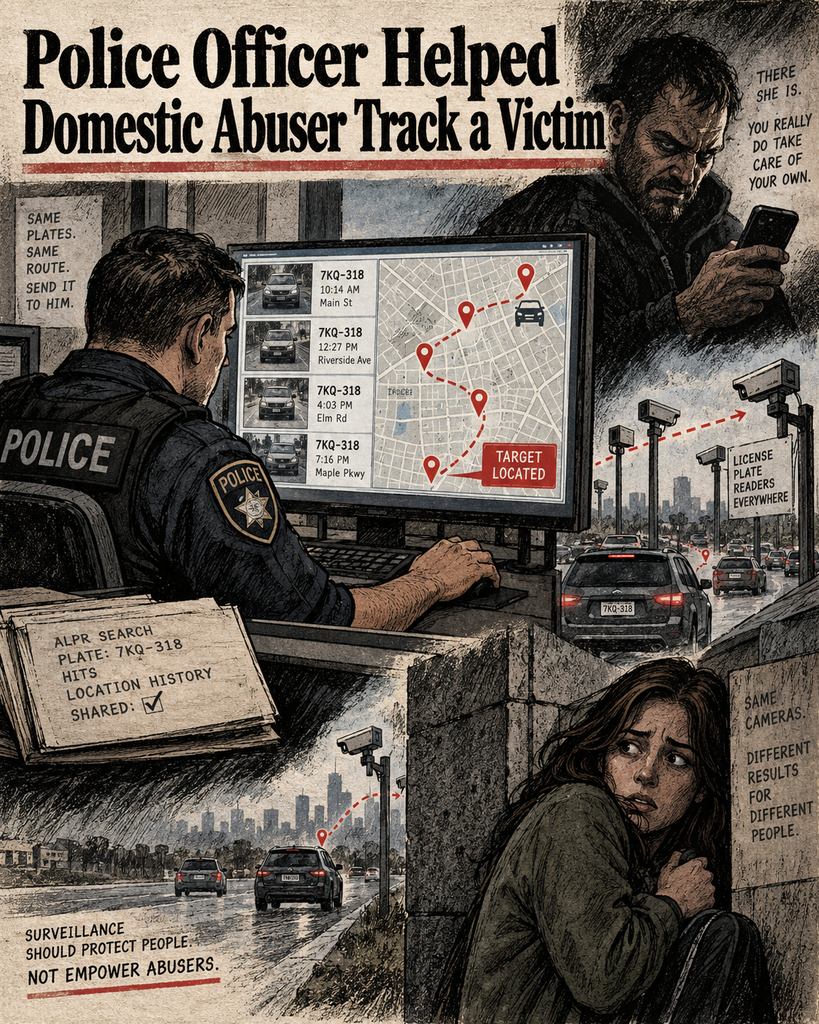
Flock knows it has a problem. After the Washington Post investigation, the company announced tighter safeguards, including requiring case numbers for searches and automatically looking for suspicious activity. Flock has also shortened its recommended default retention period from 30 days to seven days. (The Washington Post)
Those changes admit something important: the danger was never merely whether a camera could correctly read a license plate. The danger was what thousands of people with access to a national network could do with that information.
Police departments say the cameras help solve crimes. They are right.
Flock says its system records vehicles rather than faces and that access controls, audit logs, and limited retention protect the information. That is also true. (Flock Safety)
But neither answer resolves the larger question.
For every criminal caught, enormous numbers of ordinary Americans drive beneath these cameras while going to work, church, a doctor’s office, a political meeting, a girlfriend’s house, an attorney’s office, or simply home. They have committed no crime. Their movements are nevertheless converted into searchable information.
Police naturally want to keep a tool that makes police work easier. Flock naturally wants to keep selling an AI-loaded surveillance system to thousands of police departments.
But when about one in a hundred alerts results in an arrest while millions of innocent motorists are continually recorded, who exactly is being watched — the criminals, or the rest of us?