We Warned About Houston’s Finances. City Hall Still Owes Us Answers.
I am going to bang our own drum, because we have been asking these questions for weeks. Houston’s latest budget setback did not create my doubts about Mayor John Whitmire’s financial management. It gave those doubts more substance.
On September 10, in “The Other Whitmire Knew What a Balanced Budget Was: Kathy Whitmire,” we questioned the wisdom of adding major financial commitments while acknowledging a structural deficit.
On September 11, we asked whether Houston was kicking debt and infrastructure projects down the road. Delaying necessary work leaves future taxpayers with the expense and residents with the unresolved problem.
Then, on October 13, we asked what the fight over dedicated funds for a relatively small car-wash contract revealed about Houston’s finances. A $2.6 million multiyear contract had become a confrontation over certification and flood-mitigation money. The administration defended its procedure; Controller Chris Hollins challenged it.
These were warning signs worth examining before today’s headline.
The Budget Gap Keeps Growing
Finance Director Melissa Dubowski now projects an $88 million shortfall, compared with the $25 million anticipated when the budget was adopted. Hollins estimates $64 million. Either figure represents a substantial deterioration, following a reduction in expected property-tax revenue.
Hollins had already warned in June that budget assumptions could produce additional deficit spending. He also questioned the sustainability of relying on utility-related revenues for general operations. His certification of the budget was expressly not an endorsement of its financial strategy.
Moving garbage expenses into the utility system changes which account pays. Postponing projects changes when the bill arrives. Neither action, standing alone, eliminates the underlying expense.
The 311 “Improvement” Deserves a Closer Look
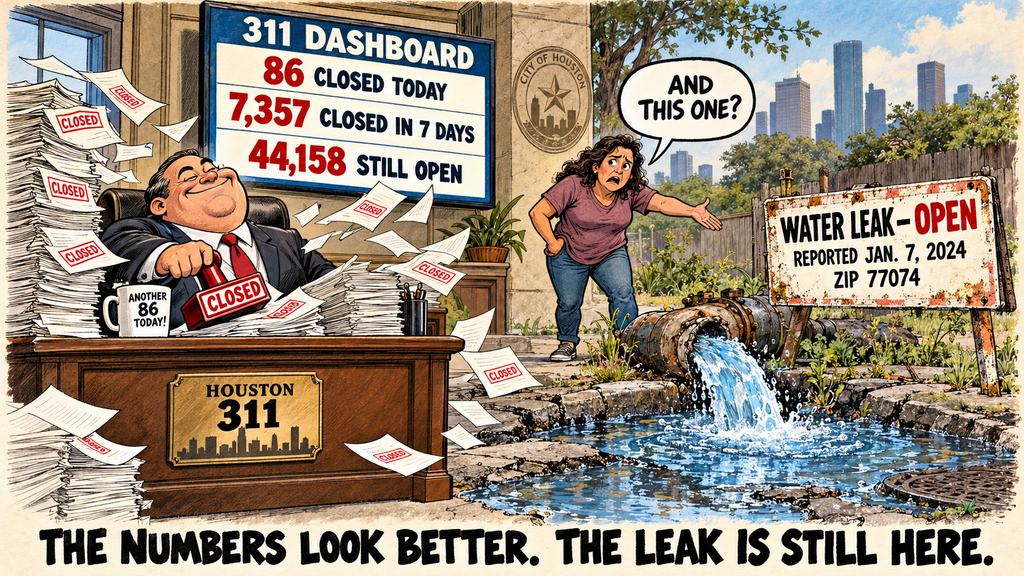
Now City Hall offers another impressive number: an approximately 88% reduction in outstanding solid-waste 311 tickets. But the city’s own presentation says incoming requests declined only 11%, continuing at roughly 12,000 to 15,000 a month. Those are two very different measurements.
Using that dramatic backlog percentage to sell a broad story of service recovery strikes me as a public-relations ruse unless the city demonstrates what happened on the ground. In my own experience, a complaint can disappear while the problem remains.
The presentation also acknowledges that, before February, many tickets were closed without a completion date. It identifies inconsistent data as an ongoing challenge. Those admissions make verification more important.
Residents deserve a breakdown showing how many complaints ended with completed work, how many were transferred or otherwise administratively closed, and how completion was checked. A citation, a closed ticket, and a corrected violation are separate outcomes.
The presentation’s **41% on-time heavy-trash figure—covering August routes—**also shows how much work remained. A smaller computer backlog cannot substitute for reliable collection.
Outside Money Comes With Outside Pressure
The administration submitted a $150 million multiagency federal grant application without first securing required council approval. Whitmire later announced its withdrawal, acknowledging a staff error while questions remained about immigration-enforcement conditions. That is a documented transparency failure, whatever the financial motivation.
Houston had already experienced the leverage attached to outside funding: council amended its ICE restrictions after Abbott froze $110 million in grants.
We Asked Before. We Are Asking Again.
My opinion is that Houston’s finances are more fragile than Whitmire’s reassuring presentation suggests. The growing shortfall strengthens that concern; the funding disputes and unanswered questions make independent scrutiny essential.
Show us the recurring revenue that pays recurring expenses. Show us what the utility system is absorbing. Show us which projects keep slipping—and whether the complaints marked closed were actually resolved.
We raised these questions before the latest shortfall. City Hall still owes Houston answers.