
A friend of mine, Genero (GINO), had the confidence of many of the teachers and administrators, and we managed to find out what our IQs were and where we stood in the school for valadectorian and saludatorina. Back then, at least in our school district, it did not matter, as there were no scholarships or grants. There was no one to encourage us to go to college or tell us which careers we should pursue. Looking at my yearbook, they don’t mention who the valadectorian was.
I did find out that my IQ was 126 when I was in the eleventh grade. A few years later, I took a Mensa test and scored 140. That was way before the internet; there were no calculators either. I recall the first calculator that could add and subtract costing more than $100. In college, we used slide rules, which were not cheap.
In the 1960s, Texas schools, like many nationwide, heavily relied on standardized IQ and aptitude tests—such as the Lorge-Thorndike or Otis-Lennon tests—to measure students’ abilities and aptitudes. These tests typically covered verbal, non-verbal, and numerical skills to sort students into academic tracks, with results often kept confidential from families.
- Common Testing Context: Schools used these tests to divide students, sometimes without informing parents of the specific results.
- Test Types: Common tests during that era, as noted in discussions on platforms like Facebook, included assessments for mechanical aptitude and verbal reasoning.
- Significance: These tests in the 1960s were part of a “Great Sorting” in education, determining student placement and future opportunities.
In Junior high, that must have been how they divided our classes; we had group A, B, C, and D.
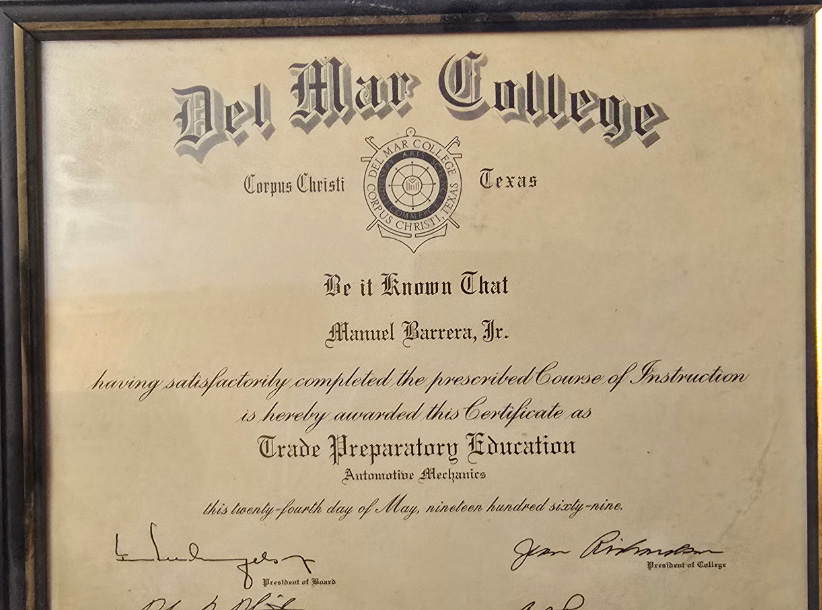
I went and got a trade from Del Mar Tech, an Auto Mechanic degree. By then, I had decided I wanted to go to college, as I did not like having my hands dirty all the time, and having an axle land on your head does not help. I took the ACT and scored a 27. Which, based on my research, places me in the top 10% of test takers. I excelled in math, and when I entered Oklahoma State University, they told me that my math scores were in the top 1% of the country.
Being smart is not all it is cracked up to be, as you often see or notice things that others don’t. I recall the first time I cried, it was not because of pain, it was because I realized that I lived in a world where people who looked like me were second-class citizens. I asked God why He put me in such a world.
In the sixth grade, our teacher asked what we wanted to be when we grew up. I told her the President of the United States. I still recall her remark that the United States would never elect a Mexican as president. Thus far, what she said has remained true.
I invented Doritos before anyone even thought about it. I recall telling my mother that if we can figure out how to package them, we can sell them. Those were corn tortillas fried in a pan. I loved to make those. Atlas, what was true then is still true; it takes money to get your idea to market. The cost of copyrighting it is high, not to mention the production costs. I have had other ideas over the years, but the cost of bringing them to market has always been a problem.
When I was taking Auto-mechanics, one of our assignments was to invent or create something new. I came up with the idea of dual pointers for race cars. My instructor laughed at my idea. While the idea was not new, it was not in use when I shared it with him. No internet to discover things as easily as one does.
We had the World Book Encyclopedia at home. I started reading and got to the middle of the M before I called it quits.
The most important lesson I learned while attending Oklahoma State University was that white people were not smarter.
Dual-point distributors in race cars improve high-RPM performance by increasing dwell time, allowing the ignition coil to fully saturate and preventing spark scatter, ensuring a hotter, more stable spark. They distribute heat across two sets of points to reduce burning and extend durability compared to single points, which can “float” or overheat at high engine speeds.
Key Aspects of Dual Points in Racing:
- High-RPM Stability: By using two sets of points—one to open the circuit and one to close it—the ignition system maintains efficiency above 6,000 RPM, where single-point systems often fail to keep up.
- Increased Dwell: The setup allows for greater total dwell time, ensuring the coil has enough time to charge between firing cycles, which is critical for high-compression racing engines.
- Common Applications: Widely used in vintage racing, particularly in 1960s/70s Mopars, Ford FE engines, and Chevrolet applications, or aftermarket units like Mallory Dual Points.
I have read that ignorance is bliss, but it must be, as questioning everything that we are told certainly does not make one likable.
If you read this far, it is me, Meme, writing down a little bit of my history.


