
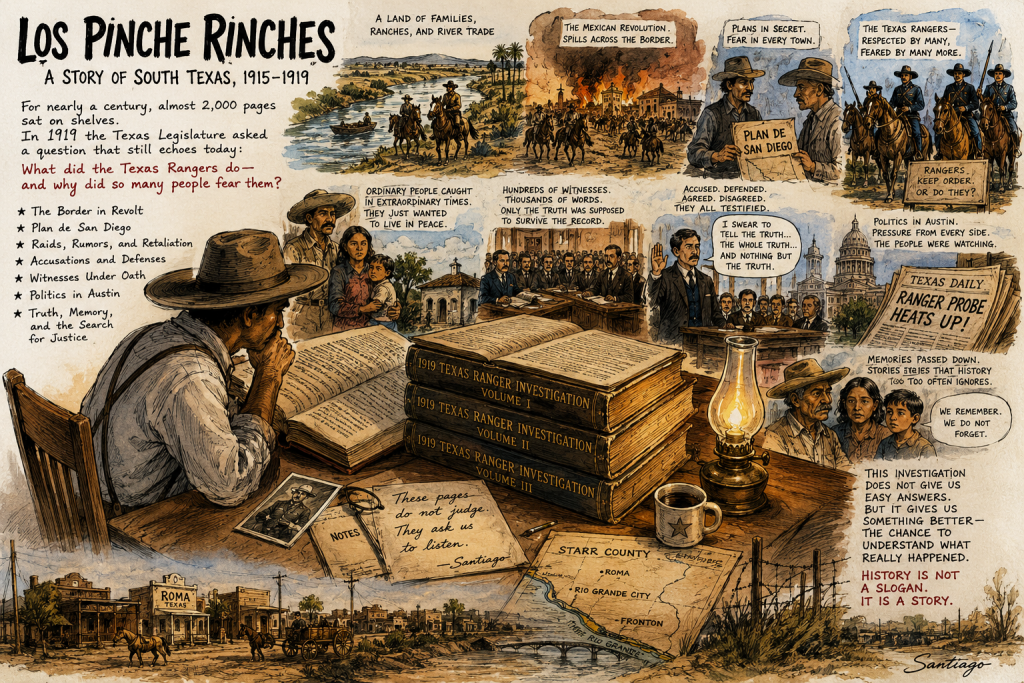
This will be a long project; this is a summary of the Texas Rangers’ investigation in Texas. Their abuse never completely stopped until many years after the investigation; during the Starr County investigation, there were many allegations against them that were proven, even taken to the United States Supreme Court.
The Canales Investigation (1919)
A Very High-Level Executive Summary
Part I: Opening the Record
For more than a century, the Canales Investigation has occupied an unusual place in Texas history. It is frequently cited but rarely read. Historians quote portions of it. Advocates on every side invoke it. Yet few people have worked their way through the nearly 2,000 pages of sworn testimony contained in its three volumes.
The investigation was not convened to write history. It was convened because members of the Texas Legislature believed there were serious allegations that demanded public examination. Representative J. T. Canales, himself a South Texan, presented numerous formal charges involving the conduct of members of the Texas Ranger Force during one of the most violent periods in the history of the Texas-Mexico border. The Legislature responded by creating a joint committee to hear witnesses, receive documentary evidence, and determine what had occurred.
At first glance, the investigation appears to be a trial of the Rangers.
It is not.
It is, instead, a trial of an era.
Between 1915 and 1919, South Texas lived under extraordinary pressure.
The Mexican Revolution raged just across the Rio Grande. Refugees crossed the border seeking safety. Armed bands crossed in both directions. Livestock theft, smuggling, political violence, and fear became part of daily life. The Plan de San Diego, whether realistic or not, heightened anxiety throughout the border counties. Local sheriffs struggled to maintain order. The Governor called upon the Texas Rangers because they were designed to respond quickly in places where ordinary law enforcement could not.
Many Texans regarded the Rangers as indispensable.
Many Mexican-Americans regarded them with fear.
Those two realities existed simultaneously.
The investigation begins from that tension.
One of the first surprises found in the testimony is its breadth.
The witnesses are not limited to Rangers.
The committee heard from:
- Texas Rangers.
- Sheriffs.
- County attorneys.
- Judges.
- Soldiers.
- Merchants.
- Ranchers.
- Physicians.
- Legislators.
- Ordinary citizens.
- Mexican-American residents.
- Anglo residents.
Some praised the Rangers.
Others condemned them.
Some contradicted themselves.
Others contradicted one another.
The committee did not receive one story.
It received dozens.
The hearings also reveal something modern readers often forget.
South Texas in 1919 cannot be understood by viewing only one event.
The Mexican Revolution…
the border raids…
the draft during World War I…
the Porvenir killings…
political rivalries…
racial prejudice…
economic interests…
county politics…
all overlap.
The testimony repeatedly demonstrates that no single incident existed in isolation.
Every witness carried into the hearing room his own experiences, loyalties, fears, and prejudices.
After only an initial reading, one conclusion already stands out.
The Canales Investigation does not support simple conclusions.
Readers searching for proof that every Ranger was heroic will be disappointed.
Readers searching for proof that every Ranger was a murderer will also be disappointed.
The testimony presents courageous conduct.
The testimony presents troubling conduct.
Sometimes it presents both within the same individual.
That complexity is precisely what gives the investigation its historical value.


