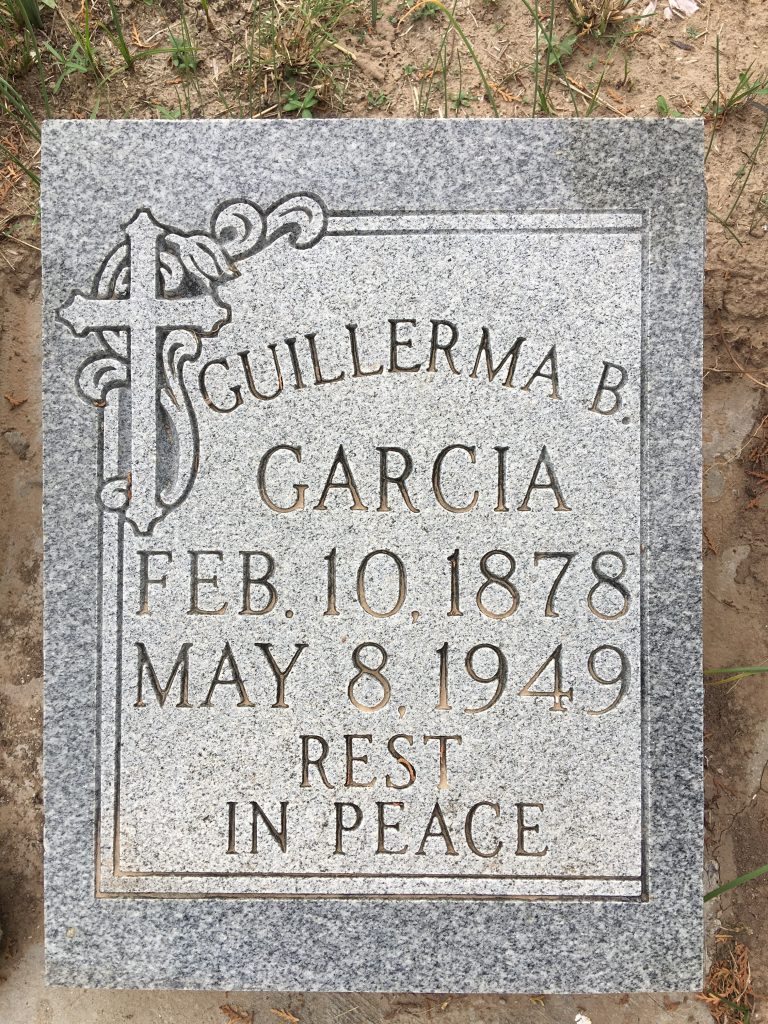
That is the headstone for my great-grandmother. She was born in Texas and buried in Texas.
After I retired, I started researching my family’s history. Our family has been in what is now Texas, probably since the early 1700s. But it is difficult to know which side of the Rio Bravo, the Rio Grande, they were born on. Today I got lucky and found some material which more or less proved what I thought when it said they were born in Mier, which is in Mexico, but at one time, eighty percent (80%) of Mier was north of the Rio Grande River.
.
.
Jose Rafael was our 5th great-grandfather on my mother’s side of the family.

Los Arrieros, TX.Los Arrieros is on the Rio Grande off U.S. Highway 83 ten miles northwest of Roma-Los Saenz in western Starr County. It is an old Spanish-speaking community dating to the eighteenth century. The name is Spanish for mule drivers. The location of the Arrieros Ranch has been identified as the site of the El Cántaro ford near Mier, Tamaulipas, which played a key role in the development of Nuevo Santander. In the late 1680s Alonso de León reportedly crossed the ford during one of his attempts to find Fort St. Louis. Los Arrieros was founded by descendants of followers of Spanish colonizer José de Escandón. It is mentioned as a ranch headquarters in the 1800 church census of Mier, Nuevo Santander, Mexico, as it was a part of the Mier municipality until 1848. It is again mentioned in a memorandum of 1848, explaining to the state of Tamaulipas that the Treaty of Guadalupe Hidalgo had cost the municipality 80 percent of its territory, and 400 people on ten ranches north of the Rio Grande, including Arrieros. By 1990 only a few homes remained near the river and on the gravel roads of the old town. By that time most of the people had moved up to Highway 83, where their homes stretched from the west part of the old 83 cutoff for two or three miles to the Salineño turnoff. About 300 people lived in this area, most of them from Los Arrieros. A few were from Chapeño, a settlement that broke up after the building of Falcon Dam.
I will be honest, one of the reasons I started doing this is because I got sick and tired of gabachos asking me where I was from. I recall one time this pinche gabacho, turns out he was an Arab or from that section of the world. He asked me where I was from.
I replied here. He persisted here, Corpus Christi. That is in Texas.
Well, where were your parents from? He persisted, here.
Not content, he said, well, they must have come from Mexico at one point.
I looked at him and asked him where he was from. He replied here. Where are your parents from, he replied Lebanon.
I said so. You are an Arab. He got so upset that he stormed out of the room.
I knew that my grandparents had been born here in Texas, which dates back to the 1870s, but I became curious about how long our family has been here in what is now the United States. We have been here longer than the gabachos have.
Tracing your family history is neither easy nor cheap. Going through records, thinking you found a relative from the 1600s, only to find that it was an error, so you go back and start all over again. There goes my great-grandmother, the Queen of Spain, and the Virgin Mary is no longer a long-ago cousin. Turns out I am almost 20% Jewish.