July 29, 2026
I stepped outside for only a few minutes this afternoon.
The heat struck immediately. It was not merely hot. Houston’s humidity made the air feel heavy, as though every breath had to be pulled through a wet towel. I soon went back inside, where the air conditioner was running.
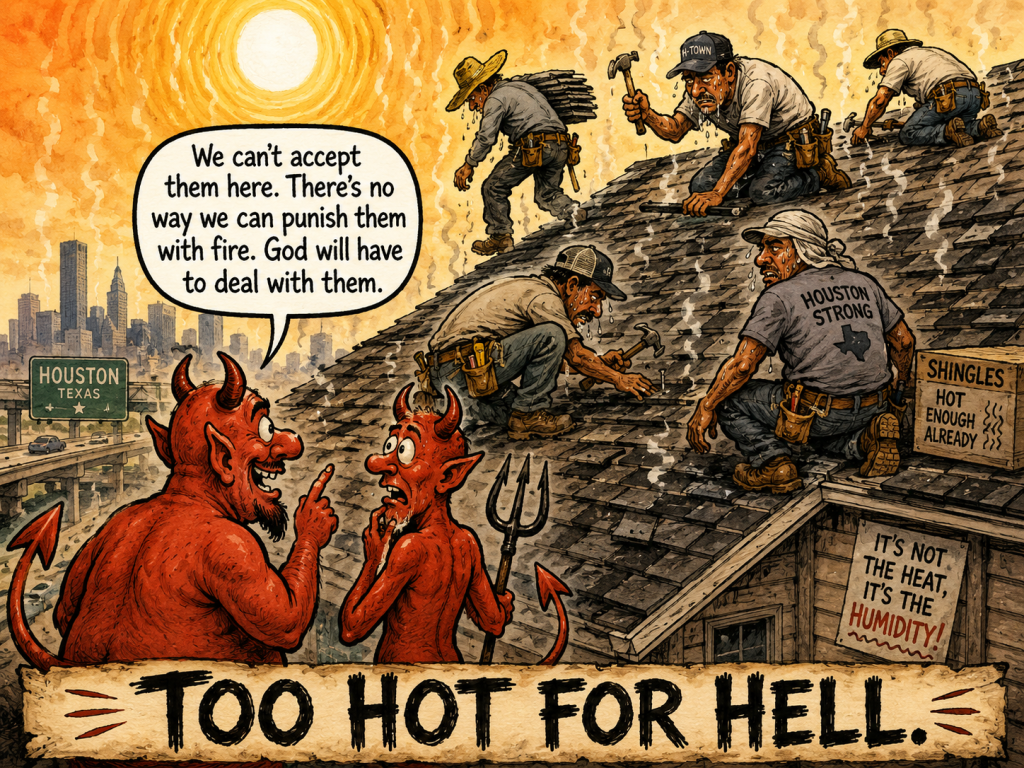
Across the way, men were working on a roof.
They could not go back inside.
They were lifting materials, bending, kneeling, and moving across dark shingles under the full afternoon sun. The temperature reported by the weather service did not describe what they were experiencing. OSHA warns that workplace heat includes not only the air temperature and humidity but also radiant heat from direct sunlight and hot surfaces. On a roof, the sun beats down from above while the shingles return absorbed heat from below. (OSHA)
From the ground, roofing can look almost ordinary. A man climbs a ladder, carries a bundle, drives nails, and moves to the next section.
From the roof, it is hard physical labor performed on a sloping surface that can burn the hands and knees, with little shade and nowhere nearby to cool down. A moment of dizziness is dangerous enough on the ground. On a roof, it can also mean a fall.
I found myself wondering how many Americans would willingly do that work when the heat index feels like 110, 115, or even 120 degrees.
Then I realized that may be the wrong question.
The men on the roof may have been Americans. I did not ask where they were born, what papers they carried, or which language they spoke at home. None of that would explain why they remained on the roof after I had gone back into my air-conditioned house.
The better question is: How many people can afford to come down?
A worker may know the warning signs of heat exhaustion. He may feel the headache beginning, notice his hands trembling, or realize that his shirt is soaked through. He may also know that the rent is due, the refrigerator is nearly empty, and the electric company does not accept heat as an excuse.
Missing an afternoon may mean losing half a day’s wages. Complaining too often may mean losing the job. Walking away may protect his health today while leaving his family without groceries tomorrow.
That is not fearlessness.
It is necessity.
Houston recently saw what this heat can do. On July 22, emergency rooms in the Houston area treated 95 people for heat-related illness in a single day, nearly matching the record set after Hurricane Beryl. The heat index reached as high as 117 degrees in parts of the region. Outdoor workers were among those most exposed. (Houston Chronicle)
Ninety-five sounds like a statistic until you picture the people inside it.
One may have been a landscaper who began feeling confused while pushing a mower.
Another may have been a construction worker who stopped sweating even though his skin remained dangerously hot.
Another may have been an older woman whose air conditioner could no longer cool her apartment.
And one could easily have been a roofer who believed he could finish one more row of shingles before climbing down.
The danger to construction workers is not new. A national study examining occupational deaths from 1992 through 2016 found that construction workers made up about 6 percent of the American workforce but accounted for 36 percent of all occupational heat-related deaths. During those years, 285 construction workers died from heat exposure. (CDC Stacks)
Six percent of the workers.
More than one-third of the deaths.
That number changes how we should see the men on the roof. They are not background scenery in Houston’s growth. They are among the people accepting the greatest physical risk so the rest of us can live beneath roofs that do not leak.
We often praise hard work without looking closely at the worker.
We admire the new house, repaired school, paved street and freshly shingled roof. We notice when the work is late, or the price goes up. We rarely stop to consider the body carrying the lumber, kneeling on the shingles or absorbing hour after hour of heat.
Nor should we romanticize it. There is nothing noble about a system that requires a person to choose between his health and his family’s dinner. A worker should not have to become a heat victim to prove that he is hardworking.
Employers can reduce the danger with water, rest, shade, training, acclimatization, and schedules that move the hardest work away from the hottest hours. Workers also need the freedom to say they are becoming sick without fearing that someone else will immediately take their place.
But even the best safety rules cannot erase the economic pressure that keeps a man on the roof.
That pressure is familiar to anyone who has ever lived close to the next bill. People do things they would never choose freely because someone at home depends on the money. They work through pain, illness, fear, and dangerous heat because poverty does not pause when the weather service issues a warning.
The men I saw this afternoon were not working because the heat did not hurt them.
They were not working because their bodies were somehow better suited to suffering.
They were working because the roof had to be finished, the paycheck had to be earned, and their families still had to eat.
I lasted outside only a few minutes.
They stayed on the roof.