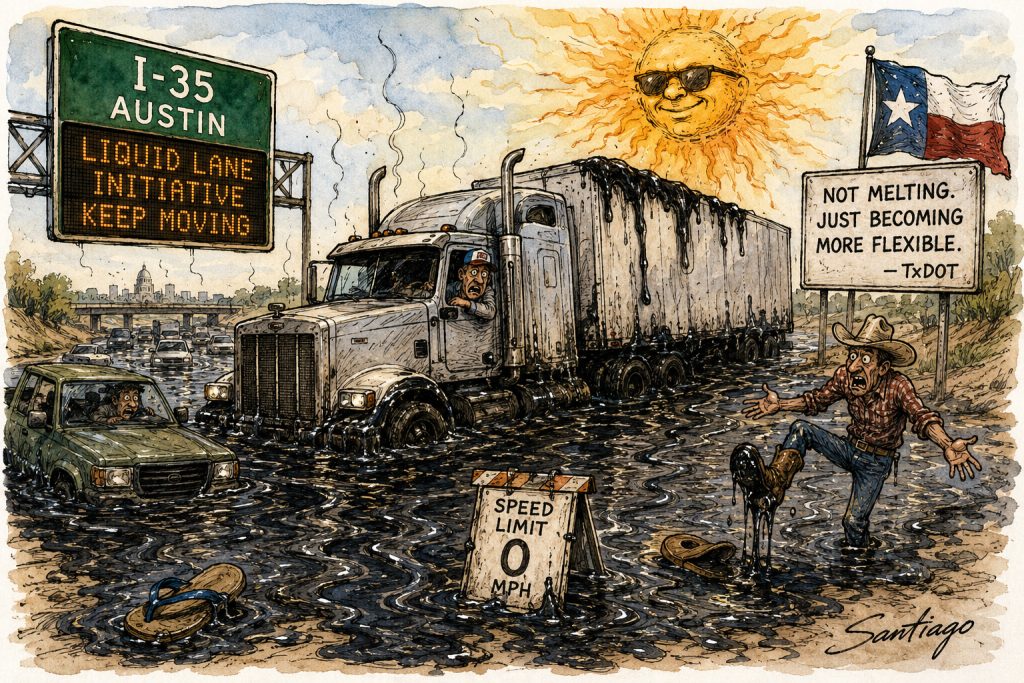
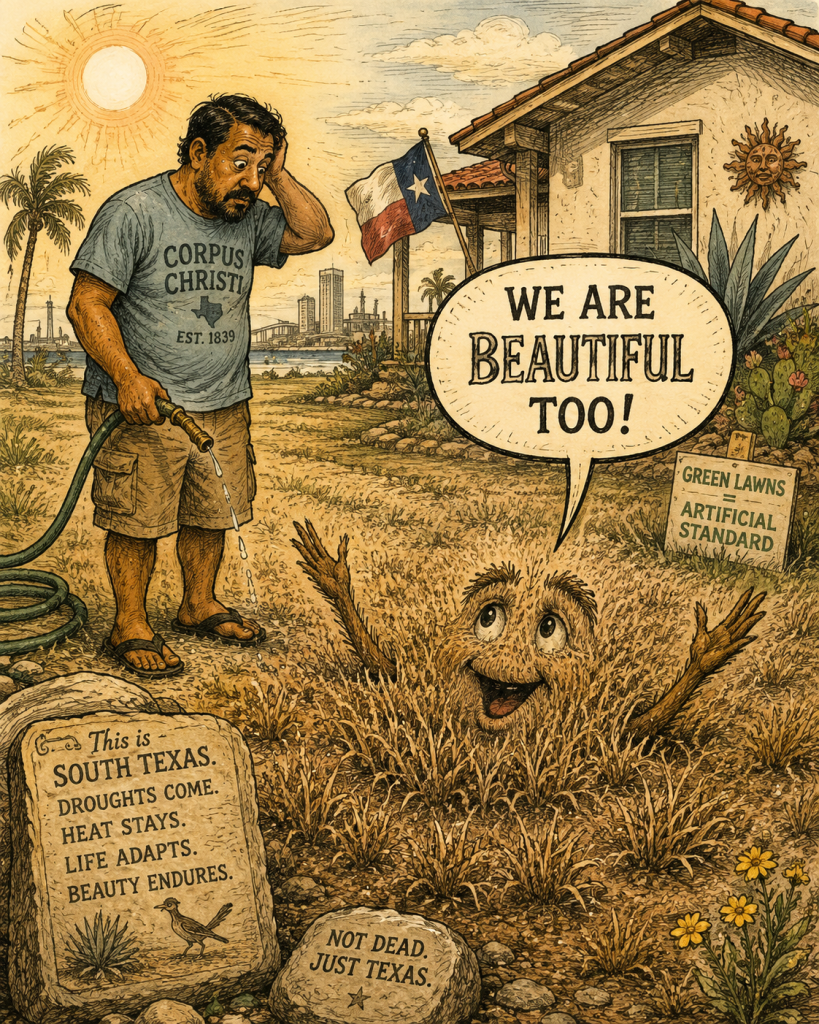
When Corpus Christi announced that it was easing its water restrictions, some Corpus natives began talking about what the change would mean.
The first thing several people mentioned was the grass.
“We can water our yards again.”
I laughed.
Corpus Christi had endured nearly two years of severe water restrictions. Reservoirs had fallen dangerously low. Residents had reduced their average monthly household consumption from about 6,000 gallons to 4,000. The city was still searching for expensive new sources of water.
And the symbol of deliverance was permission to pour treated drinking water onto St. Augustine grass.
On August 4, Corpus Christi moved from Stage 3 to Stage 2 restrictions. Residents may now water their lawns once every two weeks, before 10 in the morning or after 6 in the evening. City Manager Peter Zanoni praised the “real sacrifices” residents had made, specifically mentioning that they had stopped watering their lawns. (City of Corpus Christi)
Nothing says that a water crisis has passed quite like turning the sprinklers back on.
Except the crisis has not passed.
As of August 5, Lake Corpus Christi was 76.5 percent full, but Choke Canyon was still only 24.8 percent full. Together, the two western reservoirs were at 39.2 percent of capacity. The recent rain brought welcome relief, but it did not transform the Coastal Bend into a place where water will always be plentiful. (Drought Status Stage 2)
It merely gave us permission to make the grass green again.
The grass is not innocent
Americans treat the front lawn as though God included it in the plans for the family home.
He did not.
Before the Civil War, most Americans did not have lawns. Grass was generally something animals ate. Maintaining a large area of short, decorative grass required land, labor, and money that ordinary families could not afford. (National Museum of American History)
The lawn came to America from the estates of Europe, where it displayed wealth. A landowner who left productive ground empty was announcing that he had more land than he needed. A household that kept the grass closely cut was announcing that it had animals, servants, or laborers available to maintain it.
In the nineteenth century, American landscape designers promoted the English style for suburban homes. Andrew Jackson Downing recommended broad areas of lawn as part of the proper residential landscape. By the twentieth century, seed companies, sprinkler manufacturers, and lawn-care businesses were selling Americans the promise of a permanently green carpet around the house. (Smithsonian Libraries)
After World War II, the lawn became part of the complete American package:
A detached house.
A family automobile.
A backyard for the children.
A green front lawn for the neighbors.
Lawn care expanded dramatically as the suburbs spread, and by then the grass was doing more than decorating the house. It was testifying about the people inside it. A neatly cut green lawn said the homeowner was responsible, prosperous, and respectable. (National Park Service)
The front yard became a public résumé.
The white lawn
The postwar suburban dream was not originally available to everyone.
Restrictive covenants, redlining, discriminatory lending and the practices of developers excluded Black, Latino, Asian and Jewish families from many suburban communities, including Levittown, the development that became the model for postwar suburbia. (National Park Service)
The green lawn did not create segregation, but it became part of segregation’s scenery.
The identical houses, freshly paved streets, and carefully maintained yards presented an image of order and prosperity. They also presented an image of whiteness. The neighborhood looked uniform because the people permitted to buy homes there were expected to be uniform.
Eventually, Black and Brown families fought their way into neighborhoods from which they had once been excluded. They bought the houses, paid the mortgages, and inherited the rules.
Keep the property painted.
Do not leave an old car in front.
Cut the grass.
Kill the weeds.
Do not let the yard turn brown.
Nobody had to tell us directly that we were being measured. We understood that a neglected yard would not be treated merely as a neglected yard. It might be treated as evidence that the neighborhood was declining because people like us had arrived.
So we learned to maintain the green lawn as proof that we belonged.
That is what I mean by making ourselves white by keeping our grass green.
I do not mean that a Mexican American homeowner turns on the sprinkler and consciously thinks, “Today I will become white.”
Culture is more subtle than that.
We inherited a picture of what successful American life was supposed to look like, and that picture had been drawn in the white suburbs. When we finally gained access to the house, we also accepted the landscape surrounding it.
We changed the appearance of South Texas to resemble the appearance of places where acceptance had once been denied to us.
St. Augustine comes to South Texas
Along the Gulf Coast, St. Augustine became the grass that could produce the thick, soft, green carpet homeowners wanted. It tolerates heat, shade and coastal conditions better than many other turfgrasses.
But keeping it green requires water.
A Texas Water Development Board guide says St. Augustine is best suited to areas receiving at least 35 inches of annual rainfall when supplemental irrigation is unavailable. Another state report estimated that it requires about 45 inches of water annually for sufficient growth and green coloration. (Texas Water Development Board)
That is the important phrase: green coloration.
The grass may survive by turning brown. We water it because survival is not enough. The lawn must continue performing its social duty. It must remain green enough to tell the neighbors that everything inside the house is under control.
So we take water that has been collected, transported, treated, and made safe for human consumption, and we spray it onto the ground to maintain the proper shade of respectability.
Then drought arrives.
The reservoirs fall.
The city asks people to conserve.
The grass turns brown.
And everyone waits impatiently for permission to make the neighborhood look respectable again.
The reward for conservation
Corpus Christi officials were right to praise residents for reducing their water consumption. Dropping average household use from roughly 6,000 to 4,000 gallons a month was a real accomplishment. The community proved that people can change their habits when the danger becomes obvious. (MySA)
But the public reaction to the new rules reveals how little our idea of normal has changed.
We did not hear:
“Now we have more protection for drinking water.”
“We have gained time to build a sustainable supply.”
“We should reconsider which plants belong in South Texas.”
We heard:
“We can water the grass.”
After 596 days of Stage 3 restrictions, the return of lawn watering was presented as evidence that ordinary life could resume. (MySA)
But perhaps ordinary life is the problem.
We live in a drought-prone region, maintain a grass that demands regular moisture to preserve its color, and then celebrate whenever enough rain falls to let us begin the cycle again.
Rain.
Relief.
Sprinklers.
Green grass.
Drought.
Restrictions.
Brown grass.
Prayer for rain.
Then sprinklers again.
We call that normal because the lawn has trained us to judge water security by its color.
Let South Texas look like South Texas
A brown lawn is not a moral failure.
Native plants are not signs of poverty.
A home surrounded by vegetation suited to the Coastal Bend is not less respectable than one wrapped in thirsty green carpet.
Perhaps the next stage of progress will come when Corpus Christi residents no longer hear “water restrictions eased” and immediately think of St. Augustine grass.
Perhaps success will be measured by how much water remains available for people, not how quickly we can return it to the lawn.
We, Brown people, spent generations fighting for the right to live in neighborhoods with green lawns.
Now we may need to fight the idea that keeping those lawns green is what proves we belong there.
South Texas should not have to disguise itself as an English estate—or a white postwar suburb—to be beautiful.