
Houston Is Already Sinking. Now Look at What Is Underneath Us.
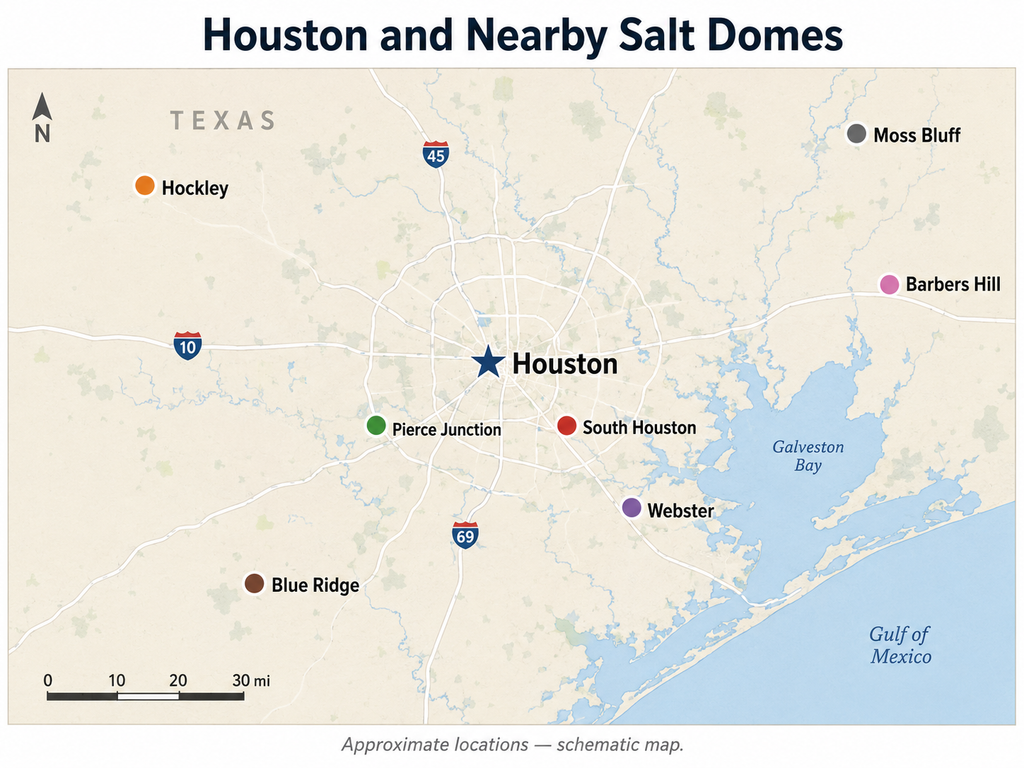
The worst-case scenarios involving Houston’s salt domes have happened before — just not here on a large scale.
A month or two ago, I wrote about Houston slowly sinking. Now I have found something underneath us that makes that story considerably more interesting.
Salt domes.
Houston is not sitting on one enormous salt dome waiting to swallow the city. But numerous salt domes lie beneath and around the metropolitan area. Pierce Junction is actually inside the Houston city limits. Other Houston-area salt-dome fields include Blue Ridge, South Houston, Sugar Land and Humble. (CBTH)
Collapse and Failure Mechanisms
Salt domes are inherently unstable due to their soft, compressible nature. The Bureau of Economic Geology’s report on Texas salt domes outlines mechanisms of cavern failure that can occur in such structures Bureau of Economic Geology. These include:
- Cap-rock failure from overpressure or structural stress.
- Salt creep and slow deformation over time.
- Cavern collapse when support structures (casing, sumps) fail or are removed.
- Seismic or hydrodynamic loading from nearby operations or reservoir changes.
Normally, that is just geology.
But humans have spent more than a century drilling into these formations, mining the salt, dissolving it with water, and creating enormous underground caverns to store oil, natural gas, and other hydrocarbons.
That is where things can get interesting.
What Happens When a Cavern Fails?
Salt moves very slowly under pressure. Cavern walls can creep inward. Roofs can weaken. Water can dissolve salt. Pressure can change. And if a cavern has been excavated too close to the edge of a salt dome, surrounding rock can eventually break through.
Worst case?
The ground above it can collapse.
That isn’t speculation.
It Happened Near Houston
In 1949, a former salt mine at the Blue Ridge salt dome in Fort Bend County was being converted to solution mining when uncontrolled dissolution led to rock failure.
The underground workings collapsed.
So did the surface.
Several buildings were lost. Texas researchers later identified Blue Ridge as one of a number of historical Texas salt-cavern failures. (Texas Water Development Board)
Houston already has one example almost in its backyard.
Then There Was the Lake That Disappeared
Louisiana showed what the truly bizarre worst case can look like.
In 1980, drillers working on Lake Peigneur accidentally penetrated an underground salt mine.
Lake water began pouring into the mine.
Fresh water dissolves salt, so the opening grew larger. The lake developed a giant whirlpool and began disappearing underground. The drilling rig went down. Barges went down. The shoreline disappeared.
Eventually so much water vanished that the nearby canal reversed direction, bringing water back toward the lake.
A lake essentially fell into a salt mine.
The resulting collapse zone reached roughly 1,300 feet across. (Texas Water Development Board)
Nobody was killed.
That may be the most miraculous part of the story.
Bayou Corne Was Different — and Perhaps More Frightening
In 2012, residents near Bayou Corne, Louisiana, first noticed strange bubbling in the water.
Then the ground started sinking.
An abandoned cavern along the edge of the Napoleonville salt dome had failed. The collapse produced a growing sinkhole, and natural gas migrated into the surrounding aquifer. Authorities ordered monitoring wells, seismic equipment, and gas-removal systems while residents were evacuated. (Energy & Natural Resources Dept.)
At one point, the sinkhole covered about nine acres. (Energy & Natural Resources Dept.)
Imagine that happening beneath a densely populated part of Houston instead of a Louisiana swamp.
The Houston Worst Case
Nobody should read this as a prediction that Houston is about to disappear into a hole.
But worst-case scenarios are not difficult to imagine because versions of every one of them have already happened somewhere else.
A cavern failure could produce localized subsidence or a sinkhole. Ground movement could damage houses, streets, pipelines, or utilities. If hydrocarbons were involved, a failure could create fire or explosion hazards. Brine or gas could migrate into groundwater. A serious event could force the evacuation of nearby neighborhoods.
And Houston adds something Louisiana did not have at Lake Peigneur:
millions of people, thousands of miles of pipelines, and one of the largest concentrations of petrochemical infrastructure on Earth.
The salt domes themselves have been underground for millions of years.
They aren’t what worries me.
It is what humans have drilled, mined, dissolved, and stored inside them.