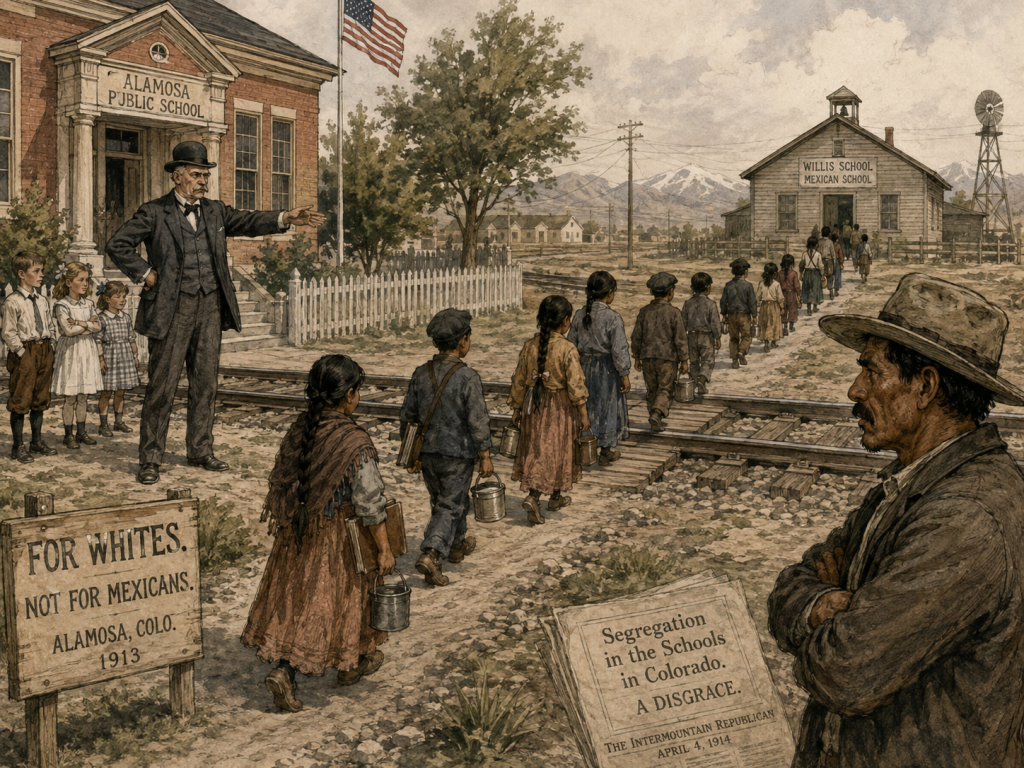
Colorado school officials had an interesting argument in 1914.
They were not segregating Mexican-American children by race.
Why?
Because Mexicans were white.
There was just one problem with that defense.
The same school district was requiring Mexican-American children to attend a separate school that everyone—including the school board itself—called the “Mexican School.”
Sometimes discrimination produces its own comedy.
Except there was nothing funny about being the child sent across the railroad tracks.
The Mexican School
The story happened in Alamosa, Colorado, in the San Luis Valley, where Hispano families had deep roots extending back through New Mexico and the Spanish and Mexican periods.
The Alamosa school district built a separate school in 1909 on what was known locally as the Mexican side of town. Originally, officials said it was intended to help Mexican children who did not speak English.
Then in 1912 the district went considerably further.
It established a policy of sending all Mexican children to the Mexican School.
Whether they needed help learning English apparently stopped mattering.
Their surname and ancestry were enough.
Francisco Maestas Said No
Francisco Maestas worked as a foreman for the Denver & Rio Grande Railroad. His son Miguel was required to attend the Mexican School even though another public school, the North Side School, was closer to the family home.
Getting to the Mexican School also required Miguel to cross active railroad tracks.
In 1913, Francisco tried to enroll his son at the closer school.
The district refused.
Miguel was Mexican.
He belonged at the Mexican School.
Francisco Maestas and other Mexican-American parents decided they had had enough.
The community organized. Parents boycotted the segregated school. They hired a Denver attorney and went to court.
The case became Francisco Maestas et al. v. George H. Shone et al.
Then Came the Remarkable Defense
The Mexican-American parents argued that their children were being separated because they were Mexican. Colorado’s constitution prohibited public schools from classifying children on the basis of race or color.
The school district answered with what may be one of the strangest defenses in the history of segregation:
Mexican-American children were Caucasian.
Therefore, officials argued, they were no different racially from the white children and could not possibly be victims of racial segregation.
Read that again.
The district was operating a Mexican School.
Mexican children were being sent there.
White children were not.
But according to the district, it wasn’t racial segregation because Mexicans were white.
Apparently they were white everywhere except at the schoolhouse door.
The English Excuse
Once race supposedly disappeared, the district offered another explanation.
The Mexican School was necessary because the children could not speak English well enough to attend the other schools.
That sounded considerably better in court.
Then the children started talking.
In English.
Miguel Maestas testified in English. When lawyers tried questioning him through an interpreter, Miguel answered in English before the interpreter could finish translating the questions.
Other Mexican-American children did the same thing.
Parents testified that their children spoke English.
Teachers from the Mexican School testified too. One said most children in her grades knew enough English to do the work. Another said most of the children spoke English and that English was generally the best way to teach them.
Then came even more damaging testimony.
The principal of another district school said she had been ordered to send all Mexican children to the Mexican School.
That made the English-language explanation difficult to maintain.
One School Board Member Made It Even Clearer
During the trial, school board member Joseph Darling was asked about segregation.
He eventually admitted that he would not permit his own children to attend school with Mexicans and said he remained of that opinion.
He also acknowledged that the separate school was officially called the Mexican School in school-board records.
The district could call Mexican children Caucasian in its legal papers.
A board member’s testimony revealed something considerably more familiar.
The Parents Had Already Asked Politely
The lawsuit was not the parents’ first move.
A committee representing Mexican families had previously gone before the school board with a petition signed by 180 Mexican heads of families, asking for what they called their constitutional rights.
According to testimony, one school official responded that they had no rights.
So they went to court.
The Mexicans Won
In March 1914, District Judge Charles Holbrook ruled for Francisco Maestas and the other families.
Holbrook found that school officials had used the English deficiencies of some Mexican-American children as justification for sending all Mexican-American children to the separate school.
He ordered the district to allow Miguel and other qualified Mexican-American children to attend the public schools nearest their homes.
It was a victory.
But it was not yet the sweeping declaration that would come decades later in cases such as Brown v. Board of Education. Holbrook still permitted the district to keep children who genuinely lacked sufficient English skills in the separate preparatory school.
Even so, Mexican-American parents had successfully challenged their children’s segregation 40 years before Brown.
Then America Forgot
The case received newspaper attention when it happened. One contemporary Catholic newspaper described it as possibly the first American court fight against the segregation of Mexican children in schools.
Then Maestas v. Shone disappeared from American history for more than a century.
Researchers Rubén Donato, Gonzalo Guzmán and Jarrod Hanson eventually reconstructed the case from court files and old newspapers. They now regard it as one of the earliest Mexican-American challenges to school segregation in the United States.
Colorado has since formally recognized its importance.
White When Convenient
The case also exposes something Mexican Americans would encounter repeatedly.
Sometimes they were legally considered white.
Sometimes they were treated as Mexican.
The definition could change depending on which classification best preserved the existing system.
In Alamosa, school officials used both arguments at once.
Mexicans were white when the district needed to prove it wasn’t discriminating against them.
But their children were Mexican when the district decided which schoolhouse door they could enter.
Francisco Maestas and the other parents did not need a sociology professor to explain the contradiction.
They could see it every morning when their children walked past one school on the way to the Mexican School.