.
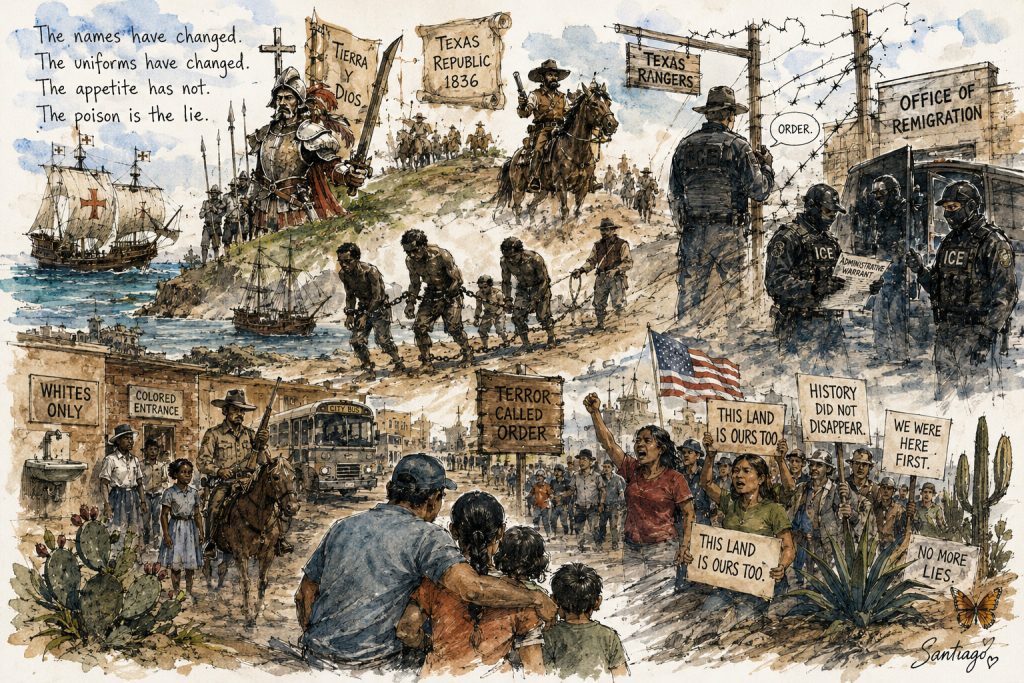
Not much has changed in the last one hundred years; we still have men in masks terrorizing Latinos, men disappearing, dying before they get to jail or detention. They always find reasons to hate people who look like me: animals, poisoning the blood, rapists, drug dealers. They create names to tell me they’re protecting society from scum like us, and then they use the men in masks to round us up and, in some cases, disappear us.
Before the Legend
The Canales Investigation — Podcast-Style Condensed Draft
In 1919, Texas still knew how to make heroes out of Rangers.
They were frontier men. Border men. Hard men for hard country. In the stories Texans liked to tell, one Ranger could ride where soldiers could not, find trails outsiders could not see, and bring order to places where courts felt far away.
Then a South Texas legislator named J. T. Canales walked into Austin with another story.
He did not say Texas needed no protection.
He did not say the border was peaceful.
He did not say every Ranger was bad.
What he said was more dangerous than that.
He said some of the men hired to protect the border had become men the border feared.
And he wanted Texas to investigate.
Not whisper about it.
Not bury it in county rumors.
Not leave it to families who already knew what had happened.
Investigate it.
Under oath.
In public.
Before the Legislature.
That is where the Canales Investigation begins on paper.
But the real story began earlier, along the Rio Grande.
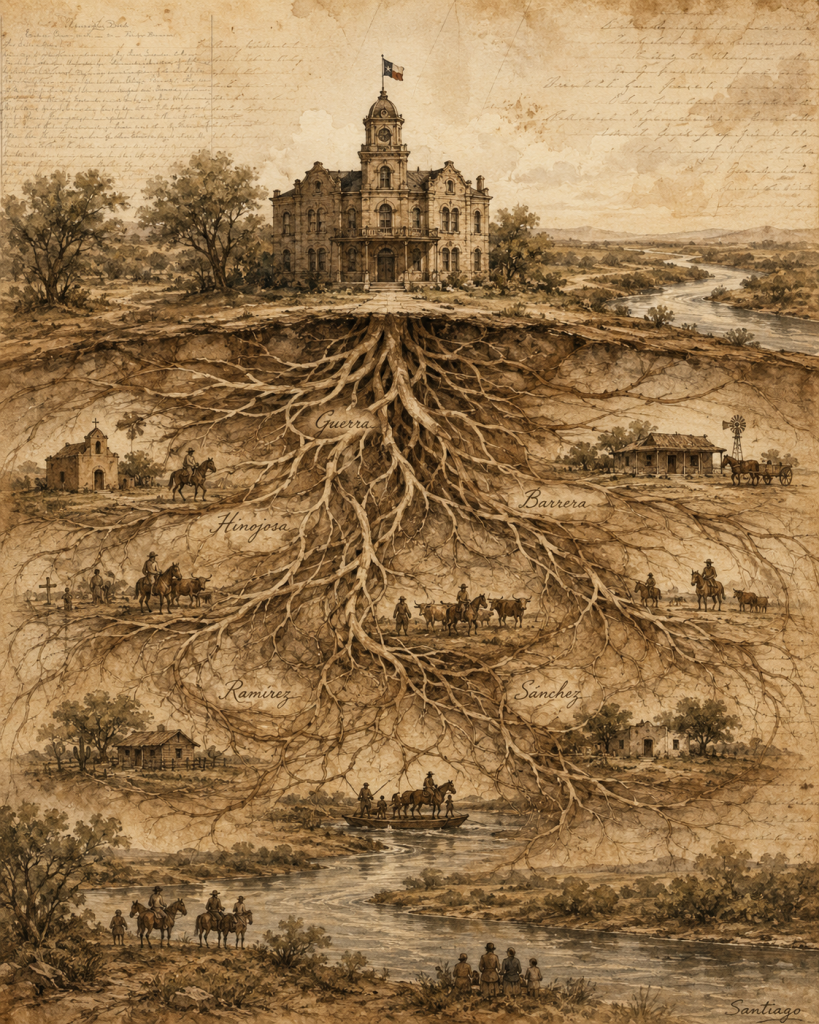
South Texas in the 1910s was not a quiet place. The river was not only a border. It was a road, a hiding place, a family line, a trade route, an escape route, and sometimes an accusation. Men crossed it for work. Families crossed it because they had always lived on both sides. Cattle crossed it. Smugglers crossed it. Revolution crossed it. Rumor crossed it faster than anything.
The Mexican Revolution shook northern Mexico, and the shock reached Texas. There were raids. There were thefts. There were armed men in the brush. There were stories of bandits, spies, German propaganda, deserters, slackers, smugglers, and revolutionaries. Some stories were true. Some were exaggerated. Some may have been completely wrong.
But fear does not always wait for proof.
And in South Texas, fear became part of the law.
Some families looked toward the river and wanted Rangers. They wanted men who knew the country, men who knew the trails and water holes, men who could ride at night and not get lost. To them, a Ranger meant protection.
Other families heard the same word and felt something else.
They heard Ranger and thought of doors opened without permission. Men taken on suspicion. Prisoners who never reached court. Bodies found later. Wives left asking who had the right to take a husband from bed.
That is the world Canales carried into Austin.
He was not a stranger to the Rangers. That matters. Canales had grown up with them. His family’s ranch, La Cabra, had been a place where Rangers could stop for help, food, horses, and shelter. He knew respected Rangers. He had seen the older version of the legend up close.
That made his accusation heavier.
He was not attacking an institution he had never known.
He was saying something had changed.
In his mind, the change began around 1915, when the border crisis deepened, and the Ranger force began to include men who used danger as permission. The border was violent, yes. But Canales kept returning to one question:
When the law is under pressure, does it become stronger?
Or does it disappear?
On January 30, 1919, Canales put his charges in writing. The next day, a joint committee of the Texas House and Senate opened hearings into the State Ranger Force. The committee said it wanted a fair investigation: whether the Rangers were necessary, what they had done, and how the force could be improved.
But Canales’ charges were not just accusations.
They were doors.
One door opened in San Diego, Duval County, where Rangers were accused of drunken intimidation and firing pistols in the streets.
Another opened with Jesus Villarreal, a constable from Concepción, accused of helping young men cross into Mexico to avoid the draft. Rangers and Army scouts stopped him near the river. The defense had a real argument: young men were trying to evade military service. But Canales asked a different question.
Even if the suspicion was real, what happened after Villarreal was taken?
Was he questioned?
Or was he abused into confession?
That was the line Canales kept drawing. Arrest a man if you have cause. Charge him. Take him to jail. But do not beat the law out of him and call the result justice.
World War I made everything worse.
The war reached Starr County and Duval County not through trenches, but through paper: registration cards, draft boards, classifications, lists of men called, men not called, men delinquent, men accused of desertion. On the border, that paper quickly found the river. Some men registered. Some served. Some waited. Some crossed into Mexico. Some were chased.
Fort Ringgold became part of the story. So did Army scouts. So did Rangers. So did young men with suitcases on a road near the Rio Grande.
In most places, the draft was an office matter.
On the border, it could become a midnight pursuit.
Then came Lisandro Muñoz.
At Los Sáenz Ranch in Starr County, Sergeant J. J. Edds was looking for a deserter named Alonzo Sanchez. The deserter was real. The war was real. The purpose of arrest may have been lawful.
But the man killed was not Alonzo.
Zaragoza Sanchez said he was sleeping outside in the yard when the shot woke him. His cousin Lisandro had been sleeping nearby on another cot. Edds said he believed Lisandro was Alonzo and that a struggle forced him to shoot.
Zaragoza answered with the law of ordinary people:
Maybe you had the right to arrest Alonzo.
You did not have the right to kill Lisandro.
That sentence could stand over the whole investigation.
Because Canales was not asking Texas whether officers had hard jobs.
He was asking whether a hard job gave them permission to make fatal mistakes and then call the mistake necessity.
Then came Florencio Garcia.
Garcia was arrested on suspicion. That word matters.
Suspicion.
The Rangers believed he might know something about cattle theft. They took him. They moved him. They held him overnight. They said they released him.
But he did not come home.
He was not found in jail.
Later, remains believed to be his were found.
The defense said they turned him loose.
Canales’ question was simple:
When officers take a man, when does their responsibility end?
Can the State take a man from the world, move him from road to jail to road again, and then answer his family with one sentence?
We turned him loose.
That is not enough.
Not if law means anything.
Then came Jose Maria Gomez Salinas.
His case was not the same. Gomez was accused of horse theft. The record does not require us to pretend he was innocent. But innocence was not the legal issue.
He was already a prisoner.
Sergeant Edds wanted Gomez sent to Hebbronville instead of Rio Grande City because he feared a judge might release him on habeas corpus before the evidence was ready.
That is where the case turns.
Habeas corpus is not a technicality. It is the law asking an officer, “Why are you holding this man?”
But Gomez never got that far.
He was handed to men for transport. He was handcuffed. He was shot in the back before reaching jail.
Canales suspected more than he could prove. The defense pushed back, and fairly so, when hearsay was offered as fact.
But the strongest part of the Gomez case does not require hidden conspiracy.
It requires only the visible failure.
A prisoner was supposed to reach the law.
He died before the law could reach him.
Then came Porvenir.
Porvenir should not be told first. If it comes first, it can seem like an isolated horror. It needs to come after the smaller failures, because by then the pattern is clear.
One man pressured.
One man killed by mistake.
One man disappeared after suspicion.
One prisoner shot before jail.
Then fifteen men taken from their homes.
Before dawn on January 28, 1918, armed men came to Porvenir. The record describes Rangers, soldiers, and ranchmen surrounding the village, taking people from their houses, selecting fifteen men, marching them away, and shooting them.
The official explanation pointed toward suspicion from the Brite Ranch raid.
The families said the dead men had nothing to do with it.
But even if suspicion existed, Porvenir forced Texas to face the question no defense of necessity could answer:
When did suspicion become a death sentence?
The wives remembered masked men. Rifles. Husbands pulled from bed. Children awake in the dark. By morning, the men were dead. Some families crossed into Mexico.
That is not a footnote.
That is the place where the Ranger legend cracks.
Not because the border was safe.
It was not.
Not because raids were imaginary.
They were not.
But because danger cannot turn execution into law.
The defense of the Rangers had strength. It must be heard.
People in the Big Bend and elsewhere wanted protection. They feared raids, theft, smuggling, and violence from across the river. They believed Rangers knew the land better than soldiers. They believed Rangers could do what ordinary officers could not.
And sometimes they were right.
Adjutant General Harley did not simply say every Ranger was innocent. He said bad men had been removed. He said low pay made it hard to hire better men. He said the force was necessary and should be improved, not destroyed.
That was the best defense:
Keep the Rangers.
Purge the bad men.
Pay better men.
Strengthen command.
Protect the border.
Canales’ answer was not weakness.
It was law.
If a man is guilty, arrest him.
If a man is dangerous, charge him.
If a man is a deserter, take him in.
If a man is a thief, bring him to court.
But do not beat him for a confession.
Do not take him on suspicion and lose him.
Do not hand him off and let him die before habeas can reach him.
Do not take fifteen men from their homes and call it border protection.
This was not a fight between law enforcement and crime.
It was a fight over whether law enforcement had to obey the law.
There was another problem too: the badge itself.
Not every Ranger was a regular paid Ranger. Some men held Special Ranger commissions. Some were cattle inspectors. Some were connected to ranching interests. Some were private men with public authority.
That raised a different question.
Who got watched as a suspect?
Who got chased as a slacker?
Who got accused as a deserter?
And who got handed a commission?
Canales pressed that issue because he understood that power begins before the gun is fired. It begins when the State decides who may carry authority in the first place.
A badge is not just metal.
A badge changes the air between two men.
In South Texas, where poor men and Tejano communities already lived under suspicion, that mattered.
At the end, Texas did not simply abolish the Rangers. That was never the only question.
The harder question was how to keep protection without preserving unchecked power.
Sheriff W. T. Vann gave one of the plainest answers: pay Rangers enough to hire good men, but put them under bond like sheriffs, deputies, marshals, constables, and other peace officers.
That was not radical.
That was responsibility.
If a sheriff had to answer for his authority, why not a Ranger?
Near the close of the record came rules. Rangers were told to enforce the laws without partiality and to cooperate with local officers where possible.
Rules matter.
But rules came late.
After Porvenir.
After Florencio Garcia.
After Gomez Salinas.
After Lisandro Muñoz.
After Jesus Villarreal.
A rule can guide the next officer.
It cannot bring back the man already taken.
That is why the Canales Investigation still matters.
It did not destroy the Ranger legend.
It did something more useful.
It placed the legend under oath.
It made Texas hear the other side of the story — the side told from yards, roads, jails, river crossings, and homes where the law did not always arrive as protection.
Before the legend, there was testimony.
Before the testimony, there was the border.
And before Texas could decide what the Rangers meant, J. T. Canales forced it to ask what law meant when the men carrying it were the ones accused of breaking it.