What the 102nd Medical Battalion Did
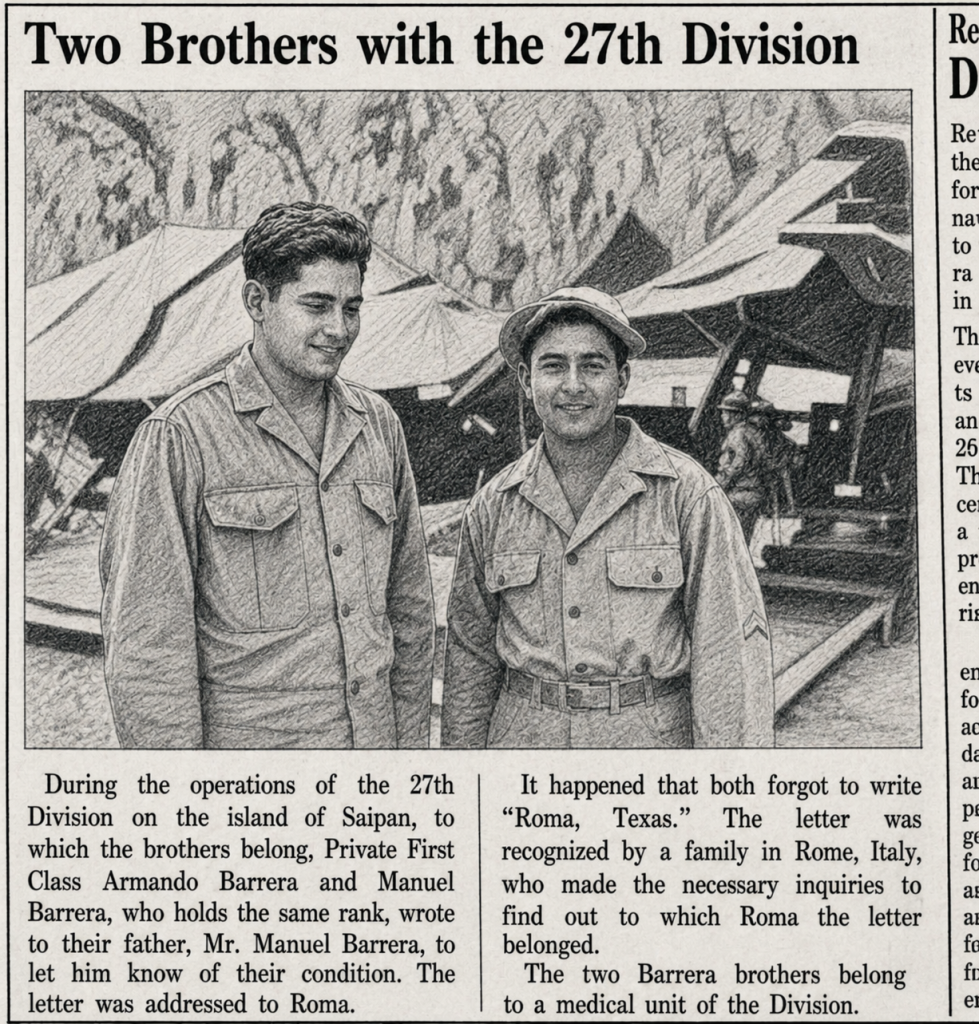
The image on the left is my uncle, Armando Barrera, and my father, Manuel Barrera. The newspaper made a mistake; their father’s name was Felipe.
I found that the 102nd Medical Battalion was the medical battalion assigned to the 27th Infantry Division. Its responsibility was to keep wounded soldiers moving away from the battlefield and toward increasingly advanced levels of treatment. Its collecting companies supplied medics, litter bearers, ambulances, and collecting stations, while its clearing company received, stabilized, sorted, and prepared casualties for transfer to field hospitals, surgical units, hospital ships, or evacuation facilities.
On Saipan, collecting platoons of the 102nd came ashore with the division and advanced alongside the infantry regiments. Their aid stations were close enough to the fighting to come under heavy enemy fire. Wounded soldiers sometimes had to be lowered into foxholes for protection. Doctors treated men by flashlight beneath blankets or raincoats during blackout conditions. Because there were not enough litter bearers, musicians from the division band were used to help carry casualties.
Saipan
The Army’s official medical history gives a remarkably clear picture of what the 102nd did there. Its collecting platoons advanced with the infantry regiments. Aid stations came under direct enemy fire. Wounded men sometimes had to be lowered into foxholes for protection, doctors operated by flashlight beneath blankets or raincoats, and members of the 27th Division band were pressed into service because there were not enough litter bearers.
During the enormous Japanese attack on July 7, 1944, the enemy overran parts of the 105th Infantry and cut the roads leading to the collecting stations. The two battered battalions suffered more than 900 casualties. A few litter bearers slipped through the Japanese-controlled area at great personal risk, and one jeep-ambulance driver forced his way through before other ambulances could follow. Litters ran short, so medical personnel improvised stretchers from blankets and poles.
A contemporary Saipan casualty breakdown lists the 102nd Medical Battalion itself as suffering four enlisted men killed and twenty-two wounded—twenty-six casualties. Medical personnel were being shot while trying to save other men.
Okinawa
The conditions on Okinawa were just as dangerous. The Army’s medical history states that medical personnel there suffered a casualty rate exceeded only by the infantry. Litter bearers from the collecting companies moved wounded men over difficult terrain, through mud and artillery fire, and were deliberately targeted by enemy fire. At times ordinary artillerymen and infantry replacements had to be used as additional litter bearers because the trained medical men had been killed, wounded, or exhausted.
That gives real meaning to your father’s description of Okinawa. He was not simply “a medic stationed on Okinawa.” He was part of the group responsible for going forward, picking up wounded soldiers and physically carrying them out while the battle continued around them.
The most important discovery
The original unit records appear to survive. The National Archives index lists an entire group for the 102nd Medical Battalion in Box 8475, including:
- Operations reports for Okinawa, January–June 1945
- A report covering the period from Saipan through the Okinawa operation
- The battalion headquarters journal for April 12–July 2, 1945
- Battalion General Orders covering 1942, 1944, and 1945
Those records are identified on National Archives microfilm references WOR 43033 through WOR 43038.
The 102nd Medical Battalion was therefore not a rear-area hospital organization. It formed part of the division’s forward medical-evacuation chain. Its men followed the infantry, established aid and collecting stations near the battlefield, carried the wounded out under fire, provided emergency treatment, and kept casualties moving toward surgery and hospitalization.