The New Mexico Clue
The first clue did not look like a clue.
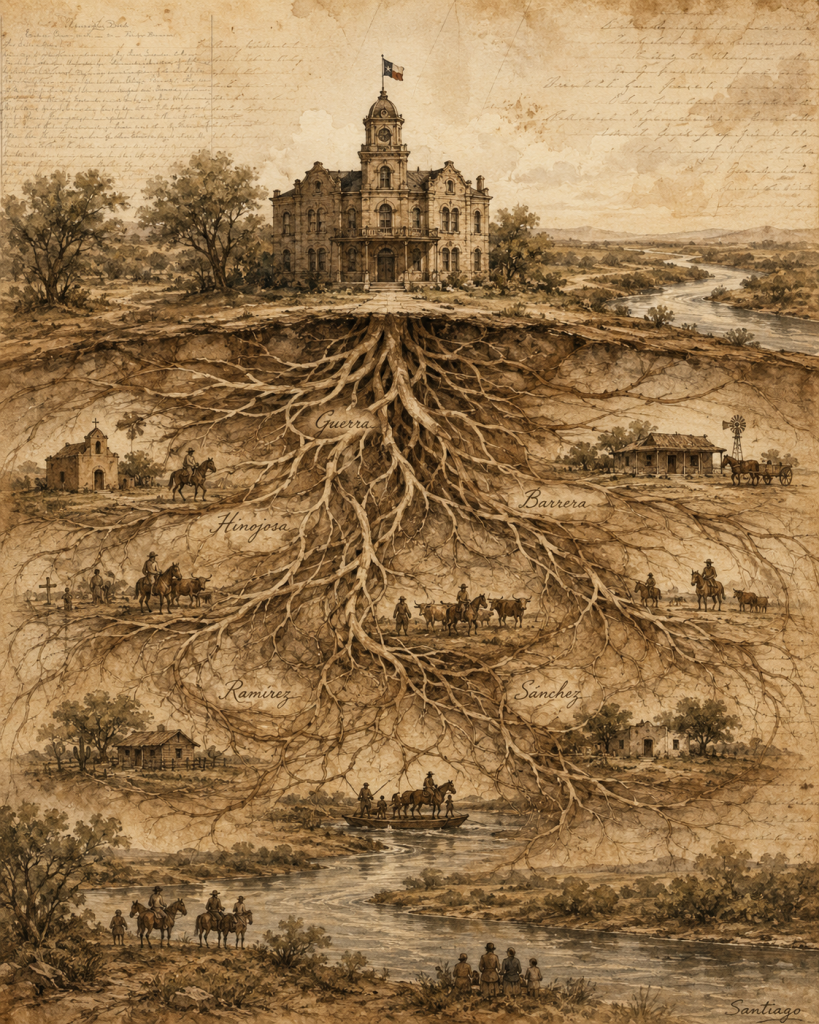
It was only a line in an old census, the kind of record most people would pass over without stopping. Faded ink. Crooked handwriting. Names squeezed into narrow boxes by a man who probably wanted to finish his work and move on to the next household. A page from Starr County, Texas, 1880.
But old records do not shout. They whisper.
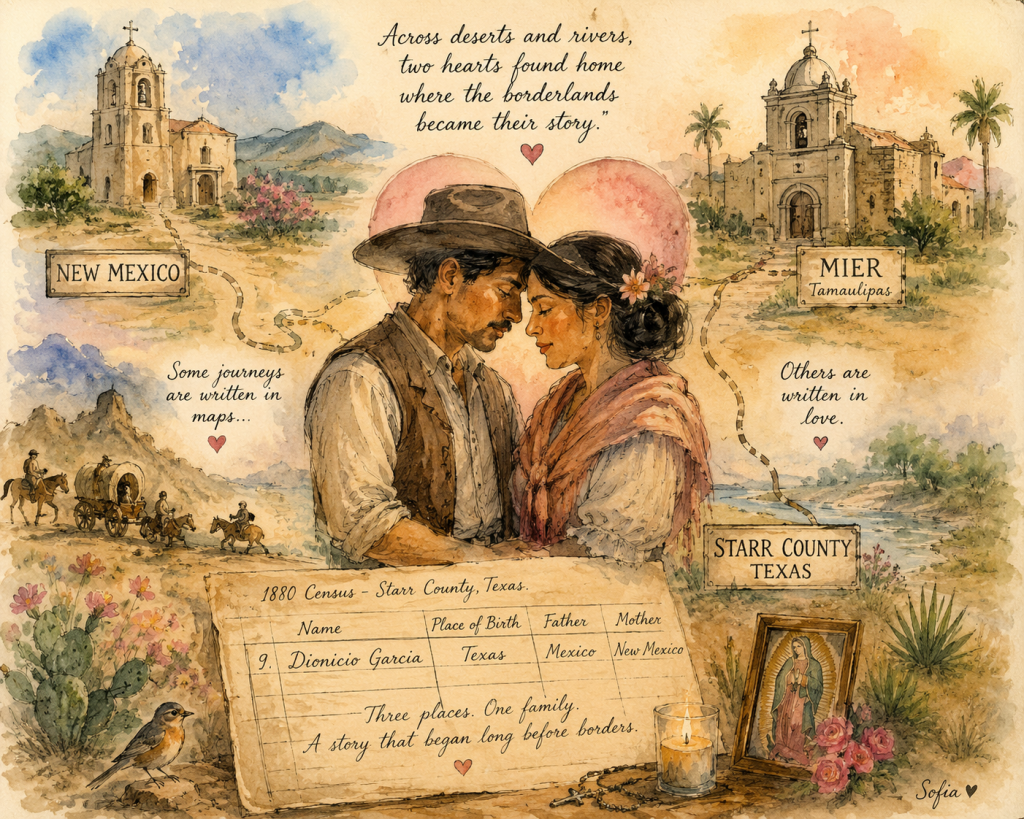
On line 9 was a boy, about eight years old. Dionicio García. Born in Texas. His father was born in Mexico. His mother born in New Mexico.
That was where the mystery opened.
Not because Texas was surprising. Not because Mexico was surprising. In Starr County, along the river, Mexico was not a foreign idea. It was family, trade, church, memory, and blood. The river divided countries on paper, but people had crossed it long before clerks and governments turned crossings into suspicion.
The surprise was New Mexico.
New Mexico kept appearing like a footprint in dust.
There had been another clue before this one: a man from New Mexico who married a woman from the Mier world. His name appeared as Jesús Candelaria, or Candelario, depending on the hand that wrote it and the eye that tried to read it later. He was about twenty-four, born in New Mexico. His wife, Rosa, about nineteen, belonged to the Tamaulipas/Mier border world.
That record raised a question and then left the room.
How did a man from New Mexico find his way to a woman from Mier?
Now the 1880 census asked the question again, but from the other direction.
How did a woman born in New Mexico become the mother of a Texas-born García child in Starr County?
One New Mexico connection could be an accident. Two begin to sound like a road.
The road is what we do not yet see.
It may have been a trade road. It may have been a family road. It may have followed soldiers, sheep, cattle, wagons, church ties, land claims, or old Spanish-Mexican settlements that were never as separate as later maps made them appear. It may have been a road traveled by men looking for work, by families fleeing trouble, by widows remarrying, by young women carried into new households through marriages arranged by kinship networks we have not yet reconstructed.
The mystery is not whether they moved. The records say they did.
The mystery is why.
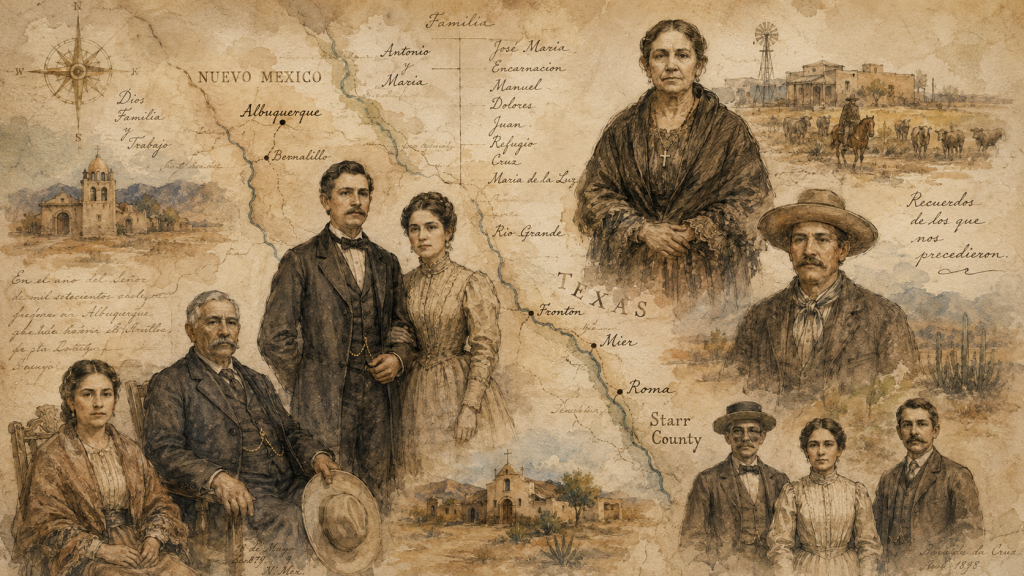
New Mexico and South Texas seem far apart now. A person looks at a modern map and sees distance, highways, state lines, deserts, checkpoints, and empty miles. But older people did not live inside our modern map. They lived inside older geographies — presidios, missions, ranchos, river crossings, kinship, Spanish surnames, land grants, and Catholic parish books.
A man could be “from New Mexico” and still belong to the same Spanish-Mexican borderlands world as a woman from Mier. A woman could be born in New Mexico and later appear in Starr County, not as a stranger, but as someone moving along a path already known to others.
That is what the census line suggests.
Dionicio García did not know he would become evidence. He was only a boy in 1880. He did not know that more than a century later, someone would look at that faint line and see not only his name but a door. He did not know his birthplace, his father’s birthplace, and his mother’s birthplace would become three points on a map: Texas, Mexico, New Mexico.
Three places. One family.
There is another possibility, too. The records may be telling us that the family story is older than the border. Not older than the land, but older than the hard edges later imposed on it. Before Texas became Texas, before New Mexico became a state, before the Rio Grande became the kind of border it is today, families moved through a northern Mexican world that stretched across what later became two countries.
To the government, a person might be born in Mexico, Texas, or New Mexico.
To the family, the question may have been simpler: Who are your people?
The answer may have mattered more than the place.
That is why these records feel different from ordinary genealogy. They are not merely proving names. They are challenging the story that Mexican American families “arrived” late, as if they stepped into Texas from somewhere else after history had already begun.
This family was already in the older map.
The New Mexico clue says the family belongs not only to Starr County, not only to Mier, not only to the river, but to the wider borderlands — that long Spanish-Mexican world where people moved before the United States learned how to draw lines across their lives.
Still, the mystery remains.
Who was the New Mexico-born mother in the García household?
Why did she come south?
Was she connected to the earlier New Mexico-born man who married into the Mier world?
Were these two records separate accidents, or fragments of the same lost road?
Some mysteries hide because there is no evidence. This one hides because the evidence is scattered. A census line here. A marriage there. A birthplace column on the far right side of a page. A name written one way by one clerk and another way by the next. A family memory that did not survive because the people who knew it went on to the next stage of life before anyone thought to ask.
The old people carried the answers in ordinary conversation. Then they left, and the ordinary became lost.
Now the work is to listen to paper.
The paper says: New Mexico.
It says: Mier.
It says: Starr County.
It says: Mexico, Texas, New Mexico — all in one family line.
And somewhere between those places, on a road not yet found, a woman traveled south, or a man traveled east, or two families met in a way that seemed natural to them and mysterious to us.
The mystery continues because the records have not finished speaking.
They have only begun.