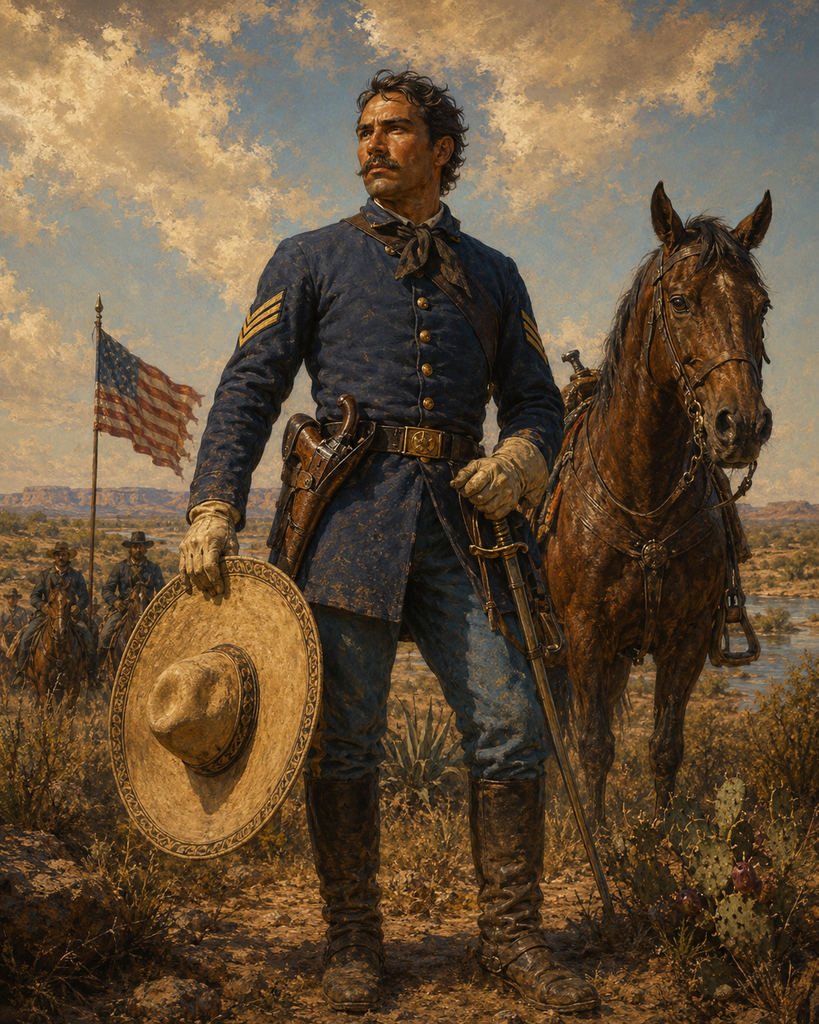
They may never make the movie, but this one deserves to be remembered. The strongest version is not “Tejanos also fought in the Civil War.” It is Tejanos fighting one another over what Texas was going to become.
Most Americans know what the Civil War looked like in Virginia.
Blue uniforms. Gray uniforms. Great armies moving across fields with names like Gettysburg, Antietam, and Bull Run.
Along the Rio Grande, the war looked different.
Here, a man might have been born in Mexico and lived in Texas. His cousins might still live across the river. He might speak Spanish, ride for a living, and have no particular affection for either Abraham Lincoln or Jefferson Davis. He might hate slavery. He might hate the new Anglo political establishment more. He might join the Confederacy because he wanted to stay near his family—or cross into Mexico rather than be forced into anybody’s army.
And sometimes the man shooting at him from the other side was another Tejano.
That was the Civil War in South Texas.
The war came almost immediately
Texas formally joined the Confederacy in 1861, but not everybody along the Rio Grande accepted the decision.
In Zapata County, officials reported that the vote for secession had been unanimous. It apparently wasn’t.
In April 1861, Antonio Ochoa, an influential local Tejano, gathered Union supporters and confronted County Judge Isidro Vela at Carrizo, the old Zapata County seat. Ochoa and several other prominent residents demanded that their county remain in the United States. After a long meeting, Vela persuaded them to go home peacefully. (University of Texas at Rio Grande Valley)
It might have ended there.
It didn’t.
Several days later, Confederate cavalry commanded by Santos Benavides of Laredo arrived. Judge Vela ordered Ochoa arrested, and Benavides’s men went to El Clareño, where Ochoa and his supporters lived.
Fighting broke out.
According to the University of Texas Rio Grande Valley’s Civil War project, numerous civilians were killed. The event became remembered as the Massacre at El Clareño. Rather than eliminating opposition to the Confederacy, the killings strengthened it. (University of Texas at Rio Grande Valley)
The American Civil War had barely begun, and Tejanos were already killing Tejanos along the Rio Grande.
Mexico was just across the river
That changed everything.
A Union sympathizer in Virginia could not simply ride a few miles and enter another country. Along the Rio Grande, a Tejano often could.
Brownsville demonstrated what that meant. After secession, Confederate supporters drove Unionist neighbors from the city and confiscated some of their property. Many of those Unionists crossed into Matamoros, where some organized military units intended to fight their former neighbors.
Then the fortunes of war reversed.
When Union forces captured Brownsville in 1863, Unionist refugees crossed back from Mexico and reclaimed their property. This time Confederates fled across the same river. Control of Brownsville would change again before the war was finished. (University of Texas at Rio Grande Valley)
The Rio Grande was a border, but during the Civil War it could also become an escape hatch.
Cross it one way, and you were beyond Confederate authority.
Cross it the other way, and you were back in Texas carrying a rifle.
A war within the war
The violence in Zapata County continued.
The famous border fighter Juan Cortina, already known for challenging Anglo authority before the Civil War, supported the Union cause and operated from Mexico. Anti-Confederate guerrillas moved through the region, attacking Confederate interests and supply lines. (University of Texas at Rio Grande Valley)
One of the most important guerrilla leaders was Octaviano Zapata.
After Confederate forces retaliated against Unionists by destroying homes and buildings at La Soledad, Zapata’s men attacked El Clareño again. They captured Judge Isidro Vela—the same official who had ordered Antonio Ochoa arrested in 1861—and hanged him.
The feud had now come full circle.
Zapata continued raiding until September 1863, when Santos Benavides and his Confederate Tejanos pursued him across the international boundary and killed Zapata and several of his men near Mier, Tamaulipas. (University of Texas at Rio Grande Valley)
The Confederacy and the Union were fighting.
Mexico had its own political struggles.
And along the Rio Grande, old arguments over land, political power, family alliances, and the treatment of Mexican Texans became tangled together with both wars.
Calling everyone simply “Union” or “Confederate” does not begin to explain it.
Some Tejanos chose gray
Thousands of Mexican Texans served the Confederacy.
Historian Jerry D. Thompson estimates that at least 2,500 Tejanos joined Confederate forces. Some fought far from Texas at places including Antietam, Gettysburg, Chickamauga and Appomattox. Others served close to home in cavalry and militia units. (Texas State Historical Association)
The most famous was Santos Benavides.
Benavides eventually became a colonel, the highest-ranking Tejano in Confederate service. His brothers Refugio and Cristóbal also became Confederate officers.
But Confederate service did not necessarily mean every Tejano soldier had suddenly embraced plantation slavery or Confederate nationalism.
Some joined local units because Confederate conscription threatened to send them far from South Texas. Some wanted to defend their communities. Some had family, business, or political ties to Confederate leaders. Others undoubtedly supported the Confederate cause. (Texas State Historical Association)
The reasons were as complicated as the border itself.
Others put on United States blue
Almost 1,000 Tejanos and Mexican nationals served in Union forces, according to historical estimates.
The most remarkable unit was the Second Texas Cavalry, U.S.A.
It was composed overwhelmingly of Tejanos and Mexican nationals recruited from communities along the Rio Grande. Its officers included men with names such as George Treviño, Clemente Zapata, Cesario Falcón, and Mónico de Abrego. (Texas State Historical Association)
Their motivations differed too.
Some opposed slavery. Some resented Confederate conscription. Others had watched Mexican landowners lose property through the American legal and political system after 1848. Some enlisted for the bounty money. Some were already enemies of the local Confederate political establishment.
But whatever brought them there, when they put on the United States uniform, they became soldiers fighting against Confederate Texas.
One was Patricio Pérez, a vaquero from Havana Ranch in Hidalgo County.
When Union forces occupied the Valley in 1863, Pérez rode to Brownsville and enlisted in the Second Texas Cavalry. He became a sergeant, served in Louisiana and Mississippi, survived the war, and returned home to ranching. (University of Texas at Rio Grande Valley)
He was a Tejano.
He was a vaquero.
And he was a Union soldier.
Then Tejanos marched against Laredo
On March 19, 1864, the strange nature of the South Texas Civil War became impossible to miss.
A Union force of more than 200 men advanced upriver toward Laredo. Its objective was the enormous quantity of Confederate cotton being collected there for shipment into Mexico.
About half the attacking force belonged to the predominantly Tejano Second Texas Cavalry.
Waiting for them was Santos Benavides.
Benavides had only about 72 Confederate defenders. He barricaded streets, positioned marksmen around San Agustín Plaza, and prepared to defend his hometown. Cotton bales—the product helping finance the Confederacy—became part of the defenses. (University of Texas at Rio Grande Valley)
At about three in the afternoon, the Union troops attacked.
Three times they advanced.
Three times Benavides’s men drove them back.
The fighting continued for more than three hours before the Union force withdrew downriver. (University of Texas at Rio Grande Valley)
Forget, for a moment, the familiar picture of the American Civil War.
Picture Laredo instead.
Tejanos behind barricades defending the Confederacy.
Tejanos advancing against them, carrying the flag of the United States.
Spanish-speaking Texans on both sides.
Some of those men may have known one another. In communities this small, some almost certainly knew one another’s families.
That was a civil war in the most literal meaning of the words.
And then came the last battle
By May 1865, Robert E. Lee had already surrendered in Virginia.
Abraham Lincoln was dead.
For most Americans, the Civil War was over.
Not beside the Rio Grande.
On May 11, 1865, Union commander Theodore Barrett sent an expedition from Brazos Santiago toward Confederate positions near Brownsville.
The first force contained 250 soldiers of the 62nd United States Colored Infantry and 50 men of the Second Texas Cavalry. (National Park Service)
Think about who was marching together.
Black soldiers of the United States Army.
Tejano Union soldiers from Texas and the Mexican borderlands.
They were moving through the same country where Tejanos had been fighting over the Union and Confederacy since 1861.
On May 12 and 13, they encountered Confederate forces near Palmito Ranch.
More Union soldiers joined the fight. Confederate cavalry under John “Rip” Ford counterattacked with artillery, and the Federal force eventually retreated toward the coast. (National Park Service)
It became generally recognized as the last land battle of the American Civil War.
The war that Americans remember as having begun at Fort Sumter ended, on land, beside the Rio Grande.
And among the Union soldiers sent into that final fight were Black men and men of the Second Texas Cavalry.
The history we didn’t get
Hollywood gave America The Free State of Jones, the story of a white Mississippi Confederate deserter who rebelled against the Confederacy.
It is a story worth telling.
But South Texas had its own resistance.
Antonio Ochoa stood before a county judge and said his community should remain in the Union.
Men died at El Clareño.
Homes were destroyed.
Isidro Vela was hanged.
Octaviano Zapata fought a guerrilla war until Confederate Tejanos hunted him into Mexico and killed him.
Unionist families fled across the Rio Grande and later came home.
Santos Benavides led Tejanos for the Confederacy.
Patricio Pérez and hundreds of others wore United States blue.
And at Laredo, Tejanos fought Tejanos in the streets while Confederate cotton sat piled around San Agustín Plaza.
None of this means there was one Tejano position on the Civil War. Quite the opposite.
That is the story.
Mexican Texans were not standing on the sidelines while somebody else’s Civil War passed through Texas.
They chose sides.
They changed sides.
They resisted conscription.
They defended their towns.
They escaped into Mexico.
They came back carrying rifles.
They fought for the Confederacy, and they fought to destroy it.
And sometimes they fought one another.
By the time Black soldiers and Tejano Unionists marched together toward Palmito Ranch in May 1865, South Texas had already endured four years of a civil war inside the Civil War.
America remembers Gettysburg.
Texas remembers the Alamo.
But scattered along the Rio Grande are the remains of another story—the story of the Tejanos who fought over whether Texas would remain Confederate, become Union again, or simply leave them alone.
Nobody gave them a movie.
We can at least give them their story.
________
Quite a lot—and the surprising part is that the Benavides family did not collapse after the Confederacy lost. They remained one of the most powerful Tejano families in Laredo.
Santos Benavides went back to ranching and merchandising with his half-brother Cristóbal during Reconstruction. He later returned to public office, serving twice as a Laredo alderman and three terms in the Texas House between 1879 and 1884. By then he had become an important Democratic political leader among Mexican Texans in South Texas. (Texas State Historical Association)
And Santos never really stopped being a borderlands political operator. His ranch, Charcos Largo, was accused of being used to supply expeditions into Mexico supporting his son-in-law, General Lázaro Garza Ayala, against Porfirio Díaz. Yet by 1880 Díaz himself was using Santos as an envoy to the United States. That tells you how fluid those border alliances could be. (Texas State Historical Association)
His brother Refugio Benavides did just as well politically. Refugio became mayor of Laredo again in 1873, won reelection, helped establish an early public school and the city’s first sewers, and in 1874 organized a ranger company to fight bandits and Kickapoo raiders. He lived until 1899. (Texas State Historical Association)
Their younger half-brother Cristóbal Benavides largely stayed out of politics after the war and concentrated on business. He married Lamar Bee, daughter of Confederate general Hamilton P. Bee, and they had ten children—six daughters and four sons. By 1890, Cristóbal was one of the wealthiest men in Webb County. (Texas State Historical Association)
Santos’s immediate family is more complicated—and actually makes a very good story by itself.
Santos and his wife Agustina Villarreal had no biological children together, but raised four adopted children. One was Eraclio, Santos’s biological son by Josefa González, conceived while Santos was stationed at Guerrero, Tamaulipas, during the Civil War. In 1871, Santos and Agustina formally named four children as their heirs: Agustina, Juan, Eraclio, and Santos Jr. (Texas State Historical Association)
Then the family relationships became messy. Santos changed his will in 1876. In 1881 Santos and Agustina legally revoked the adoptions of Agustina, Juan and Eraclio. Yet the emotional bonds apparently survived: when Eraclio died of influenza in 1883 after going to Monterrey for his health, Agustina was devastated and commissioned his tomb, recognizing him in death as un hijo legítimo—a legitimate son. Their daughter Agustina had died from yellow fever in Matamoros the previous year, shortly after giving birth. (Texas State Historical Association)
By 1887 Santos and Agustina had changed course yet again. Their new will left property to Juan and to their grandson Francisco Garza Ayala Benavides, the child of their deceased daughter Agustina. That will eventually generated years of litigation—the family’s property disputes were still reaching Texas appellate courts decades later. (Texas State Historical Association)
Santos died at home in Laredo on November 9, 1891. Agustina survived him by seventeen years. And here the family’s postwar story ends rather sadly: although she had once controlled substantial property in her own right, after Santos died she became executor of his estate and lost virtually all of their property through prolonged legal maneuvering and litigation. She died in Laredo in 1908 at age eighty-six. Her funeral procession was reportedly so large that it included virtually every available carriage in the city. (Texas State Historical Association)
There is another fascinating political piece. By 1884 Santos was leading the Guaraches—“Sandals”—against Laredo’s ruling Botas—“Boots.” His own son Juan V. Benavides ran for Webb County judge on the Guarache ticket. Two years later that political feud produced the Laredo Election Riot, with perhaps 250 armed men fighting in the streets and somewhere between sixteen and thirty people killed. Federal troops had to restore order. (Texas State Historical Association)
So the Benavides saga did not end at Appomattox at all.
Three Tejano Confederate brothers came home and remained ranchers, merchants, mayors, legislators, and political bosses. One became among the richest men in Webb County. Santos became a Texas legislator. Their children married into other powerful border families. And twenty years after the Civil War, Santos Benavides was again involved in an armed political struggle—this time not Confederates against Unionists, but Boots against Sandals in the streets of Laredo.
There is probably a second chapter to our Tejano Civil War story right there: “They Lost the Confederacy—but They Didn’t Lose Laredo.”