.
.
When we began looking closely at the 1940 census for Fronton, Texas, one thing stood out immediately: how little formal education most people had received.
On page after page, schooling ended in the fifth, sixth, seventh, or eighth grade. High school students were unusual. Among the pages we examined, the highest level we found was the eleventh grade.
Then there was Rosita Barrera.
In 1940, Rosita was 15 years old and living in the household of Inocente and Rosalia Barrera in Starr County. The census recorded her as their daughter. She was still attending school and had reached approximately the eighth-grade level.
Seven years later, Rosita was someplace very different.
She was at Texas A&I College in Kingsville.
A Family Memory
The first clue did not come from a government record or a newspaper.
It came from a cousin who grew up in Fronton.
She remembered that one of Inocente Barrera’s daughters had gone away to college. Inocente and Rosa Barrera raised her, but she was the daughter of Cecilio Barrera and Juanita Rodriguez Barrera. They also raised my uncle Armando, whose mother passed away when he was 2 years old.
That detail appears to have shifted with time, but the heart of the memory survived.
There really was a young Barrera woman from Inocente’s household who went to college.
Her name was Rosita.
Texas A&I, 1947
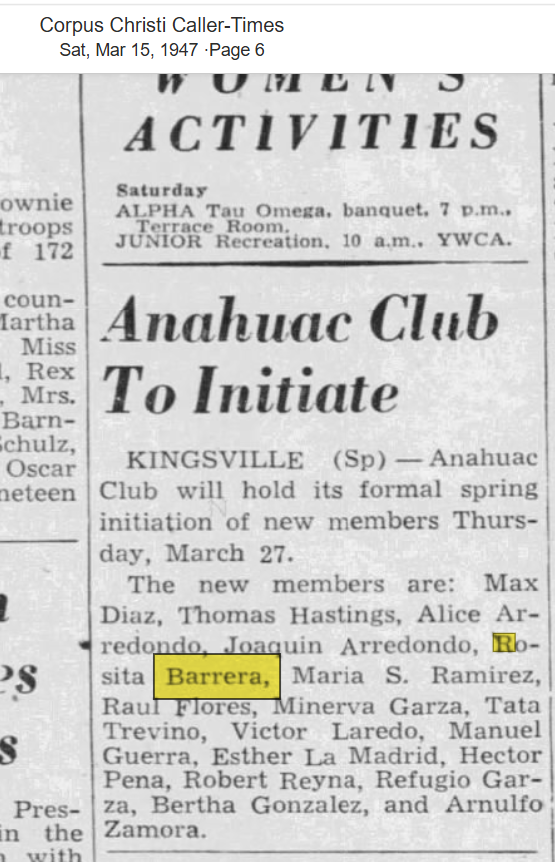
A Corpus Christi Caller-Times article dated March 15, 1947, reported that the Anahuac Club in Kingsville was preparing to initiate a group of new members.
Among them was:
Rosita Barrera.
The Anahuac Club was an organization at Texas A&I associated with Spanish-speaking students. For a Mexican-American student coming from a tiny Rio Grande community such as Fronton, it offered a social community inside the much larger college world.
That newspaper clipping takes Rosita’s college education out of family memory and puts it into the historical record.
She was there.
A girl who had been sitting in a Fronton household on the 1940 census was attending Texas A&I seven years later.
The Photograph
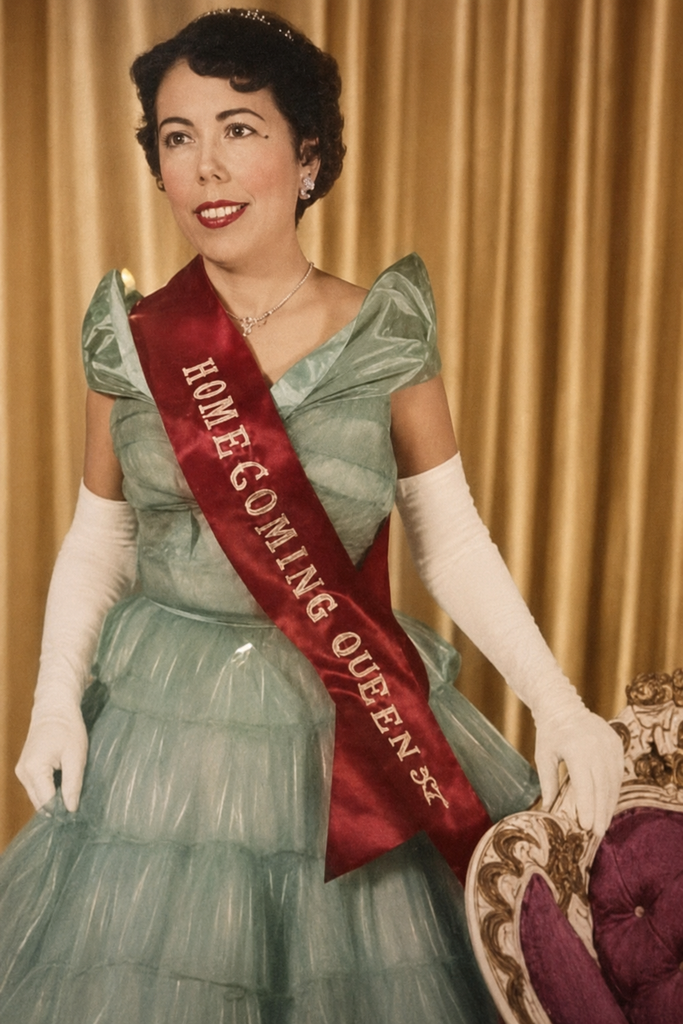
And then there is the photograph.
Rosita stands formally posed in an elegant gown. She wears long white gloves. Across her dress is a sash bearing three unmistakable words:
HOMECOMING QUEEN.
We do not yet know exactly which organization or event awarded Rosita that title. Texas A&I had several student organizations and coronation traditions, and the Anahuac Club participated in campus activities.
So we should not add something the photograph does not say. We cannot yet call her the official Texas A&I Homecoming Queen.
We do not need to.
The photograph itself establishes something remarkable enough: Rosita Barrera was a Homecoming Queen.
For a young Mexican-American woman who had grown up in Fronton during the 1930s and 1940s, the photograph tells a story even without another word.
She Came Home a Teacher
Rosita did not simply attend college and disappear from the Starr County story.
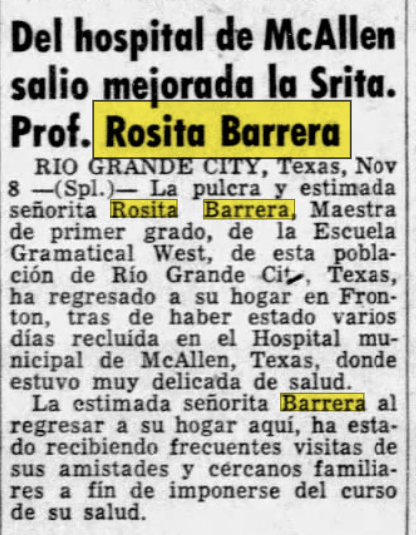
Another newspaper clipping identifies her as:
“Srta. Prof. Rosita Barrera.”
The article says she was a first-grade teacher at West Grammar School in Rio Grande City.
It was actually a story about her health. Rosita had been seriously ill and hospitalized in McAllen. The newspaper reported that she had improved enough to return home.
Then it supplied another small but important detail.
Her home was Fronton.
Rosita had gone from Fronton to college in Kingsville and then returned to Starr County as an educator.
That matters when we place her beside the census records.
From One Side of the Teacher’s Desk to the Other
The educational history of places like Fronton was not simply a story of people who did not value schooling.
Opportunity mattered.
Distance mattered.
Money mattered.
Schools mattered.
Family circumstances mattered.
Many of the adults we found in the census had been children during a period when a few years of schooling could be all that rural South Texas offered them.
Rosita belonged to the generation beginning to break through that ceiling.
In 1940, she was still the student.
Within a few years, she had become the teacher.
And not just anywhere. She came back to teach children in the same part of Starr County from which she had emerged.
Another Newspaper Clue
A later newspaper clipping places Miss Rosita Barrera among women associated with the Rio Grande City chapter of the American Association of University Women.
Again, the significance is larger than her name appearing in a society column.
Rosita had entered Starr County’s small but growing community of educated professional women.
She had gone from the ranch country around Fronton into higher education and then into a profession.
The transformation can almost be measured in one generation.
What Oral History Got Right
Family stories change.
A name moves slightly. A date moves ten years. Texas A&I becomes the University of Texas. Somebody remembered as a daughter may actually have been a niece raised as a daughter.
That does not make oral history worthless.
Sometimes it preserves the part that mattered most.
A cousin who grew up in Fronton remembered that one of Inocente Barrera’s daughters went to college.
Then the documents began appearing.
The 1940 census gave us Rosita Barrera in Inocente’s household.
The Caller-Times gave us Rosita Barrera at Texas A&I.
Another newspaper gave us Professor Rosita Barrera, first-grade teacher.
Another placed her among the educated women of Rio Grande City.
And a family photograph gave us Rosita standing proudly in her gown with HOME COMING QUEEN across her chest.
The details did not survive perfectly.
The woman did.
The Girl From Fronton
That may be the most important part of Rosita’s story.
Today, going from Starr County to college does not sound extraordinary.
In Rosita Barrera’s Fronton, it was.
She came from a community where the census shows how often formal schooling ended after only a handful of grades. She continued.
She left Fronton.
She went to Texas A&I.
She became a teacher.
And somewhere along that journey, somebody placed a sash across the young woman’s gown and called her a Homecoming Queen.
Her cousin remembered.
The newspapers remembered pieces.
The census remembered another.
The photograph remembered the rest.
And now, so do we.