In the story, I mention that my mother was told that education was enough. My mother made sure that all of her children finished high school. When she told her father that her children would all finish school, he laughed. Well, we all finished school. As the oldest, she would always tell me Memeito, you have to go to college because I don’t want any of the others to say that Memeito did not go to college. I did go, got a bachelor’s degree, and later went to law school at night and earned a Doctor of Jurisprudence degree from the University of Houston School of Law. All of her children have some college. Two of my brothers are retired police officers; one of my sisters was a nurse, and another a school teacher. One brother worked in the oil industry, and another has degrees from Princeton and Oxford; one sister co-owned a small construction company.

Following the Crops: Reconstructing My Mother’s Life as a Migrant Worker
My mother, Otalia García, was born in 1926 in a large South Texas family that called Fronton home. No matter how far the family traveled for work, they always returned to Fronton. Her father, Eduardo García, was still listed in the 1940 census as a tenant farmer. Ten years later, he was listed simply as a farm laborer.
Between those two census entries lies most of the story.
The records do not tell us the exact year Eduardo stopped making his living as a tenant farmer and became part of the migrant labor force. My mother did not leave behind a diary, and nobody in the family kept a list of every town, every crop, or every season. What survives instead are pieces: what she told me, what I personally remember, old photographs, census records, and the larger history of the migrant labor system that surrounded families like hers.
By 1940, my mother was fourteen years old. Her schooling had essentially ended. She later told me that she reached the sixth grade and was told that was enough education for her. The census appears to support that memory: she was no longer attending school and had completed about five years of schooling. For a girl in a large farming family, childhood could end early.
Work was waiting.
Eduardo owned a truck, and my mother remembered that the whole family traveled together on it. That truck became their transportation from one crop to the next. They did not wander aimlessly looking for something to do. They followed a labor calendar that had already been established across South Texas and beyond.
One of the largest migrant streams in Texas followed the cotton harvest north and west from the Lower Rio Grande Valley through the Corpus Christi area, then into Central and East Texas, with some workers continuing toward West Texas and the Panhandle. Tens of thousands of migrant workers joined the cotton harvest in Nueces and San Patricio Counties alone.
That route was part of my family’s life.
My grandparents worked around Driscoll, Texas, during the cotton season. Later, the family followed the cotton farther north into the El Campo area. I know that because I visited them there once. Long before I understood anything about migrant labor systems, I knew that my grandparents went where the cotton was ready.
Years later, I followed part of the same routine myself. Beginning when I was about seven or eight, I spent summers with my grandparents around Driscoll snapping cotton. I did that every summer until I was sixteen. By then I had transportation of my own and found a job in Corpus Christi instead.
The workday began at sunup and ended at sundown Monday through Friday. Saturday was a half day. We stayed in the sort of place newspapers of the period sometimes called a hovel. I did not know that word then. We simply stayed where there was a place to stay.
There were no beds. We slept on the floor.
That did not strike me as extraordinary at the time. I grew up in a family of eight children. My father worked for the federal government, and we were not migrant workers, but no child in our house had a room to himself. Our house expanded as the family expanded. Privacy was scarce, space was shared, and that was normal because most of the people I knew lived much the same way.
That is why old newspaper photographs of migrant housing affect me differently than they may affect someone who grew up with a bedroom of his own. Reporters looked at rough wooden shacks and saw misery. I look at some of those photographs and recognize things that look familiar.
Paula, my grandmother, had a different kind of job. Her work was not measured in pounds of cotton. She had breakfast ready before everyone left for the fields, prepared lunch for the entire family, and had dinner waiting when they returned at the end of the day.
Her labor made everybody else’s labor possible.
The historical record shows why entire families had to keep moving. Agricultural wages from one harvest were often not enough to support a family through the year. Texas created an organized migrant stream in which workers followed cotton from one region to another because a single crop could not provide enough income to live on. State and private labor systems helped direct workers from South Texas into one harvest after another.
The family’s travels did not stop in Texas.
My mother told me that she went to Michigan to pick cherries. I also remember her mentioning sugar beets, although that memory is less certain. The exact Michigan town is lost to history. Nobody wrote it down, and by the time I thought of asking the questions I should have asked, the people who knew the answers were gone.
The Michigan part of her story fits closely with what historians have documented. Texas Mexicans and Mexican Americans had been recruited into northern sugar-beet agriculture for decades. During and after World War I, when European immigration declined and beet companies needed another source of labor, Mexican and Mexican American workers became increasingly important in Michigan fields.
A Works Progress Administration study of 300 migrant families from Crystal City in 1938 described a remarkably similar pattern. Families worked spinach during the winter, some moved into onion fields, many went to cotton in Nueces County, and then they traveled north for sugar-beet work. Most of the money they earned for the year came from the northern beet harvest.
The crops fit together almost like pieces of a calendar.
The existence of Eduardo’s truck may have given the García family more freedom than migrant families who depended entirely on recruiters or company transportation. Contemporary accounts describe workers leaving San Antonio for Michigan packed forty or more onto flatbed trucks, sometimes standing for long stretches because there was no room to sit or lie down. One migrant remembered a five-day, four-night trip in a truck with faulty brakes.
My mother remembered something simpler: the family traveled together on their own truck.
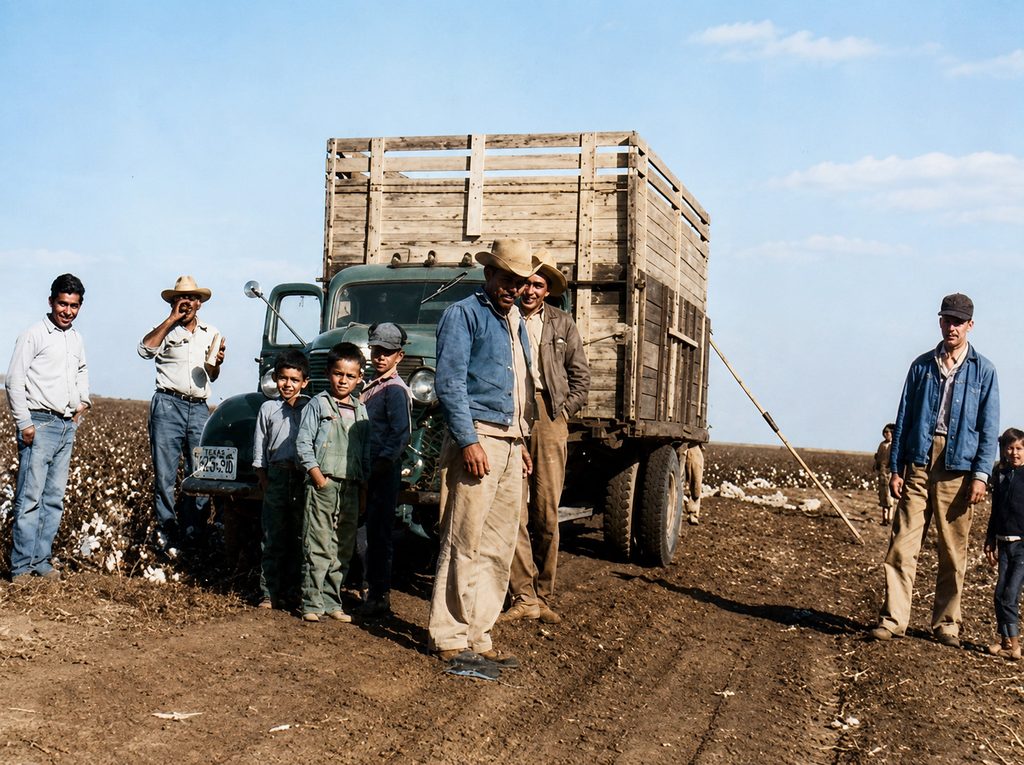
I do not know whether Eduardo drove that truck all the way to Michigan. I do not know whether the family worked beets before cherries, after cherries, or during different years. Those details are gone. But Michigan itself is not speculation. My mother remembered picking cherries there.
We also have photographs from that life.
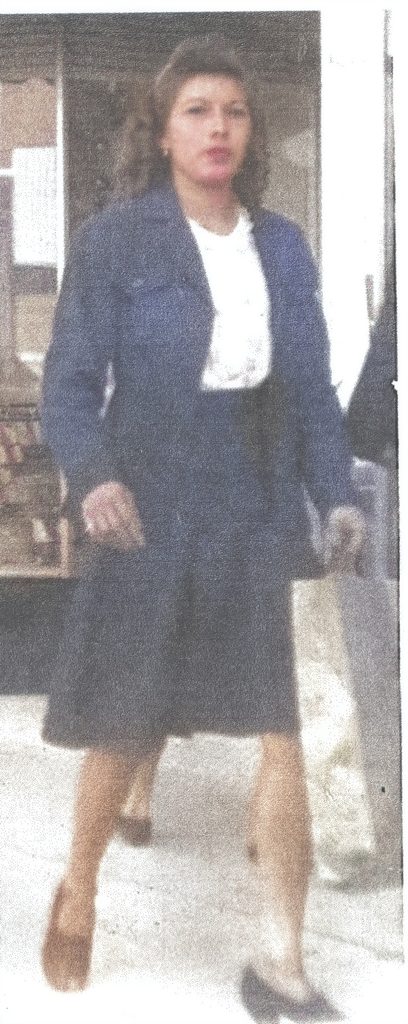
In one, my mother is young and neatly dressed, standing in one of the towns where the family had gone to work. She told me that she paid a quarter to have the photograph taken. In another, her father Eduardo is walking through town, dressed neatly and wearing a hat. My mother paid for that photograph too.
Neither photograph shows a cotton sack, a beet field, a truckload of workers, or a rough camp. That is part of what makes them valuable. Migrant workers did not stop being people when the workday ended. They went into town, dressed up when they could, spent a little money, had their pictures taken, and lived ordinary lives inside an extraordinary system of movement and labor.
The two census records show the economic transformation clearly. In 1940 Eduardo García was a tenant farmer. By 1950, he was a farm laborer.
That change was part of something much larger happening in South Texas. Modern agribusiness increasingly favored temporary wage labor over older systems such as tenant farming and sharecropping, which carried year-round obligations between landowner and tenant. A mobile labor force could be brought in when crops needed workers and released when the harvest ended.
For growers, that system reduced obligations.
For families like mine, it meant following the crops.
The system did not necessarily produce prosperity even when it produced almost constant employment. The WPA researchers who studied migrant families found that wages remained so low that families could work nearly year-round and still remain in need.
That may be one of the most important things to understand about migrant farm labor. These were not people unwilling to work. They worked endlessly. The problem was that even endless work did not guarantee security.
My mother married in 1948, ending one stage of her life. By then she had lived through tenant farming, migrant labor, interrupted schooling, cotton fields in South Texas, movement north through places such as El Campo, and at least one journey all the way to Michigan.
A generation later, I was still working some of the same cotton fields.
When I was a child in Driscoll, I did not think of myself as participating in history. I was simply working with my grandparents. I slept on the floor because that was where we slept. I went into the fields because that was what everyone else did. Nobody explained that we were continuing a labor pattern that had shaped Mexican and Mexican American life in South Texas for decades.
Only much later did the pieces begin to fit together.
The census gives me Eduardo the tenant farmer in 1940 and Eduardo the farm laborer in 1950. My mother gave me the truck, Michigan, the cherries, and probably the beets. My own memory gives me Driscoll, El Campo, cotton, sunup to sundown, the floor we slept on, and Paula feeding everyone before and after the workday.
The historical record supplies the roads connecting those memories.
I cannot tell you the name of the Michigan town where my mother picked cherries. I cannot reconstruct every harvest the family followed or every place where they slept. Some of that history disappeared because no one thought to ask the questions while the answers were still sitting across the kitchen table.
But enough remains.
It is the story of Eduardo, Paula, Otalia, and a large South Texas family that loaded itself onto a truck and followed the crops wherever work could be found. It is the story of a girl whose schooling ended after the sixth grade, of a mother who cooked three meals a day for a working family, of children who became laborers early, and of a family that traveled from the cotton country of South Texas to the orchards and beet fields of Michigan.
And for them, none of it was history.
It was simply life.