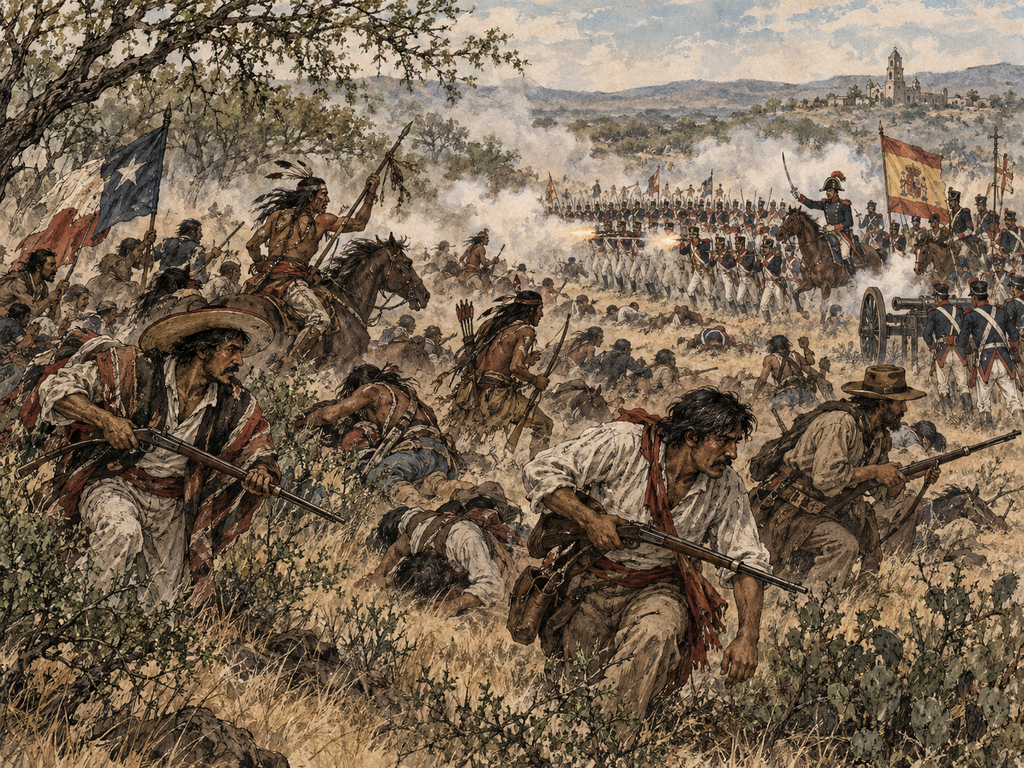
The bloodiest battle probably ever fought on Texas soil, and it is not in our Texas history books. Massacres on both sides; an entire army wiped out. Makes the Alamo or the Battle of San Jacinto seem like walks in the park. Apaches fighting with Tejanos, Americans, Bandits, adventurers, and invasion of Tejas to take it from Spain.
Texas likes to say six flags have flown over it. In reality, more than six did. In 1812–1813, the Green Flag of the Gutiérrez–Magee republic flew over parts of Texas while its government controlled Nacogdoches, Goliad and San Antonio and adopted a constitution.
I thought I knew the broad outline of Texas history. Spain came first, then Mexico, then the Anglo settlers, the Alamo, San Jacinto, and the Republic of Texas. But while reading an 1842 issue of the Telegraph and Texas Register, I ran across a story about an “infamous massacre” connected to something called the Gutiérrez–Magee Expedition.
I had never heard of it.
“Expedition” makes it sound almost harmless. It was not. In 1812, a private army crossed from Louisiana into Spanish Texas, captured towns, fought Spanish troops, occupied San Antonio, declared a new government, murdered prisoners, and was finally destroyed in one of the bloodiest battles ever fought on Texas soil. The force included Mexican revolutionaries, Tejanos, Anglo-American filibusters, former Spanish soldiers, Native warriors, adventurers, smugglers, and some men drawn from the bandit world of the Neutral Ground between Louisiana and Texas. (Texas State Historical Association)
The story also reminds us that Tejano history did not begin when Stephen F. Austin arrived in Texas. Tejanos were already fighting over independence, government, land, and survival long before 1836.
A Mexican revolutionary and an American soldier
The movement began with José Bernardo Gutiérrez de Lara, a Mexican revolutionary from Nuevo Santander who opposed Spanish rule. He traveled to the United States looking for support for the Mexican independence movement and eventually returned to the Louisiana frontier. There he joined forces with Augustus William Magee, a young former U.S. Army officer and West Point graduate who resigned his commission and became the military commander of the invading force. (Texas State Historical Association)
Historians usually call the force the Republican Army of the North, and the Texas State Historical Association calls the campaign an early filibustering expedition against Spanish Texas. In that period, a filibuster was not a senator giving a long speech. It was a privately organized military expedition into foreign territory. (Texas State Historical Association)
The army itself was a strange collection of people with different motives. Some Mexicans and Tejanos wanted independence from Spain. Some Americans wanted to help that revolution. Others hoped Texas might eventually become part of the United States. Some recruits were attracted by promises of booty. The border region from which many of them came had long been a haven for smugglers and armed bands because neither Spain nor the United States exercised complete control there. (Texas State Historical Association)
TSHA’s newer history of the Republican Army of the North goes even further. It says a group of bandits had established itself in the Neutral Ground after a smuggling ring was broken up in 1808, and that the later filibuster drew recruits from that world as well as from former Aaron Burr associates and political exiles. So it would be wrong to call everyone in the army a bandit, but it would also be wrong to clean the story up and pretend the army was made entirely of idealistic revolutionaries. (Texas State Historical Association)
They invaded Texas
The army crossed the Sabine River in August 1812 with roughly 130 men and quickly captured Nacogdoches. It then moved west, taking Trinidad de Salcedo on the Trinity River and later La Bahía, today’s Goliad. As the force moved deeper into Texas, its numbers grew with American and Mexican recruits, Spanish deserters, Tejanos, and Native allies. (Texas State Historical Association)
At La Bahía, Spanish governor Manuel María de Salcedo tried to destroy the invading force. His troops besieged the Republicans for months, but the defenders held out. Magee died during the siege in February 1813, and Samuel Kemper took command. After several failed Spanish attacks, Salcedo withdrew toward San Antonio. (Texas State Historical Association)
The Republicans followed.
On March 29, 1813, they met Spanish royalist troops at the Battle of Rosillo, about nine miles southeast of San Antonio. The battle was short and decisive. The Republicans routed the royalists, captured artillery, weapons, horses, and supplies, and advanced toward San Antonio. On April 1, Salcedo surrendered the city. (Texas State Historical Association)
For a short time, the revolutionaries controlled Spanish Texas.
Tejanos and Lipan Apaches fought together
This is where the story becomes even more interesting.
The Republican Army was not simply an Anglo-American force fighting Spaniards. By 1813 it had become a mixed army of Tejanos, Anglos, French Creoles, former royalists, and Native warriors. TSHA estimates that by the summer of 1813 the force may have numbered 1,500 to 2,000 men, including perhaps 700 to 1,000 native Tejanos and 500 to 600 Anglo Americans, along with an unknown number of Native fighters. (Texas State Historical Association)
Among the most important Native allies were the Lipan Apaches. Their participation was not accidental. TSHA notes that generations of relationships between Lipan bands and old San Antonio families made the Lipans natural allies of Tejanos when rebellion against Spain spread into Texas. Lipan warriors carried propaganda and supplies for the Republican Army and fought alongside the rebels. (Texas State Historical Association)
Two Lipan leaders can be named: Cuelgas de Castro, leader of the Sun Otter Band, and Flacco, leader of the High-Beaked Moccassin Band. Both commanded sizeable Lipan contingents at Rosillo and later at the Battle of Alazán Creek. (Texas State Historical Association)
The Lipan Apache Tribe’s own history adds an important qualification. It says Flacco and Cuelgas de Castro did not personally bring their warriors to the Battle of Medina, although other Lipan chiefs did participate. That does not contradict the broader record showing Lipan involvement in the campaign; it simply reminds us that Native alliances were not uniform and that different bands and leaders made their own decisions. (Lipan Apache Tribe)
That relationship tells us something important about early Texas. Tejanos and Native peoples were not living in completely separate worlds. They traded, negotiated, formed alliances, shared enemies, and sometimes fought together when their interests matched.
Then came the massacre
After San Antonio surrendered, Governor Salcedo, Nuevo León governor Simón de Herrera, and other Spanish officers became prisoners. They had reportedly been promised safe conduct out of Texas. Instead, on the evening of April 3, a group of Tejano rebels took the prisoners outside San Antonio and killed them. TSHA describes fourteen captured royalist officers as having been executed. (Texas State Historical Association)
The killings divided the Republican Army. Some American volunteers were outraged and left the campaign. Samuel Kemper was among those who returned to the United States, although other Americans defended the killings by pointing to earlier Spanish brutality. (Texas State Historical Association)
Nearly thirty years later, the Telegraph and Texas Register was still looking back at the event and calling it an “infamous massacre.” That caught my attention because this was not a Mexican newspaper trying to make Texans look bad. This was a Texas newspaper condemning brutality committed by men fighting on the revolutionary side.
There is a lesson there. Sometimes the old newspapers were less interested in protecting the legend than later generations became.
A republic before the Republic
After taking San Antonio, the revolutionaries declared Texas independent of Spain on April 6, 1813, and created a provisional government under Gutiérrez. This was more than twenty years before the Texas Declaration of Independence of 1836. (Texas State Historical Association)
But the coalition was already coming apart. Americans and Tejanos disagreed over leadership, strategy, and the treatment of prisoners. Gutiérrez was eventually replaced by José Álvarez de Toledo y Dubois. Meanwhile, Spanish commander Joaquín de Arredondo marched north with a large royalist army to retake Texas. (Texas State Historical Association)
The final collision came south of San Antonio.
The Battle of Medina
On August 18, 1813, roughly 1,400 Republican soldiers met about 1,830 Spanish royalists at the Battle of Medina. The Republican force included Anglos, Tejanos, Native warriors, and former royalists. The Spanish army included a young officer named Antonio López de Santa Anna, who would return to Texas twenty-three years later. (Texas State Historical Association)
The battle became a disaster for the Republicans. Royalist troops drew them into a trap, and the fighting turned into a slaughter. TSHA estimates that only about 100 Republican soldiers survived, while the royalists lost about fifty-five men. The Battle of Medina is generally described as the bloodiest battle ever fought on Texas soil. (Texas State Historical Association)
The brutality did not end when the battle ended. Arredondo returned to San Antonio and carried out harsh reprisals. Hundreds of suspected rebels were shot, women connected to rebel families were imprisoned, and similar purges took place in East Texas. The bodies of the Republican dead at Medina reportedly remained on the battlefield for nine years before Mexican authorities finally ordered their remains gathered and buried. (Texas State Historical Association)
So this is not a simple morality tale in which one side was civilized and the other barbaric. Prisoners were murdered by men fighting for the revolution, and royalist troops later answered rebellion with executions and collective punishment.
Why did I never learn this?
That may be the question that interests me most.
Most of us were taught a Texas history that moved quickly from Spanish missions to Mexican rule, Anglo settlement, the Alamo, and San Jacinto. The Gutiérrez–Magee invasion does not fit comfortably into that story.
It shows Mexican revolutionaries fighting for Texas before Stephen F. Austin became the center of the narrative. It shows Tejanos as political and military actors rather than spectators. It shows Lipan Apache leaders fighting beside Tejano rebels. It shows American adventurers and former soldiers crossing into Spanish territory long before Mexico supposedly became the aggressor in the Texas story. And it shows atrocities committed by both revolutionary and royalist forces.
The name itself helps hide what happened. “Gutiérrez–Magee Expedition” sounds almost like an exploration. In reality, an armed force crossed an international boundary, captured towns, occupied San Antonio, established a government, fought several battles, and was finally destroyed.
Call it a filibustering expedition if we want to use the historians’ term. Call it a revolution if we are describing the Mexican and Tejano participants who wanted independence from Spain.
But we should also call it what Spain undoubtedly understood it to be:
an invasion.