How an ancient web of families survived empires, borders, and outsiders
Starr County survived four hundred years of solitude because nobody there was ever truly alone.
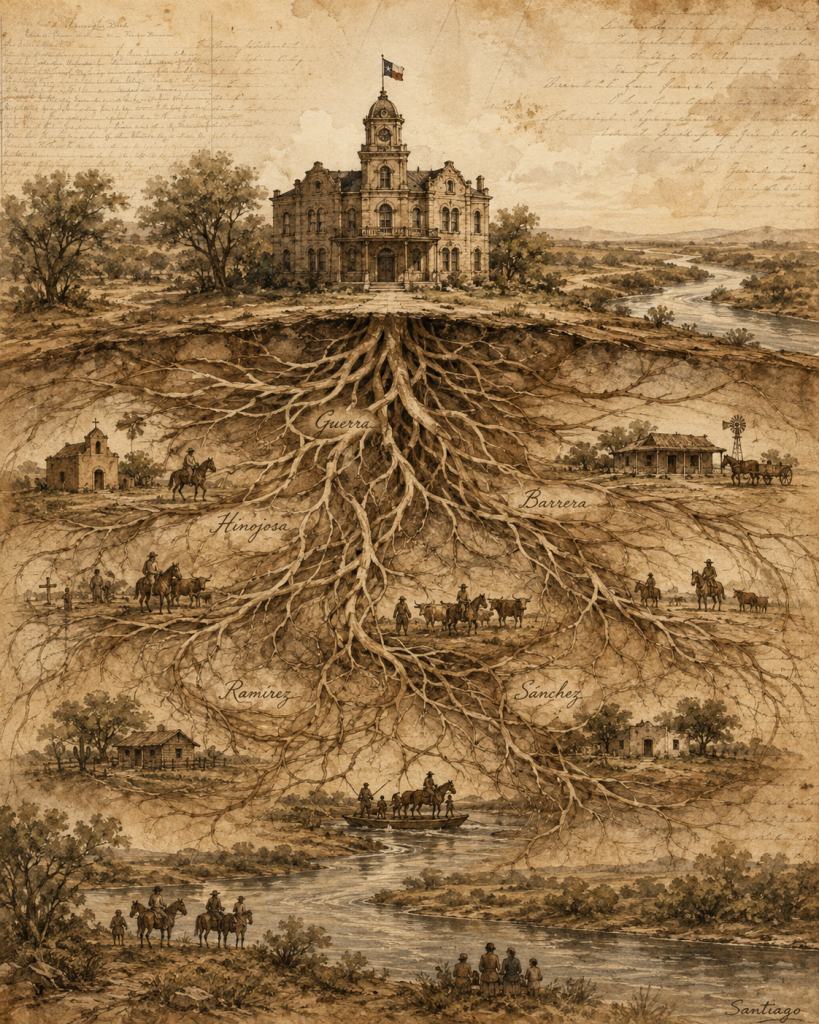
The Web Beneath the Courthouse
The deed looked like nothing.
Ten dollars. A piece of inherited land. A description filled with old names—Palo Blanco, Ramireño, Charco Redondo—and the usual legal language that could put a man to sleep before he reached the bottom of the page.
Then one name appeared.
Santos Guerra.
She was not a famous rancher or a political boss. She was an older sister in the family tree. Yet there she was, transferring inherited Guerra land to Felipe Barrera. Two surnames that historians often place in separate chapters were standing together on the same sheet of paper.
That is when the land record stopped being boring.
It was a small opening into the real history of Starr County.
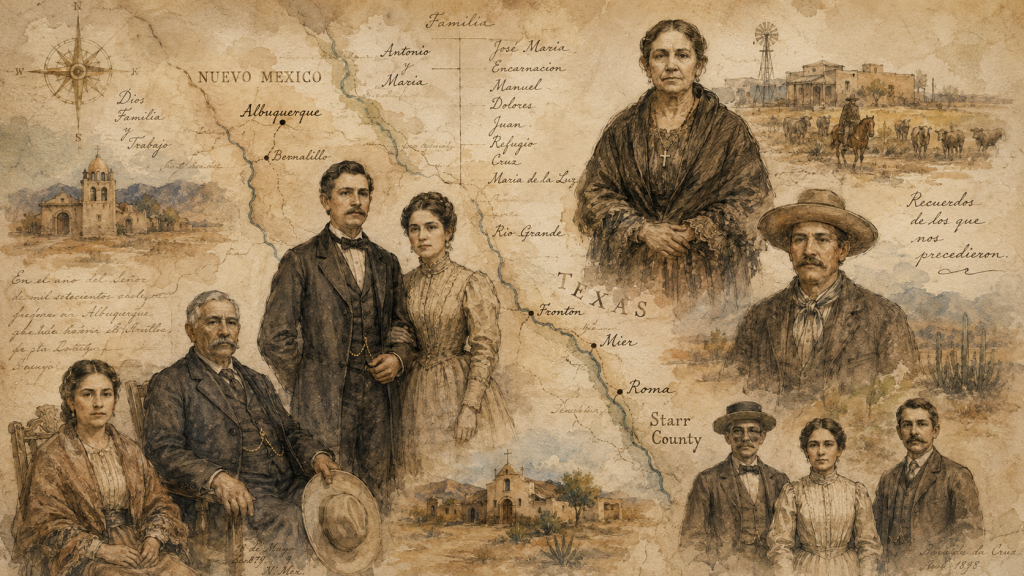
The histories usually tell us about families one at a time. There were the Guerras, the Hinojosas, the Ramírezes, the Barreras, the Garcías, the Sánchezes, the de la Garzas, and the Longorias. Each family receives its own genealogy, its own land grant, its own heroic ancestor.
But the people living there did not experience their world surname by surname.
They married one another.
A Guerra daughter married a Hinojosa. Her sister married a Ramírez. A Barrera married their cousin. A Sánchez stood as godfather to the children. A widow remarried into another ranch family after her husband died. Her children grew up beside half-brothers and stepsisters carrying different names but belonging to the same household.
After enough generations, the family tree no longer looked like a tree.
It looked like a net.
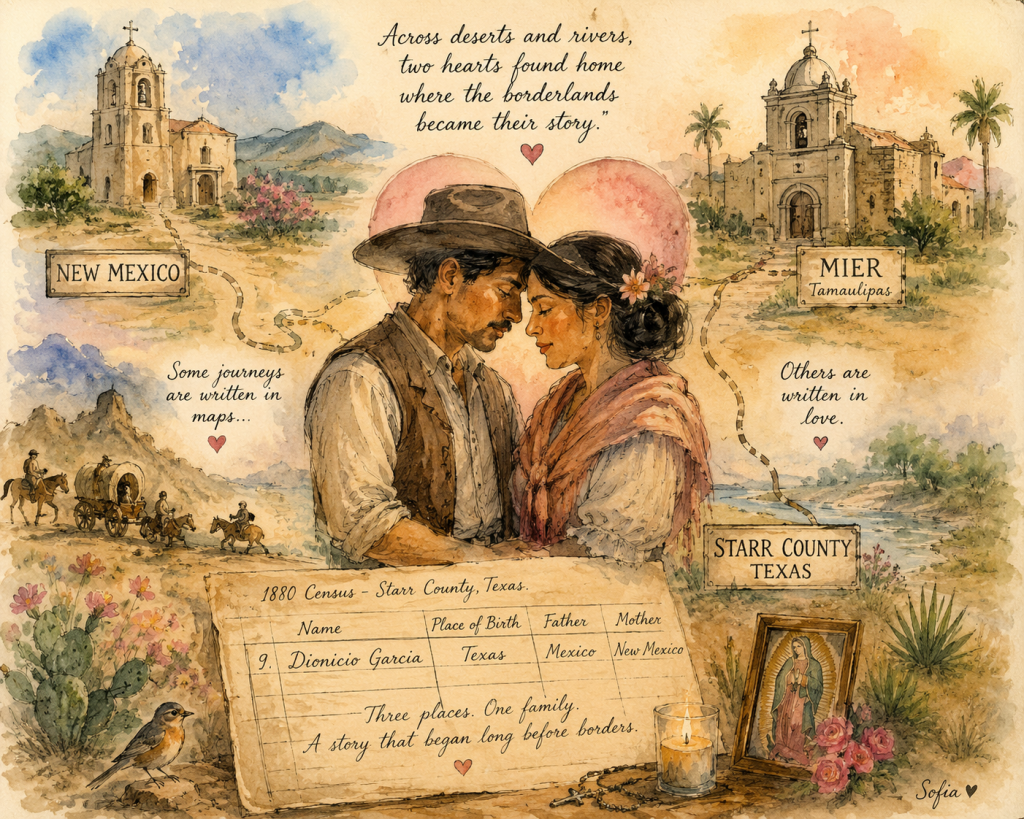
That net reached from Camargo and Mier to Revilla, Roma, Rio Grande City, Fronton, and the ranches scattered through the brush country. It crossed the river because the river had never been a wall. Families lived on one side, owned land on the other, attended baptisms across the water, traded cattle, found husbands and wives, and returned to bury their dead.
The boundary came later.
The family was already there.
By the time Manuel Guerra was born in the nineteenth century, the people of the lower Rio Grande had already survived generations of frontier life. Their ancestors had lived through drought, disease, raids, warfare, failed harvests, changing governments, and the long distances between settlements. Spain claimed them. Mexico governed them. Texas declared itself a republic. The United States moved the international boundary to the Rio Grande.
The flags changed more often than the families did.
Those families survived because they had learned that government was far away but relatives were close.
A cousin could help round up cattle after a storm. A brother-in-law might lend horses, witness a land transaction, or carry news from one settlement to another. A godparent might care for a child whose parents had died. An uncle might speak for the family before a judge. A neighbor might also be a second cousin, a compadre, and a partner in an inherited tract of land.
There were quarrels, lawsuits, grudges, and sometimes violence. Being related did not mean everybody liked one another. The mountain families of Kentucky knew that lesson well. Blood could produce loyalty, but it could also preserve an argument for three generations.
Starr County had something of that mountain character. Geography helped protect it. The brush was thick, the roads were poor, the river twisted through isolated ranch country, and outsiders often understood neither the language nor the people.
But Starr County was different from the Kentucky mountains in one important way.
Its people were not merely isolated rural families.
They were the descendants of an older Spanish-Mexican borderlands society that found itself absorbed into the United States without moving anywhere.
The Americans crossed into their world and then behaved as though the local people had just arrived.
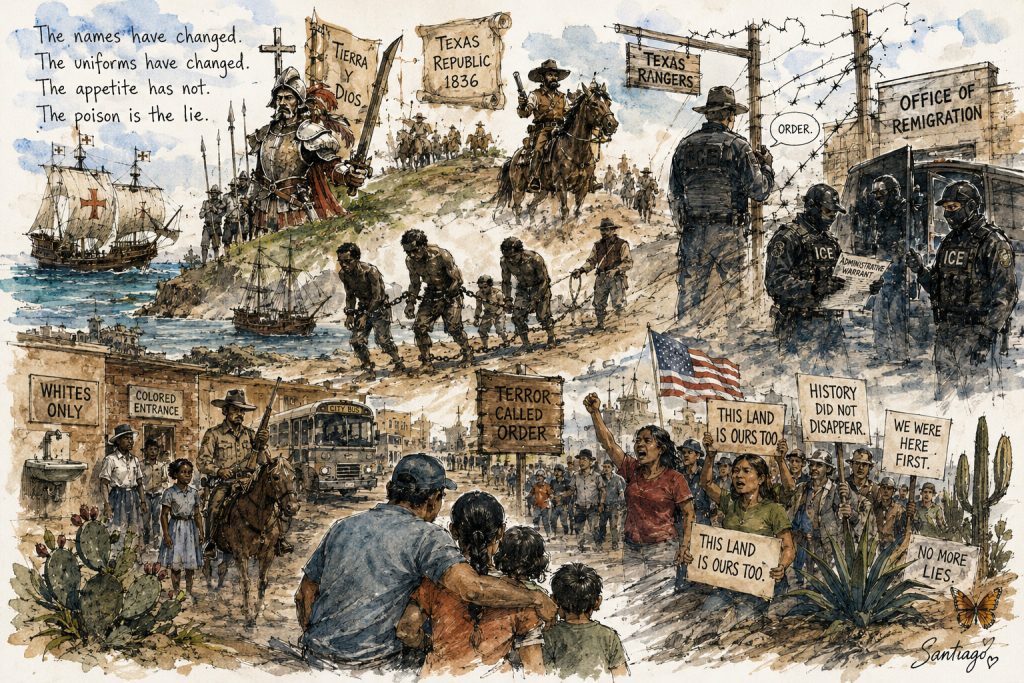
After 1848, the old families faced a different kind of danger. It was no longer only drought, raids, or distance. Now there were lawyers, speculators, tax collectors, surveyors, merchants, Rangers, and politicians arriving with unfamiliar laws and documents written in English.
Land that had been understood through Spanish and Mexican custom suddenly had to survive in American courts.
A person who could not produce the correct paper might lose property his family had occupied for generations. A widow might own an inherited share she could not locate on a modern survey. Cousins might discover that they each possessed a fraction of the same undivided tract. A stranger with money could purchase one share and then demand that the entire property be divided or sold.
That made kinship more than a social custom.
It became a defense.
The old families married among people they knew because trust mattered. They transferred land to relatives. They borrowed from one another. They placed sons, cousins, and brothers-in-law in positions where they could understand the new system. They learned the courthouse because the courthouse had become another battlefield.
Manuel Guerra did not create this world.
He was born from it.
Historians often begin with Guerra because he became the most visible man in Starr County politics. He controlled votes, made alliances, rewarded supporters, punished enemies, and dealt with state and national political leaders. Reformers called him a boss. Newspapers called his organization the Guerra machine.
But a machine is built from separate pieces.
Starr County was not.
Its people had been connected long before Guerra entered the courthouse. He did not invent their loyalties. He understood them. He knew which ranches were tied by marriage, which families had an old dispute, who needed help, whose son wanted a job, whose land was threatened, and which promise could not be broken without offending fifty cousins.
An Anglo politician might look at a voter and see one man.
Guerra saw the man’s wife, brothers, mother, godparents, in-laws, and neighbors.
He knew the web.
That was his power.
The outsiders believed they were fighting a political machine because that was the only part they could see. They saw the elections, the courthouse jobs, the favors, and the disciplined vote. They accused local people of ignorance or blind obedience because they could not imagine that the voters had reasons of their own.
Perhaps some voted because Guerra helped them. Some feared him. Some depended on county work. Some followed family expectations. Some may simply have preferred a Tejano boss they knew to an Anglo reformer who arrived promising honest government while looking hungrily at their land.
Reformers spoke of breaking the machine.
The people of Starr County may have heard something else.
They had already watched outsiders break land titles, communities, and old arrangements while calling it progress.
They knew that reform did not always arrive with clean hands.
This does not make Manuel Guerra a saint. Political bosses were not saints. Power protected some people and harmed others. Elections could be manipulated. Favors came with obligations. Families could close ranks against anyone who challenged them, including other Tejanos.
But calling it only corruption misses what stood beneath it.
The courthouse organization was the newest layer of a much older survival system.
The Guerras were not standing alone. Neither were the Hinojosas, Barreras, Ramírezes, Garcías, or Sánchezes. By blood, marriage, inheritance, and compadrazgo, the families had become difficult to separate. One surname might rise to the surface in a particular generation, but underneath it were hundreds of connections.
That may be why Starr County remained different from much of South Texas.
Elsewhere, Anglo capital and political power pushed old Tejano families aside more quickly. Land was lost, communities weakened, and local control passed into new hands. Starr County also suffered those pressures, but the old network remained unusually strong.
The brush country helped.
The river helped.
Poverty, which outsiders saw only as weakness, may also have made the county less attractive to men looking for quick fortunes.
But the greatest defense was the web.
It could bend without breaking. When one branch lost land, another still remained. When one family name faded, its descendants continued under other surnames. A Guerra granddaughter became a Barrera mother. A Hinojosa son married into the Garcías. Their children carried one name in the census and five families in their blood.
The documents record them separately.
Life did not.
That is what the ten-dollar deed reveals.
Santos Guerra and Felipe Barrera were not two unrelated people completing an ordinary land sale. They stood inside a network of inheritance and family obligation that the legal language could not explain. The clerk recorded the transaction, the property, and the price.
He did not record the conversations around the kitchen table.
He did not record who trusted whom, who was protecting the land, or what promises had been made among relatives.
He recorded the paper.
The family carried the rest.
For generations, outsiders looked at Starr County and asked how one boss could control so many people.
They were asking the wrong question.
The real question was how a people who had survived changing empires, a moved border, hostile laws, land loss, violence, and poverty continued to hold their ground.
The answer was not Manuel Guerra.
He was only one visible branch.
The answer was the web beneath the courthouse—a web woven from land, marriage, blood, memory, and necessity long before the United States arrived.
The outsiders called it a machine.
They were looking at centuries of cousins.
Starr County did not survive only in old deeds and family trees. The web is still alive—in the surnames, the marriages, the Spanish spoken across kitchen tables, the churches, the ranches, the courthouse, and the music. Four hundred years after those families began putting down roots, Starr County remains the most deeply Hispanic county in Texas. And when its mariachis play—some of the finest in the state—they are not performing the memory of a vanished culture. They are announcing that it never vanished.
.
.