William Blake once asked a question that sounds almost insulting:
“Art thou but a Worm?”
Perhaps he was asking the wrong creature.
Perhaps he should have asked us.
A worm spends its life inside a few inches of earth. It knows moisture, darkness, roots and soil. It has no reason to understand oceans, mountains, planets or stars. Those things exist whether the worm can imagine them or not.
Humans like to believe we are different.
We have telescopes. We measure galaxies. We calculate the age of stars and listen for signals that began traveling toward us billions of years before humans existed.
Then we give what we can see a magnificent name:
The universe.
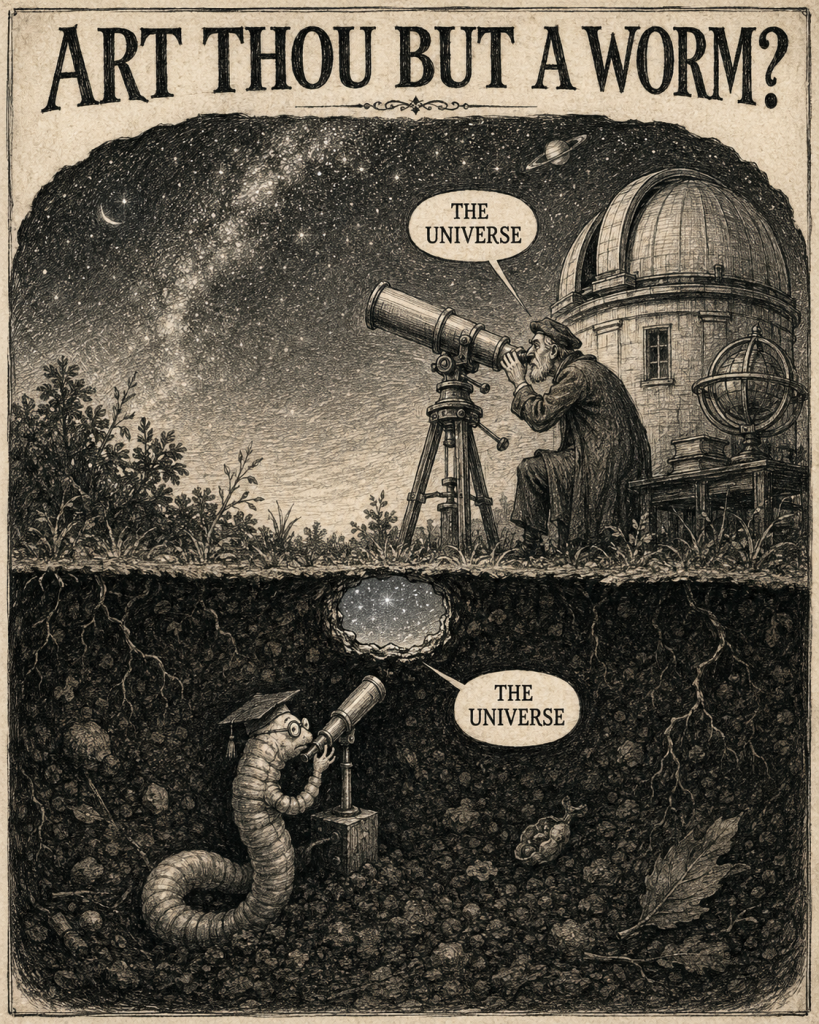
But what we actually observe is only the portion of existence whose light and other signals have been able to reach us. Beyond that boundary may be more of the same—or something our mathematics has not yet taught us how to imagine.
We don’t even know the universe’s complete shape.
It might extend without end. It might curve back upon itself. It might possess a geometry that allows someone traveling straight long enough to return eventually to the place where the journey began.
And there is an even more humbling possibility.
Perhaps the problem isn’t that the universe is impossible to understand.
Perhaps we are simply too small to understand it.
The human brain evolved to find food, recognize danger, raise children, and find the road home. It was not designed to stand outside the universe and look back at the whole thing.
A worm beneath your garden cannot comprehend Houston.
That does not mean Houston isn’t there.
Somewhere beyond everything we can see may lie the answer to a question humanity has not yet learned to ask.
We look upward and call ourselves explorers.
The worm might say the same thing when it reaches the other side of the garden.
Art thou but a worm?
Perhaps Blake was talking about us after all.