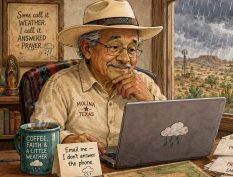
The story is faction (reconstructed as not all things are recorded) but the expedition was recorded. There is even a poem about it.
Pedro and Catalina were immigrants before Jamestown and before the Pilgrims. Had they arrived later through Ellis Island, Americans might celebrate them as courageous pioneers. Because they came through Mexico and traveled north in Spanish, many people do not even recognize their journey as part of the American immigrant story.
The Cross Beside the River
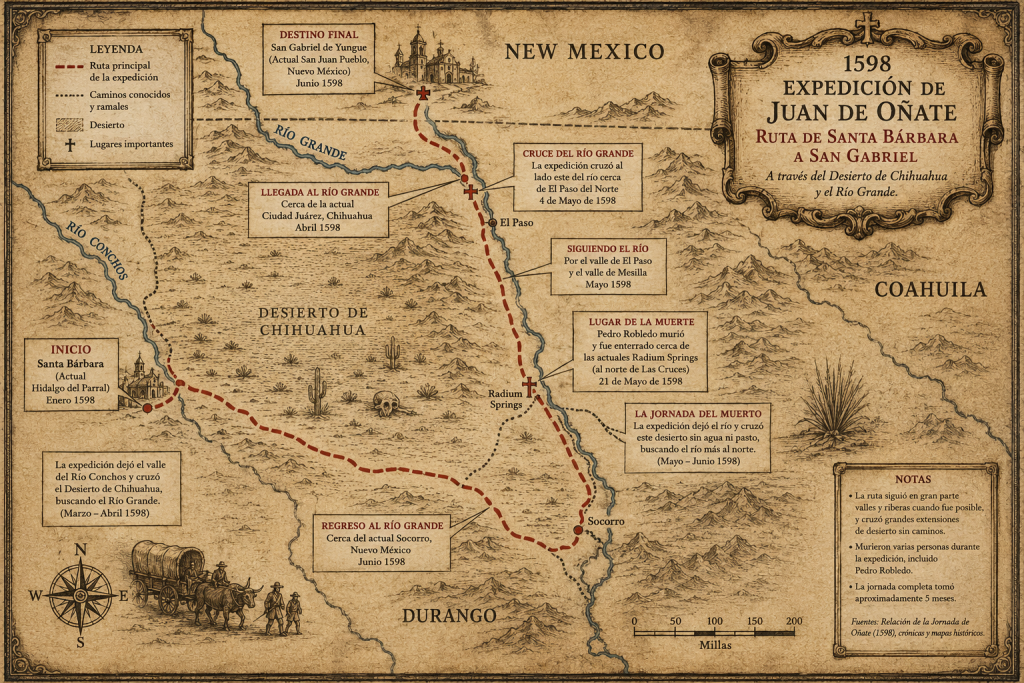
The people, dates, route, petition to leave Spain, expedition, and death of Pedro Robledo come from surviving records. Private conversations, emotions, and details of family life are reconstructed.
On May 21, 1598, a gray-haired man died beside the Rio Grande.
His wife was there.
His children were there.
The wagons, horses, cattle, soldiers, servants, and other families traveling north with Juan de Oñate were there.
But the man was no longer going anywhere.
The expedition recorder gave Pedro Robledo only a few words:
“On the 21st … we buried Pedro Robledo.”
No cause of death.
No final words.
Nothing about his wife, Catalina López, standing beside the grave while men pushed desert soil over the body of the husband who had brought her across an ocean and then into this country of dust, mountains and endless sky. (American Journeys)
The caravan could not remain there long.
Ahead of them waited the Jornada del Muerto, ninety miles of desert with almost no water or forage. Behind them lay everything they had crossed to reach this place.
Someone raised a wooden cross over Pedro’s grave.
Perhaps Catalina touched it before leaving.
Perhaps she told the children to look carefully because this was where their father would remain.
Perhaps she said nothing at all.
Grief sometimes has no words.
Then the wagons began moving.
The family continued north.
Pedro stayed beside the river.
The man who had little
Twenty-four years earlier, Pedro Robledo had stood before Spanish authorities asking permission to leave.
It was 1574. He lived in Carmena, near Maqueda in the province of Toledo. He was married to Catalina and had children named Ana, Diego, Luis and Luisa.
Pedro told the authorities that he had few possessions and that his family suffered because of it.
But across the Atlantic, in Mexico City, lived his first cousins Miguel de Sandoval and Catalina Sánchez. They were people of means. They had written repeatedly, urging Pedro to bring his wife and children to New Spain. They promised to help the family establish a better life.
Pedro was not asking permission to explore.
He was not promising to conquer a kingdom.
He was trying to feed his family.
Witnesses appeared on his behalf. They testified that Pedro and Catalina were respectable Christians and that the relatives awaiting them in Mexico were wealthy enough to help.
The petition was written down, folded into the machinery of the Spanish Empire and preserved for more than four centuries in the Archivo General de Indias.
Pedro’s own reason was simple:
There was little for them in Spain.
Perhaps there would be more in Mexico. (Google Sites)
Across the ocean
No surviving record tells us what Catalina said when Pedro came home with the news that they could leave.
She may have looked around the house at everything that could not be carried.
She may have worried about the ocean.
People who crossed the Atlantic in the sixteenth century did not step aboard knowing they would arrive safely. Storms, disease, hunger and accidents could turn the promise of a new life into a burial at sea.
The children may have understood only that they were going somewhere called New Spain, where rich relatives waited for them.
Pedro would have understood more.
He was leaving the soil where his parents and grandparents had lived. He was taking his family into a world he knew mostly through letters and stories.
There would have been no return ticket.
Whatever they carried had to fit aboard a ship.
Whatever they left behind would probably remain behind forever.
The coast of Spain slowly disappeared.
For weeks there was nothing but water.
Then, one morning, there was America.
A second life in New Spain
The records grow quiet after the family reached New Spain.
That silence contains more than twenty years.
Children grew.
More children may have been born.
Sons became men. Daughters married. Pedro and Catalina learned the roads, customs, and dangers of a country that had once existed for them only inside letters from Mexico City.
They may have believed their great journey was over.
Then came Juan de Oñate.
Oñate was organizing a colony that would travel north from the mining frontier of Santa Bárbara into what the Spanish called Nuevo México.
This was not an expedition of young men traveling lightly.
It was a town on wheels.
Roughly four hundred people joined the journey. About 130 of the soldiers brought families. More than eighty wagons and carts carried food, tools, clothing, weapons and household goods. Thousands of cattle, sheep, goats and horses moved with them, raising a cloud of dust that could announce the caravan long before it arrived. (Texas State Historical Association)
Pedro joined as an alférez, a junior officer.
The young father who had once told authorities he had almost nothing was now an older man equipped for himself and his horse. A surviving description portrays him as a man of good stature, completely gray and about sixty years old.
He was not traveling alone.
Catalina was still beside him.
Their children and grandchildren were part of the human river moving north. (Cybergata)
Pedro had already crossed one ocean.
Now he would cross a desert.
The road with no road
The caravan departed northern New Spain in early 1598.
There was no highway. No map showed every water hole. Wagon wheels sank into sand and struck stone. Animals wandered. Harnesses broke. Dust entered mouths, eyes, food and bedding.
The caravan stretched for miles.
Children walked beside wagons until they became tired, then climbed inside among sacks, tools and whatever possessions the family had brought.
At night, fires appeared across the desert like scattered stars.
Pedro may have ridden near the wagons carrying Catalina and the younger members of the family. His armor could protect him from an arrow or blade, but it could not protect him from heat, thirst, age, or disease.
The expedition left the older route and pushed directly across the Chihuahuan Desert.
For four days, an advance group found no water.
When the caravan finally reached the Rio Grande in April, people and animals rushed toward it in desperation. The river meant shade, food, grass and life after weeks of sand. (Texas State Historical Association)
On April 30, Oñate held a ceremony and claimed the Rio Grande watershed for the Spanish Crown.
The soldiers stood in formation.
Priests said Mass.
People ate and celebrated.
But the land was not empty. Indigenous peoples had lived beside that river for generations. Spain could perform a ceremony and write down a claim, but the paper did not create the people, the river or the country.
Pedro had come north as part of a colonizing expedition.
Whatever his private reasons—land, opportunity, duty, family survival—he traveled inside a larger machinery of empire.
The empire would remember Oñate.
The family would remember Pedro.
May 21, 1598
The expedition crossed the river and continued north through the Mesilla Valley.
Something happened to Pedro.
The record does not tell us whether he became sick slowly or collapsed suddenly. It does not tell us whether Catalina had spent several nights listening to his breathing or whether his death surprised everyone.
We only know the date.
May 21.
Perhaps Pedro understood he would not finish the journey.
Perhaps he called Luisa or one of his sons close.
Perhaps he looked at Catalina—the woman who had left Spain with him twenty-four years earlier—and realized she would have to complete the road without him.
He had taken her from Toledo to Mexico.
Now she would carry the family into New Mexico.
“Keep them together,” he might have said.
Or perhaps Catalina said it to him.
The truth is hidden.
Only the grave remains certain.
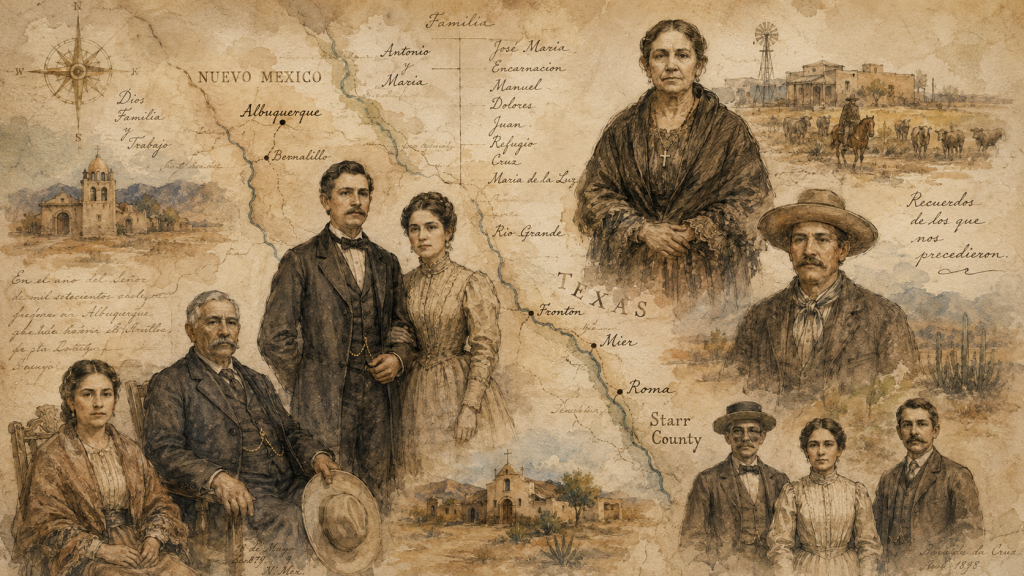
They buried Pedro near what is now Radium Springs, north of Las Cruces. A cross marked the place. Travelers began calling it La Cruz de Robledo. Later it became Paraje de Robledo, a stopping place on El Camino Real de Tierra Adentro.
The nearby Robledo Mountains still bear his name. (New Mexico Historic Sites)
Two days after Pedro died, the expedition entered the Jornada del Muerto.
Water became dangerously scarce. According to the march record, a dog appeared with mud on its paws, leading the travelers to pools of rainwater.
Pedro never saw that little dog.
He never saw the caravan emerge from the desert.
He never reached the settlement the expedition established farther north.
But Catalina and the family did. (National Park Service)
The widow kept walking
Catalina had a choice that was not much of a choice.
She could not return alone across hundreds of miles of desert. She could not remain beside the grave with children and livestock while the caravan disappeared north.
So she moved.
The wheels turned.
The animals strained against their harnesses.
The cross became smaller behind them.
At some point Catalina could no longer see it.
That may have been the moment Pedro truly disappeared from her world.
But he did not disappear from the family.
Their daughter Luisa carried part of him forward.
Then came Ana Robledo Romero.
Francisco Antonio Gómez Robledo.
Antonio Gómez Robledo.
María Luisa Gómez de Castillo.
Domingo García Noriega.
Toribio García Jurado.
María Joaquina García.
José Rafael Candelaria.
Jesús Candelaria.
Juana García.
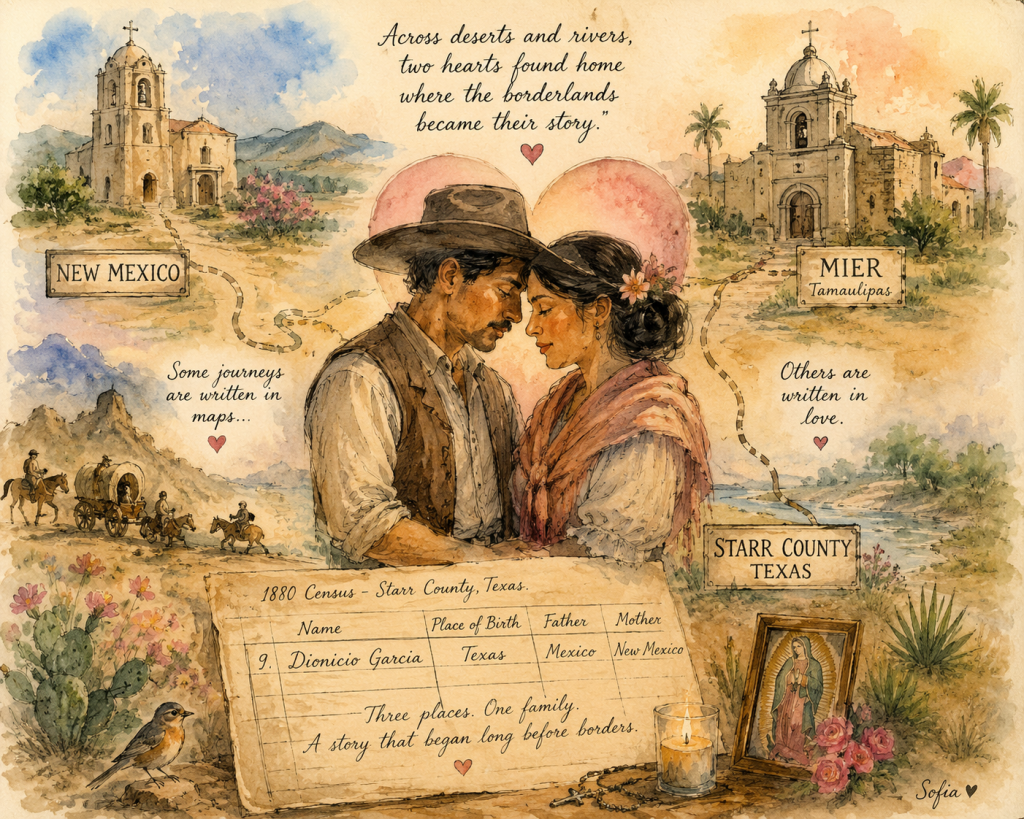
Dionicio García.
Eduardo García.
Otalia García Barrera.
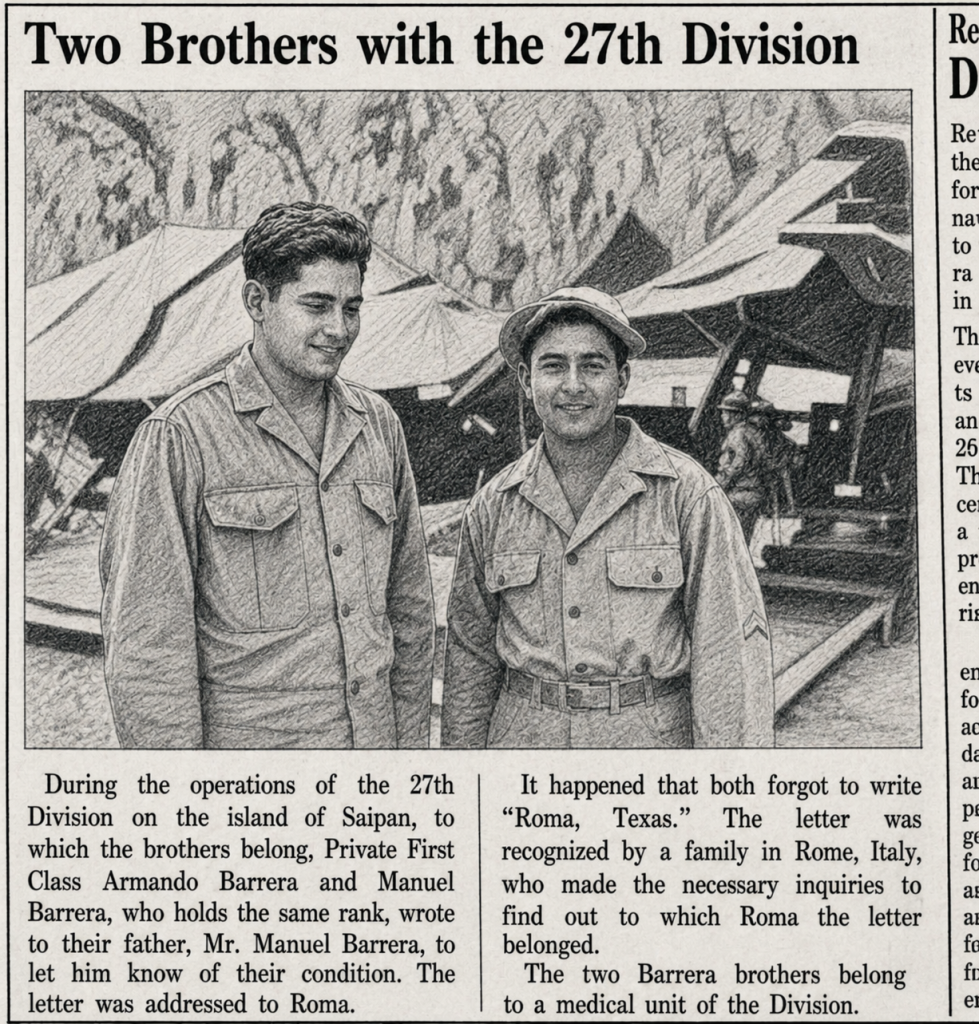
And then her son, Manuel.
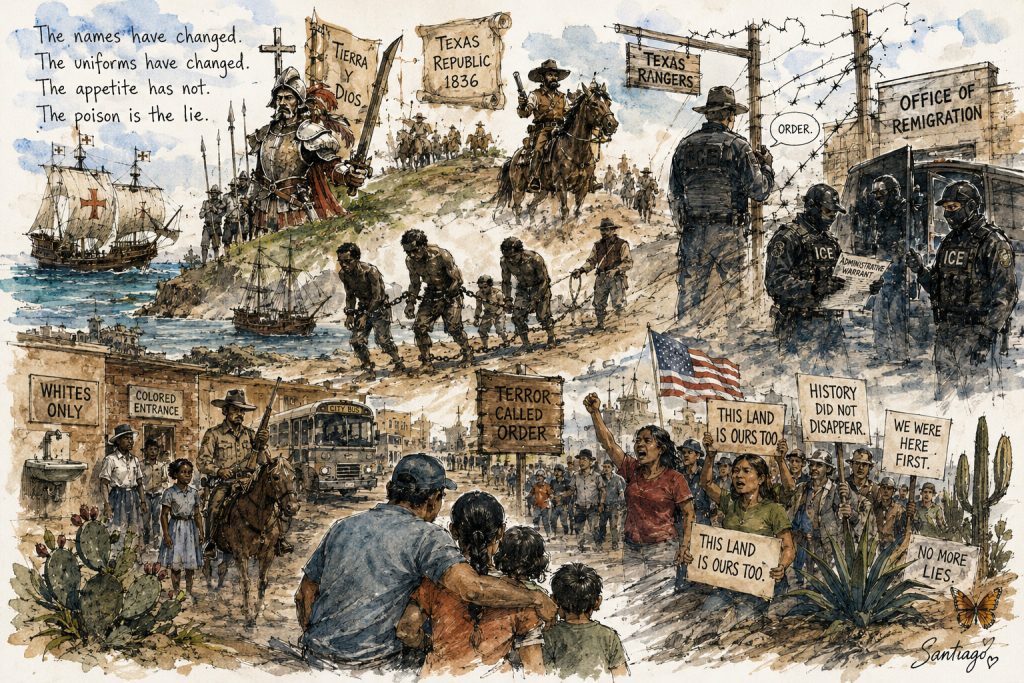
The names changed.
Robledo became Gómez. Gómez became García. García joined Barrera.
Spain became New Spain. New Spain became Mexico. Mexico lost its northern territory. The place where Pedro died eventually became part of New Mexico in the United States.
The family did not travel through all those countries.
Sometimes the countries changed around the family.
The mountains remembered
Four centuries later, one of Pedro Robledo’s descendants sat before a computer in Houston and found a name:
Pedro Robledo, 1538–1598.
Thirteen generations back.
Ancestry supplied the little box.
Birth.
Death.
Relationship.
It did not say that he once stood before Spanish officials and admitted he could not provide the life he wanted for his children.
It did not show Catalina packing their belongings.
It did not show the Atlantic.
It did not show an old gray-haired man riding north with his family.
It did not show a widow watching the desert close over her husband’s grave.
That story had to be recovered from other places.
From a petition in Seville.
From a military muster.
From the record of a march.
From a cross beside a river.
From mountains that still carry his name.
A genealogy website preserved Pedro’s dates.
But dates are not a life.
A life begins when someone asks what happened between them.
And if we do not write our history, they will not.
Pedro Robledo died on the road north.
Catalina kept walking.
The family kept living.
The map kept changing.
And more than four hundred years later, one of their descendants finally turned around and went back for him.