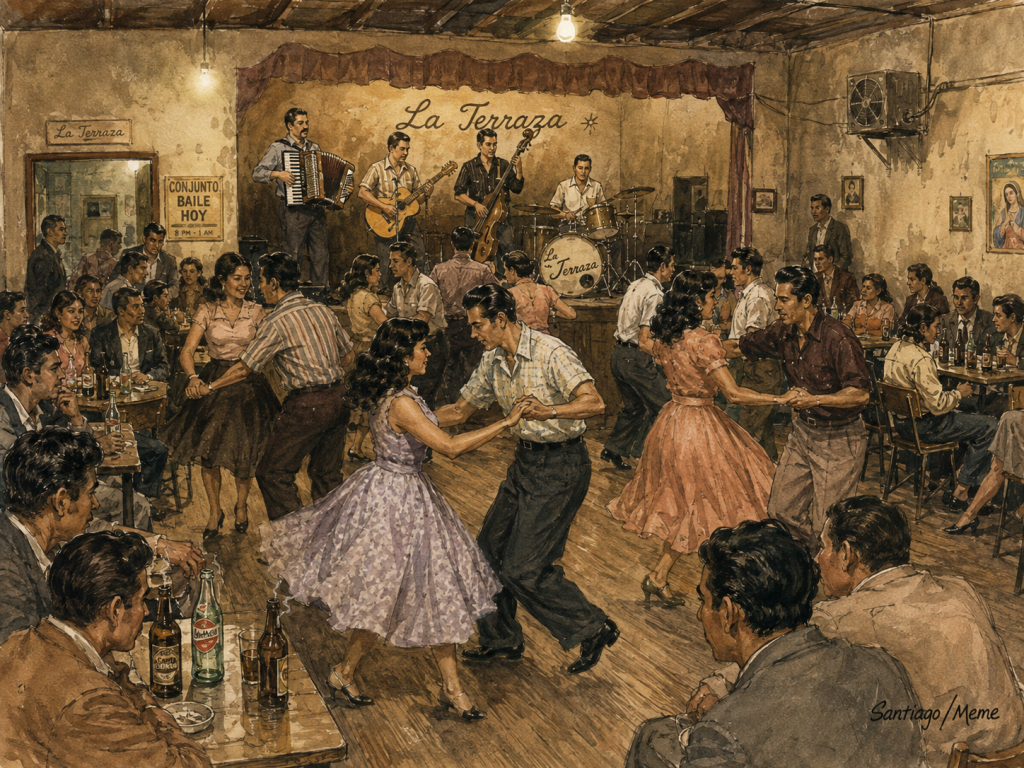
Corpus Christi had places where almost everyone felt welcome. Galvan Ballroom had its polished dance floor and orchestra tradition. Domingo Peña brought major shows to the Coliseum. The Carousel mixed Tejano with country and other music.
La Terraza was different.
It was closer to a cantina than a ballroom. It did not bring in the large orchestras that filled Galvan Ballroom. La Terraza belonged to the conjuntos: accordion, bajo sexto, bass, drums, and singers standing close enough for the dancers to see the sweat on their faces.
The studious crowd generally did not go there.
We chucos did.
But even we understood the rules. You did not want to walk into La Terraza alone if nobody there knew you. You went with friends from the neighborhood. Once you were inside and among people who knew you, there was music, beer, dancing, and the sound that I still call Tejano.
I heard Tony de la Rosa there. I heard Freddie Martínez there. I heard other conjuntos whose names I can no longer remember.
That does not mean they were unimportant. It means that sixty years later, the music remains in my head even when the names have slipped away.
For years, I could find almost nothing about La Terraza. It was as though the hall had disappeared not only from Leopard Street, but from Corpus Christi history.
Then an old advertisement surfaced.
It appeared in El Fronterizo Cancionero, a Spanish-language songbook connected to Falcon Records and distributed through the border music world. Near an advertisement for Casa Mexicana Music Store was this invitation:
“Cuando venga a Corpus visite La Terraza Hall.”
The address was 1114½ Leopard Street. The advertisement promised three things:
“Buena música, cerveza y sodas.”
That simple line described the place better than any official history could. Good music, beer, and sodas. No chandeliers. No claim that it was the finest ballroom in Texas. Just a direct invitation to people coming to Corpus who knew what kind of music they wanted to hear.
The half-number in the address matters.
A historical survey prepared for the Corpus Christi Harbor Bridge project found that the building identified as 1110 Leopard actually covered several storefronts, from 1108 through 1114. La Terraza occupied the second floor. The 1114½ address was apparently the entrance that led upstairs. City directories confirm that La Terraza Hall was operating there by 1961 and remained through at least 1965.
Family memory places the beginning earlier. According to an account recorded in the survey, Florencio González rented the upstairs space in 1956 and called it Terraza Hall. The directories do not confirm the hall until several years later, but oral history and official records often disagree about the exact moment a neighborhood business truly began.
The González family was already in the music business. Florencio and Gudelia Rendón González operated Casa Mexicana Music Store nearby at 1123 Leopard. The store sold records, accordions, guitars, and the latest music people were hearing on both sides of the border. The old advertisement for Casa Mexicana appeared directly above the invitation to La Terraza, suggesting that the store and the hall were parts of the same musical operation.
An obituary for their son, René Javier González, confirms the family sequence. His parents opened Casa Mexicana first, followed by La Terraza Hall upstairs. After Florencio’s death, the family later operated La Terraza Ballroom downstairs. René remembered helping the family and working the bar there on Saturday nights. (Dignity Memorial)
That later ballroom was at 1102 Leopard, in the neighboring building. The González family purchased that property in 1974 and remodeled it extensively. That is one reason the history became confused: people remembered La Terraza at two neighboring addresses, in two different forms—first upstairs, then downstairs.
But an address does not tell you what it felt like to enter the place.
An official survey can identify the masonry, the windows, and the storefronts. It cannot tell you which young man had friends inside, which stranger had walked into the wrong room, or which couple was dancing so closely that they forgot who else was watching.
It cannot reproduce the sound of Tony de la Rosa’s accordion in a hall small enough that the music did not need to travel far.
It cannot tell you why the college-bound and studious crowd stayed away while the chucos went.
La Terraza had a reputation. It could be dangerous, particularly for someone who arrived alone and was not known in the neighborhood. That should not be softened into a romantic story about an innocent little dance hall where everyone held hands beneath paper lanterns.
But danger was not the whole story either.
The hall gave working conjuntos a place to play. Some were already famous. Others were still trying to become known. Some may have recorded for Falcon, Ideal, Bego, or another South Texas label. Others may have played for years without ever making a record.
The written record even carries memories of Los Relámpagos del Norte at La Terraza. One Corpus Christi listener later recalled dancing there to Ramón Ayala and Cornelio Reyna. It is not a surviving newspaper advertisement, but it is the kind of eyewitness memory that often remains after the posters and booking records disappear. (Facebook)
That appearance would make sense. Before Los Relámpagos became famous throughout Mexico, Texas was central to their rise. Paulino Bernal recorded and promoted them through the South Texas music business. Corpus Christi was one of the largest Tejano markets in the region, and La Terraza was exactly the kind of conjunto hall where a group could stand only a few feet from the people who would later buy its records.
The music crossed the river more easily than historians now cross musical categories. A group could begin in Reynosa, record in McAllen, play Corpus Christi, and return to Mexico with a larger following. Norteño and Tejano were not sealed inside separate national containers. They belonged to the same border country.
La Terraza was one small room inside that country.
It will never be remembered like the Coliseum. It lacked the respectability and civic pride attached to the Galvan Ballroom. It was not built to impress tourists or appear in architectural magazines.
It existed for the people who went there.
That may be why it nearly vanished.
History tends to preserve the places respectable people were proud to mention. It preserves grand buildings, famous promoters, official photographs, and newspaper society pages. A rough conjunto hall filled with chucos, beer bottles, neighborhood loyalties, and music played too loudly for conversation was easier to forget.
But the musicians passed through.
Tony de la Rosa was there.
Freddie Martínez was there.
Los Relámpagos del Norte were remembered there.
And many conjuntos whose names may never be recovered were there too.
La Terraza did not disappear because nothing important happened inside it.
It disappeared because most of the people who knew what happened there were never asked.