______
Balde González: Frequently cited as a master of the jaiton orchestra style, Balde González brought a suave, nightclub-ready elegance to the Texas-Mexican music scene in the 1940s and 50s. [1]
Little Joe y La Familia: In the 1970s, legendary artist Little Joe Hernandez blended traditional ranchero folk music with these polished jaiton brass setups. This fusion launched the culturally massive La Onda Chicana (The Chicano Wave) movement, bridging the gap between working-class and upper-class Mexican-American audiences. [1, 2, 3]
____
Sometimes history does not disappear because it was unimportant. It disappears because it does not fit the story people later decide to tell.
That may be what happened to Balde González.
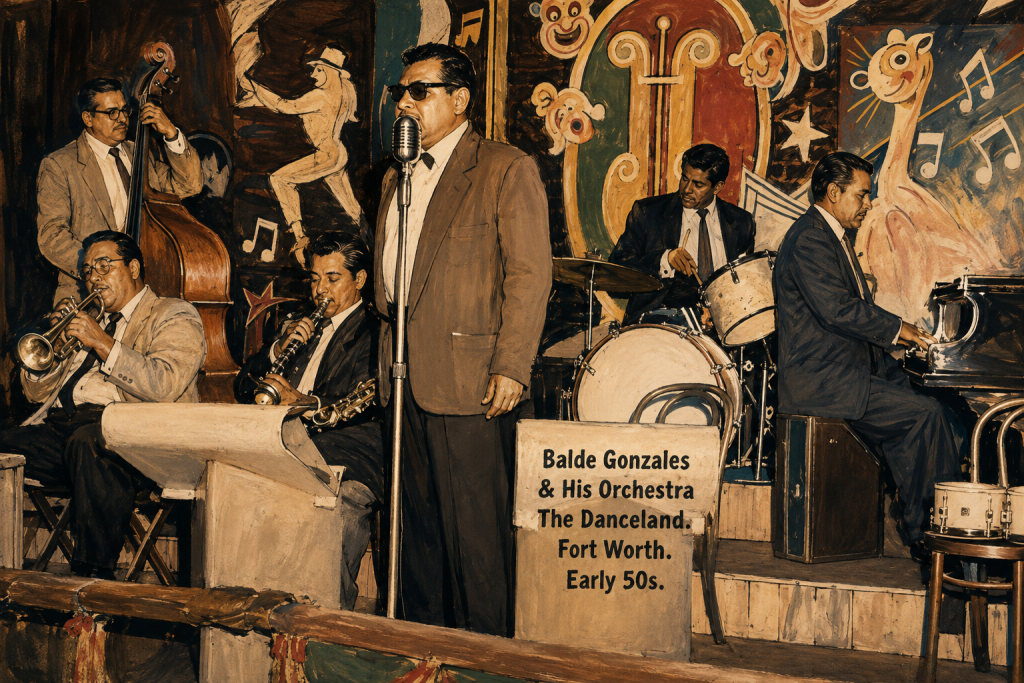
In the photograph, he stands at the microphone in dark glasses, calm and self-possessed, fronting a full orchestra. The sign identifies him plainly: “Balde Gonzales & His Orchestra, The Danceland, Fort Worth. Early 50s.” Behind him are the musicians, the drums, the piano, the upright bass, and the kind of stage that once held together a whole world of Mexican-American nightlife. It is not a garage band, not a little family conjunto crowded into a corner, but a polished dance orchestra. Looking at the picture, one immediately understands that Balde González was not a local novelty. He was a serious bandleader.
He was also blind.
Born in Beeville, Balde González became a singer, pianist, violinist, composer, and orchestra leader at a time when opportunities for Mexican-American musicians were narrow, and memory itself was even narrower. In 1949 he signed with Melco, a small record company in Corpus Christi, and began recording songs in Spanish and English. That fact alone should make him more important than he is usually treated. Before later labels and before the larger commercial machinery that would help define Tejano music for a broader audience, a small Corpus Christi company was recording a South Texas artist whose sound was elegant, urban, and deeply musical.
Balde González did not belong neatly to the categories that later dominated Tejano history. When people think of old Tejano music, they often jump quickly to conjunto accordion or to the harder-driving ranchero orchestra sounds that became more familiar in dance halls across South Texas. Balde seems to have occupied another lane. Musicians described his style as jaitón, the “high-class” sound. It was music dressed up for the evening: horns, piano, polished arrangements, boleros, fox-trots, and a softer, more cosmopolitan feel. He did not sound like a man trying to kick open the barn door. He sounded like a bandleader inviting you into a ballroom.
That difference may be one reason he slipped out of popular memory. Histories often prefer what can be easily labeled. Balde González was neither the rough country image nor the better-known later Tejano commercial image. He stood somewhere between worlds. He was South Texas, but sophisticated. He was local, but polished. He was part of Mexican-American music history, yet not easily squeezed into the short list of names people repeat.
And so a musician who once led a full orchestra and made commercial recordings became, for many people, nearly invisible.
But records remain. Collectors preserved the old discs. Archives preserved the names. A song like “Oye Corazón” lets us hear what the photograph already suggests: this was not a marginal figure. This was an artist with presence, with discipline, and with a sound that tells us something important about our past. South Texas music was never only one thing. It was not only cantinas, not only accordion, not only one dance-hall formula repeated across the decades. It also included men like Balde González, who stood at the microphone in a suit, led an orchestra, and gave Mexican-American audiences music with style.
The hidden treasure here is not only Balde himself. It is the reminder that places like Beeville, Corpus Christi, and Fort Worth were connected by a musical circuit richer than many of us were taught. There were musicians working outside the narrow spotlight of later fame, building careers, filling dance halls, and leaving behind evidence of a larger cultural world.
That is why photographs like this matter. They do more than show us who was there. They correct the record. They say: look again. The history was bigger than the names you memorized.
Balde González may not be entirely lost anymore. A blind bandleader from Beeville, recorded by a Corpus Christi label, leading a refined South Texas orchestra in the early 1950s, deserves to be heard again. Sometimes the old hidden treasure is not hidden because it was small. Sometimes it was hidden because we stopped digging.
.
.