https://indd.adobe.com/embed/f9a1dc48-4730-412d-a50d-eb89854dcfa2?startpage=1&allowFullscreen=true
About This Article
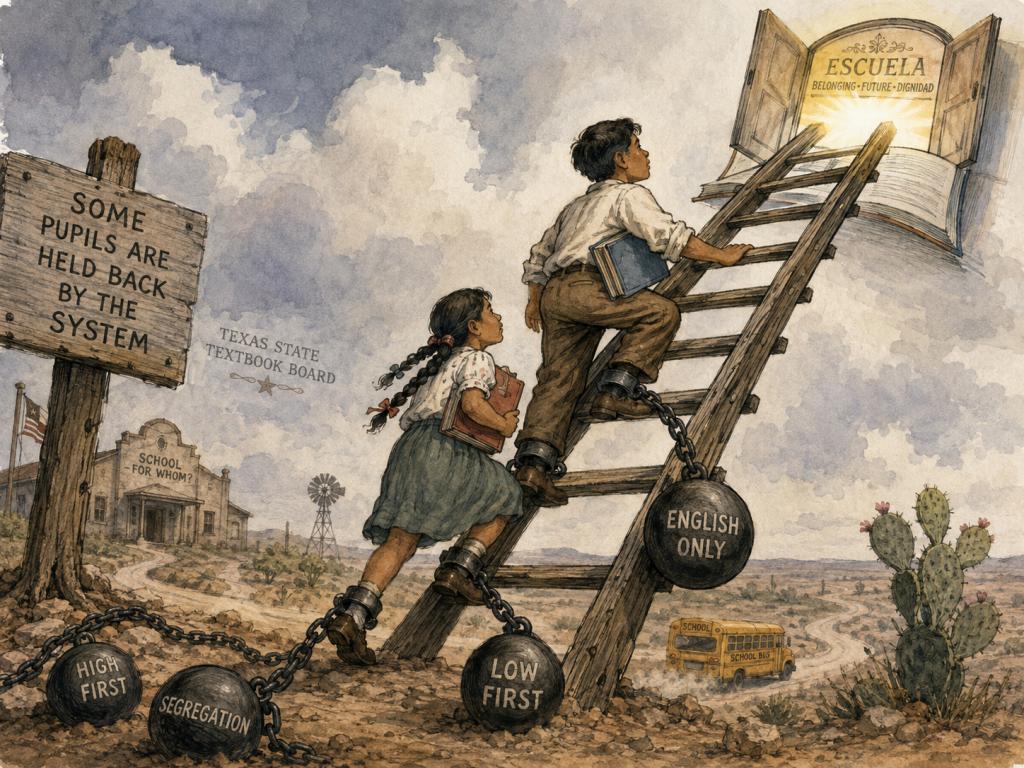
This five-part history examines how Texas schools delayed, separated, tested, transported, and sometimes quietly pushed Mexican-origin children out of public education. It begins with one puzzling phrase—“I reached the third grade”—and follows the trail into lower and upper grades, vanished students, English-language intelligence tests, segregated school maps, and a state confession that Texas later fought to withdraw.
The stories are not intended as a complete scholarly history. They are an opening into records, court cases, government reports, oral histories, and forgotten experiences that readers can explore through the source links.
A Note About the Language
The historical records often call the children “Mexicans” and contrast them with “Americans,” even when those Mexican children were born in Texas and were citizens of the United States.
That language is retained where it reflects the terminology of the time because the words are part of the evidence. The school system did not merely separate children by ancestry. It often treated Mexican and American as opposite identities.
Later we became Mexican-American, Hispanic, and Latino—names that recognized us while still placing another word before American. The language changed, but the underlying question remained:
When were we ever allowed to be simply American?
Chapter One
How Many Years Did It Take a Mexican Child to Reach Third Grade?
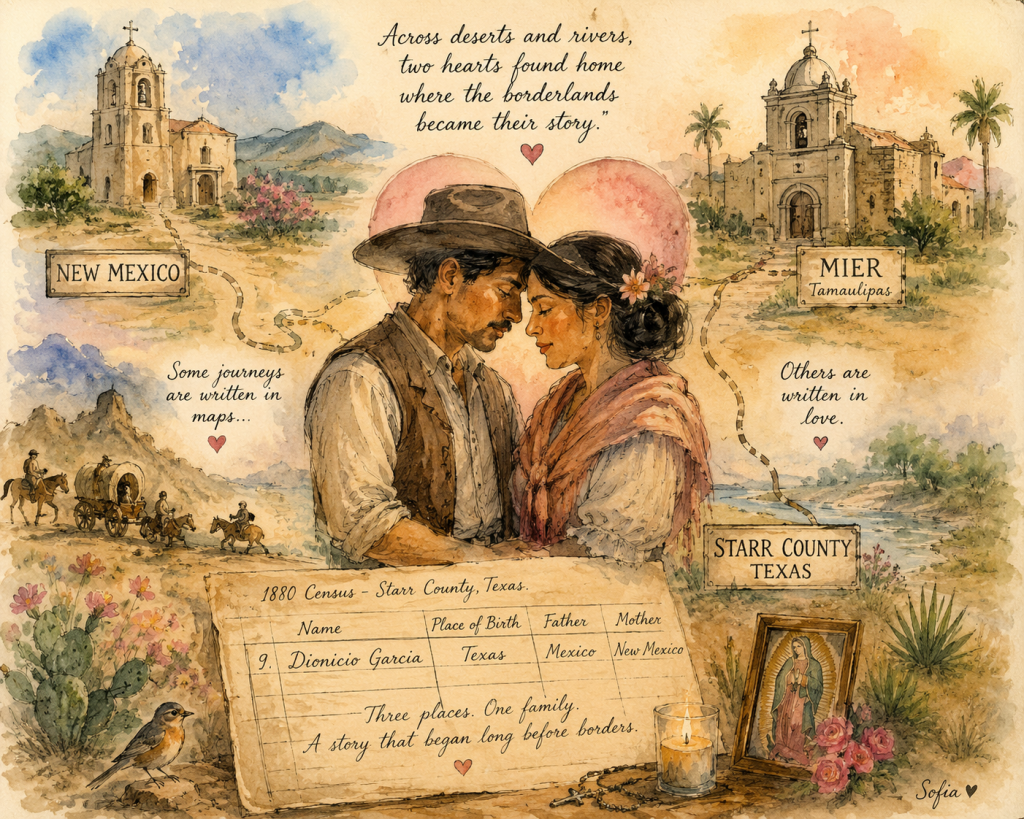
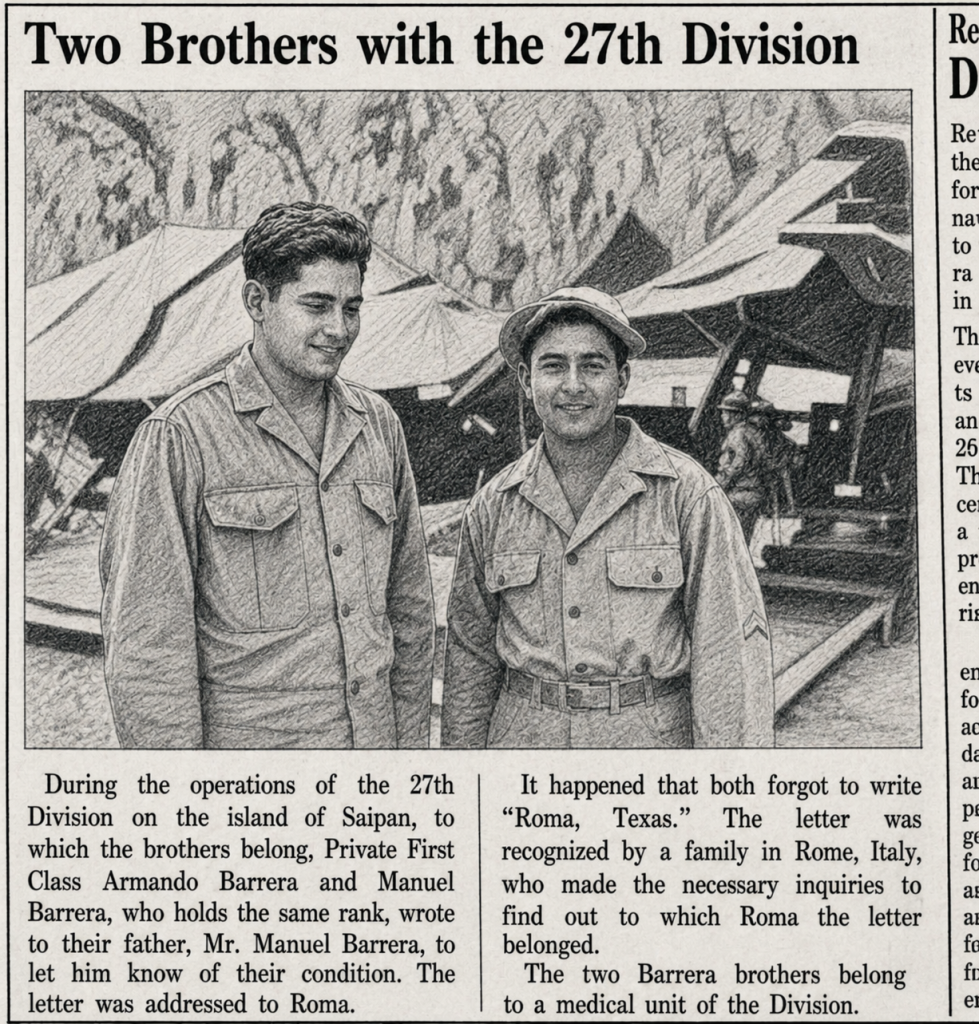
While writing the history of his parents, Meme listened to a recording his younger brother Joel had made of their father in the late 1980s.
Manuel López Barrera was describing the little formal education he received as a boy in South Texas. At one point, he said:
“Llegué al grado tres.”
I reached the third grade.
For years, Meme understood those words in the ordinary way. His father had attended school for three years and stopped after third grade.
This time he paid closer attention to the explanation that followed. His father said each grade had been divided into two levels, and each level had taken a school year.
Low first. High first.
Low second. High second.
Low third. High third.
For the first time, Meme understood that his father had not gone to school for only three years. He had spent six years reaching the third grade.
That realization opened a door much larger than one family’s history.
The grades between the grades
The terms low first and high first were not peculiar to Starr County, and they were not created only for Mexican children.
Houston assigned teachers to low first, high first, low second and high second classes as early as 1918. A Fort Stockton newspaper published separate honor rolls for low first and high first in 1920. The same language appeared in school records across Texas. (The Portal to Texas History)
The labels alone therefore do not prove discrimination. In many schools, low first and high first may have been two parts of one ordinary school year.
But the labels concealed something important.
They did not reveal how long a child remained at each level.
One child might advance from low first to high first after a semester. Another might spend an entire year in each. A third might be placed in an additional beginners’ class before being allowed to enter low first.
Years later, all three records might say that the children completed the same grade.
The record preserved the grade number.
It did not preserve the time.
Starting at zero
The artist Santa Barraza remembered beginning school in Kingsville in a class called zero.
She described attending zero before moving through low first and high first. Although school officials used language ability to justify such placements, Barraza remembered already speaking English as well as Spanish. She later attended summer school to catch up. (Asian Art Museum)
Zero was not technically first grade.
That was precisely the problem.
A child could already be attending school while the official climb through the numbered grades had not begun.
The school did not have to announce that it was delaying Mexican children. It merely created another level.
When first grade took years
In Driscoll, south of Corpus Christi, the system became impossible to ignore.
The district placed Mexican-American children into a beginners’ class during one school year, followed by low first, high first, and a segregated second grade. The placements were not based on individual testing of every child. (Texas State Historical Association)
A child could spend several years moving through what most people would understand as the beginning of elementary school.
The names sounded educational:
Beginners.
Low first.
High first.
But they could function as a barrier.
A sign saying MEXICAN CHILDREN MUST SPEND EXTRA YEARS IN FIRST GRADE would have exposed the practice immediately.
The district did not need such a sign.
It needed only respectable-sounding classifications.
The government already knew
A federal study published in 1933 warned that segregation had sometimes been used to give Mexican children shorter school years, inferior buildings and equipment, and poorly paid teachers. (ERIC)
That combination could produce a strange result.
A Mexican child might spend more calendar years enrolled in school while receiving fewer hours of instruction, fewer school days, and fewer educational resources.
Then the child could be blamed for failing to advance.
By the time he reached third or fourth grade, he might already be much older than the children sitting around him. Work waited in the fields, on ranches, along railroads and wherever a family could earn money.
Leaving school could then appear to be a decision made by the child or his parents.
The years the school had taken from him disappeared from the explanation.
The truth hidden inside the answer
A census taker, military clerk, or employer asking Manuel López Barrera for the highest grade he completed would have written:
Third grade.
That answer might have been accurate.
It was not complete.
It erased the lower and upper levels. It made six years of attendance look like three. It could make a family appear indifferent to education while hiding how slowly the school allowed the child to move.
That is why an old family recording matters.
It does not provide the final history of Mexican education in Texas. It provides the first clue.
“Llegué al grado tres.”
For decades, the family heard third grade.
Hidden inside those words were six years.
Texas counted the grade.
Nobody counted the time.
Chapter Two
The Lost Legion
In the fall of 1923, 1,275 Mexican children entered low first grade in El Paso’s public schools.
They carried books into classrooms and began the long movement through low first, high first, and the grades that followed.
Seven years later, only 174 Mexican pupils entered an El Paso high school.
A contemporary account gave those disappearing children a name:
The Lost Legion
The phrase came from an article written by W. A. Stigler for the El Paso Schools Standard. A 1933 United States Office of Education report preserved Stigler’s numbers.
The children had not vanished all at once.
They disappeared one grade division at a time.
What the numbers showed
The report compared the 1,275 Mexican children entering low first in 1923 with the 174 Mexican students entering high school seven years later.
The comparison was not a perfect tracking of every individual child. El Paso was growing, and families moved in and out. The researchers adjusted for population growth and estimated that about 10 percent of Mexican children entering first grade reached high school.
Reaching high school did not mean graduating.
The report estimated that only 16 percent of the Mexican students who entered high school remained long enough to receive diplomas. It concluded that fewer than 2 percent of the Mexican children entering El Paso public schools remained through high-school graduation.
In the spring of 1931, El Paso awarded diplomas to 182 students classified in the report as American and only 29 classified as Mexican.
A legion had entered.
A small platoon remained.
Where they disappeared
The losses did not occur only at the door to high school.
The report found a drop of approximately 15 percent in Mexican enrollment between fourth and fifth grade and another drop between fifth and sixth.
More than 20 percent of the Mexican pupils finishing low sixth did not enter high sixth.
Low sixth and high sixth sounded almost like neighboring rooms.
Yet one child in five disappeared while trying to cross between them.
The school record did not necessarily explain why.
The family may have needed another wage. The child may have left for farm labor. The school term may have conflicted with seasonal work. Repeated grades may have made the child older than his classmates. Years of being treated as inferior may have taught him what the school expected.
The ledger simply stopped recording him.
San Antonio was losing children too
The same federal report found that Mexican pupils made up more than half of San Antonio’s enrollment in the first through fifth grades.
It said approximately half left school after completing fifth grade.
The pattern was becoming visible across Texas.
Mexican children entered elementary schools in large numbers. Their rows became thinner as the grades advanced. By graduation, only a handful remained.
Officials often blamed poverty, Spanish, Mexican culture or parents who supposedly did not value education.
They seldom asked what the schools had done to the children before they left.
How to lose a child without expelling him
A school did not have to issue an expulsion order.
It could place the school farther away.
It could operate a shorter school year.
It could give the child an inexperienced or poorly paid teacher.
It could begin him in zero or beginners’ class because of his surname.
It could make him repeat a level.
It could teach him in English, test him in English, and use his difficulty with English as proof that he belonged in a lower class.
Eventually, the child might become too old for the grade and leave on his own.
The school could then say it had never forced him out.
The legion was not lost
Calling the children lost made the disappearance sound mysterious.
Texas knew where many of them went.
They went into fields, kitchens, laundries, construction crews, railroad gangs and ranch work. Girls disappeared into unpaid or poorly paid household labor that official records often ignored.
Others remained in their communities carrying the label of a third-, fourth- or fifth-grade education, even though they had spent far more years passing through the school system.
They had not failed to appear.
They had appeared every September until the passage became too narrow.
In 1923, 1,275 Mexican children entered low first in El Paso.
The remarkable fact is not merely that so few graduated.
The remarkable fact is that the school system watched them disappear, counted them carefully and called them lost.
Chapter Three
The Test That Measured English and Called It Intelligence
A Spanish-speaking child sat at a desk while an adult placed an intelligence test in front of him.
The questions were written in English.
The instructions were given in English.
The expected answers depended upon words and experiences familiar to English-speaking children.
When the Mexican child struggled, the score appeared to deliver a scientific conclusion:
The child was less intelligent.
The test did not say it had measured his English.
It said it had measured his mind.
When prejudice learned arithmetic
By the 1920s and 1930s, intelligence and achievement tests carried enormous authority in American education.
A number printed on a form could determine which classroom a child entered, what lessons he received, and whether teachers considered him capable of academic work.
Mexican children frequently scored below English-speaking children on tests given in English.
School officials could then say that separation was not based on ancestry.
It was based on ability.
The prejudice had changed clothes.
It now carried a test booklet.
George I. Sánchez tested the test
George I. Sánchez was a Mexican-American educator who began questioning whether the numbers measured what school officials claimed.
Between 1928 and 1930, Sánchez repeatedly tested 45 Spanish-speaking children in grades three through eight in Bernalillo County, New Mexico. He used achievement and intelligence tests and compared how their scores changed over time.
If the original scores measured fixed intelligence, the results should have remained relatively stable.
They did not.
The children’s scores improved as they spent more time in school and became more familiar with English and the tests.
Their minds had not suddenly changed.
Their ability to understand what the test wanted had changed.
Sánchez’s work became one of the earliest serious challenges to using standardized tests developed for English-speaking children to judge Spanish-speaking pupils. (Texas State Historical Association)
Some educators admitted the tests were unreliable
The 1933 federal study reported that some school administrators had lost confidence in standardized test results for Spanish-speaking children.
One investigator refused to administer ordinary standardized tests to foreign-language pupils because the tests had been prepared and standardized for children from different backgrounds.
That admission should have stopped the practice.
It did not.
School districts continued using language, ability, and intelligence as reasons to place Mexican children in lower classes.
Uncertain science produced very certain consequences.
The test created its own proof
Place a child in a classroom where he understands little of what is said.
Because he does not understand, he learns more slowly.
Because he learns more slowly, he performs poorly on an English-language test.
Because he performs poorly, the school assigns him to another low class.
Because he remains in the low class, he receives less advanced instruction.
The following year, the school tests him again and discovers that he is still behind.
The system has now created the evidence it needs.
It can point to the child’s record and say:
See? We were right about him.
Language became ancestry
The Driscoll school district claimed that separate early-grade classes were necessary because Mexican children needed help learning English.
But the district’s system placed children into beginners, low first, high first and segregated second-grade classes without properly testing every child as an individual. (Texas State Historical Association)
The supposed language program had become a way of treating a Spanish surname as evidence of a language problem.
The test was not always measuring what the child knew.
Sometimes the school was reading the name before the child opened his mouth.
What the number could not see
The test did not measure the child’s ability to move between two languages.
It did not measure what he knew about crops, animals, weather, machinery, family work or survival.
It did not measure the effort required to listen in one language, think in another and answer in the first.
It did not measure what the child might learn once someone taught him in a language he understood.
Most of all, it did not measure what the school had failed to provide.
Sánchez repeated the tests and watched the scores rise.
The experiment should have changed the question.
Instead of asking why Mexican children were less intelligent, educators should have asked why they trusted a test that confused English with intelligence.
The child had not failed the test.
The test had failed to see the child.
Chapter Four
The School Nearby Was Not for You
One memory opened another door.
A child growing up in Molina had to board a bus and travel several miles to school. The location was more convenient for the children of landowners than for many of the Mexican-American and Black children the district was supposed to educate.
That memory does not prove what happened across Texas.
It tells us where to look.
Not only at the names of schools, but at land purchases, attendance maps, transfer rules and bus routes.
That is where much of the segregation was hidden.
The Mexican school changed its name
In 1914, the Midland school board decided to provide Mexican children with a separate school and teacher.
The school later became known as the Latin-American School and then De Zavala Elementary. Until the mid-1940s, it ended at eighth grade. Mexican-American children could not continue into the district’s junior high schools, and no student of Mexican ancestry graduated from a Midland senior high school until 1952. (Justia Law)
Mexican-American pupils were bused into De Zavala.
Anglo children who lived near the school attended elsewhere. (Justia Law)
When Midland finally drew an attendance zone around De Zavala in 1956, the boundary closely circled El Barrio, the Mexican-American neighborhood.
A transfer policy then allowed pupils to attend schools where their racial group predominated. Anglo children living inside the De Zavala zone used the policy to transfer to more distant schools. (Justia Law)
By the 1974–75 school year, De Zavala enrolled 344 children.
Only five were Anglo. (Justia Law)
The district could point to the map and call De Zavala a neighborhood school.
But the neighborhood had been assigned a race before the boundary was drawn.
Uvalde used two different rules
Uvalde constructed Robb Elementary in a Mexican-American neighborhood and later used neighborhood attendance zones that concentrated Mexican-American children in Robb and Anthon elementary schools.
At the same time, approximately 300 students living in rural parts of the district continued to receive freedom of choice over their school assignments. (Justia Law)
The neighborhood rule applied firmly to Mexican-American city neighborhoods.
It became flexible for children living in the countryside.
The Fifth Circuit concluded that the neighborhood system had frozen Mexican-American pupils into Robb and Anthon and treated the different rule for rural children as powerful evidence of discriminatory intent. (Justia Law)
“Neighborhood school” sounded like a principle.
In practice, the district could turn the principle on and off.
Corpus Christi forced the court to study the map
The Corpus Christi case showed how a district could create segregation without a law openly ordering Mexican children into separate schools.
The federal court examined school locations, attendance boundaries, teacher assignments, transfers, and transportation. It found Mexican-American and Black pupils heavily concentrated in particular schools and found the faculty and administrative staff even more segregated than the students. (Justia Law)
One Corpus Christi option zone allowed pupils from a predominantly Anglo area to choose between a heavily Mexican-American junior high and a school with a much smaller minority enrollment.
The district did not give the same choice to nearby areas with large Mexican-American populations. (Justia Law)
Choice was available.
It was not equally available.
A school map is never only a map
A district decides where to buy land.
It decides where to construct a building.
It draws the line where one attendance zone ends and another begins.
It decides which children receive transfers.
It determines which roads buses travel and which schools they pass.
Each decision can appear ordinary when examined alone.
Together, they can reveal a system.
A Mexican-American child may be bused past a closer campus.
An Anglo child may live beside the old Mexican school and attend somewhere else.
A transfer rule may sound neutral until the records show who was allowed to use it.
Officials can then point to the final enrollment and say the schools merely reflect where people live.
But the school district helped create the pattern it later described as natural.
What the bus taught
Official records preserve board votes, construction contracts, enrollment totals and court orders.
They rarely preserve an ordinary school morning.
A child woke early.
He walked to a bus stop.
He climbed aboard and traveled miles to a school selected by people he had never met.
During the ride, he may have passed another campus.
Perhaps it was closer.
Perhaps it had smaller classes or newer equipment.
The child might not yet have understood why that school was not for him.
Years later, the district’s paperwork would say only that he had been transported.
The record preserved the bus route.
It did not preserve what the route taught him.
The lesson was simple:
The nearest school was a neighborhood school.
It was simply not your neighborhood.
Chapter Five
The Confession Texas Tried to Take Back
In 1980, a federal judge issued an opinion describing what appeared to be a remarkable confession by the State of Texas.
The opinion listed statements presented to the court as stipulations—facts the parties had agreed would not need to be proved at trial.
Among them were assertions that segregation of Mexican-American students was a historical fact in Texas public schools, that Mexican children had been assigned to Mexican schools regardless of how close they lived to other schools, and that they had often received inferior and overcrowded facilities. (Justia Law)
One stipulation went further.
It said state education authorities had cooperated with local districts attempting to avoid the burden imposed by Delgado v. Bastrop, the 1948 decision declaring arbitrary segregation of Mexican-American children unconstitutional.
The district judge called the stipulations admissions and concluded that state officials had knowingly supported segregated systems through funding and accreditation. (Justia Law)
It seemed that Texas had finally said the quiet part out loud.
Then Texas tried to take it back.
What the state said had happened
The Texas Education Agency later explained that it had reviewed hundreds of proposed statements before trial.
According to TEA officials, the agency had agreed to 198, rejected 250, and agreed to 27 only with qualifications or exceptions. (Justia Law)
The agency said its attorney had later withdrawn objections to many additional statements without permission from the officials she represented.
The attorney maintained that she had intended only to acknowledge that particular reports and documents contained those statements—not to admit that every statement was true.
That was a major difference.
There is a difference between saying:
“This historical report says Texas helped districts evade desegregation.”
and saying:
“Texas admits that it helped districts evade desegregation.”
The district judge had treated the statements as the second.
Texas argued that it had agreed only to the first.
Texas had used the statements when they were useful
The dispute became even stranger because the state had helped use the same stipulations in litigation against the Gregory-Portland school district.
State lawyers joined federal lawyers in presenting the statements as evidence while attempting to prove that the local district had discriminated.
After the district court relied upon the stipulations against both Gregory-Portland and the state, Texas realized that the evidence it had helped direct at the school district could also wound the Texas Education Agency.
The Fifth Circuit later described the state’s position as trying to use the stipulations one way in Gregory-Portland and another way when they were turned against Texas. (Justia Law)
The state had helped put the dirt on the courtroom table.
Then it objected when the judge said the dirt belonged to Texas.
The appeals court rejected the confession
In 1982, the Fifth Circuit reversed the district court’s judgment.
The appellate court concluded that the critical stipulations had been entered without proper authority, that several were vague or argumentative, and that the district judge should have allowed Texas to withdraw them. (Justia Law)
Legally, the broad statewide confession did not survive.
That means it would be wrong to say simply:
Texas formally admitted all of this, and the admission became final.
It did not.
The state challenged the supposed admissions, and the appeals court agreed that they could not support the judgment as entered.
But that is not the end of the history.
The evidence did not depend upon one confession
The court fight over the stipulations did not erase what other records showed.
The Fifth Circuit separately found intentional discrimination against Mexican-American children in Midland, where Mexican pupils were bused to De Zavala while Anglo children living nearby attended elsewhere. (Justia Law)
It found discriminatory intent in Uvalde, where neighborhood zones froze Mexican-American children into particular schools while rural pupils retained freedom of choice. (Justia Law)
A federal court in Corpus Christi found a segregated system maintained through school assignments, staffing, boundaries and unequal transfer options. (Justia Law)
The 1933 federal education report had already documented shorter school years, inferior facilities, children delayed in grade and enormous losses before graduation. (ERIC)
Texas did not have to confess for those records to exist.
What was swept under the rug
The most revealing part of the case may not be whether one lawyer possessed authority to bind the entire State of Texas.
It may be what happened after the statements entered the record.
Texas used them when they helped make a case against a local school district.
Texas disputed them when they helped make a case against the state.
The appeals court ultimately ruled that the stipulations could not carry the legal weight the district judge had placed upon them.
That decision matters and must be included.
But the arguments over procedure also helped push the underlying history back into darkness. A reader encountering only the reversal might conclude that the segregation itself had been disproved.
It had not.
The appeals court rejected the way the supposed confession was obtained and used. It did not make the buses disappear. It did not move De Zavala out of El Barrio. It did not return the years children spent in beginners, low first, and high first. It did not place the 1,275 El Paso children back into the school records after they vanished.
The better history is not:
Texas confessed.
It is:
Texas placed a confession in the record, used it when convenient, denied that it had confessed, and won the legal right to take the confession back.
But by then, enough dirt had been uncovered to show where we should keep digging.
The confession disappeared.
The history remained.