For years, I wondered what those medals meant and why my dad received them. Those seven bars- I had no idea why they were there. I finally took the time to find out. I used ChatGPT for research; that is one thing that AI does very well: it has almost the entire written history in its database.
Manuel Barrera’s World War II Medals
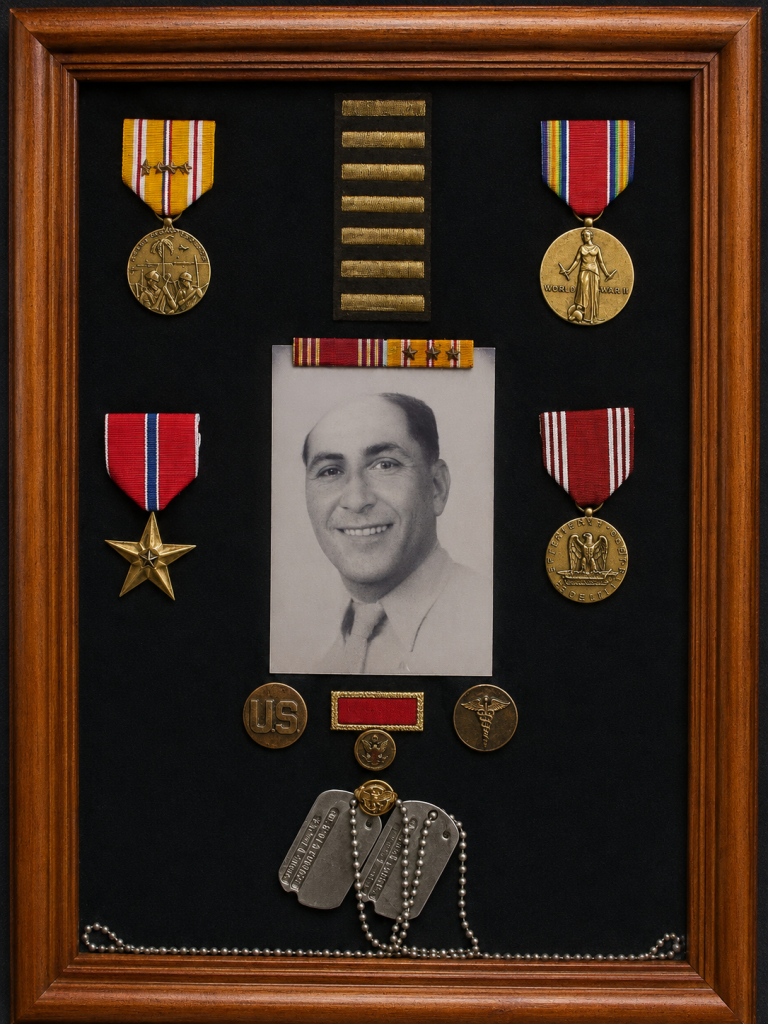
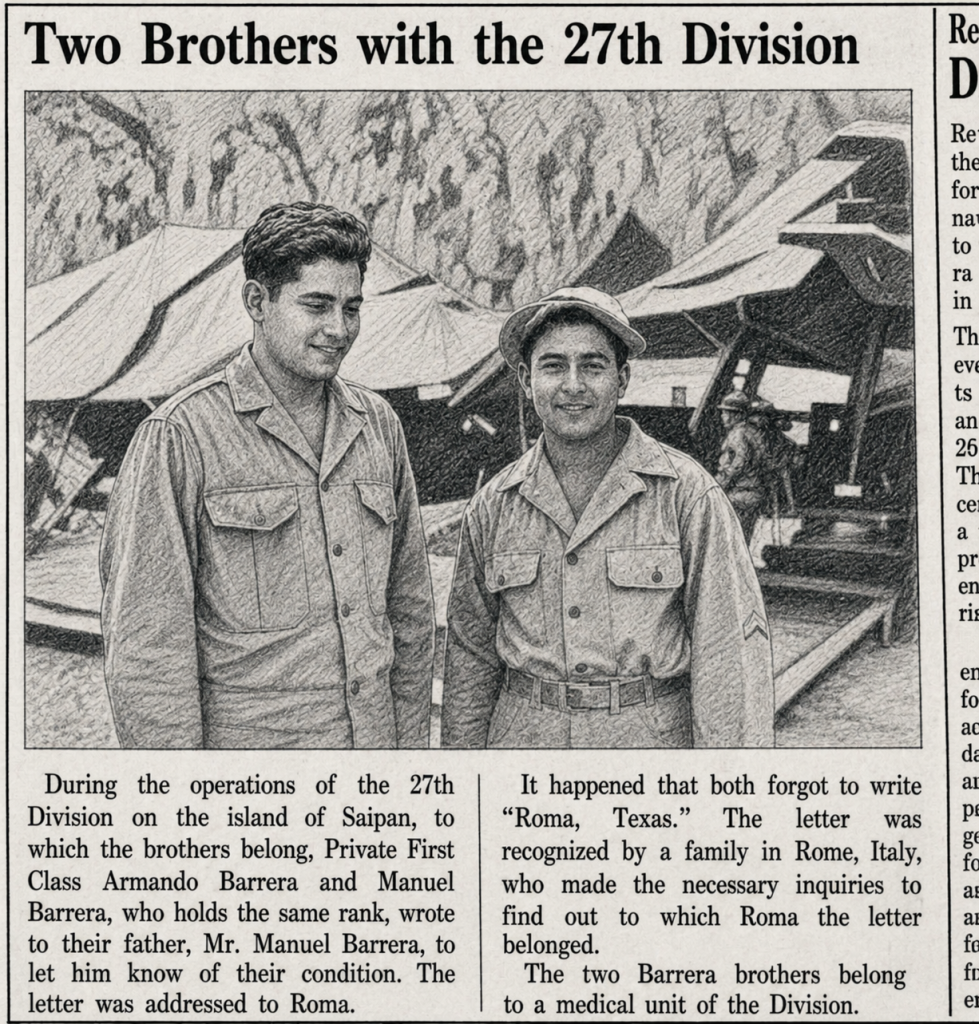
The medals and insignia preserved with Manuel Barrera’s photograph tell the story of his Army service without requiring us to guess about exactly where each decoration was earned. His separation record identifies him as a Private First Class, Company C, 102nd Medical Battalion, 27th Infantry Division, with the military specialty MOS 657 — Litter Bearer.
Asiatic-Pacific Campaign Medal
The Asiatic-Pacific Campaign Medal recognized Barrera’s service in the Pacific theater. His separation record specifies that it was awarded with a Bronze Arrowhead and three Bronze Service Stars.
The three Bronze Service Stars represent participation in three officially recognized campaigns:
- Eastern Mandates
- Western Pacific
- Ryukyus
The stars represent campaigns, not individual acts of bravery.
The Bronze Arrowhead has a different meaning. It signifies participation with an organized force in a qualifying amphibious assault landing. It establishes that Barrera participated in such an assault during his Pacific service. The medal itself does not identify which particular landing earned the arrowhead, so that should remain unanswered unless an Army record is found that establishes it.
Bronze Star Medal
Barrera was awarded the Bronze Star Medal, one of the most significant decorations in the display.
During World War II, the Bronze Star could recognize heroic or meritorious achievement or service in connection with military operations. Barrera’s separation record confirms that he received the medal, but the medal itself does not tell us the circumstances of the award.
Unless his original citation or general orders are located, it should not be described specifically as an award for valor.
Army Good Conduct Medal
The Army Good Conduct Medal recognized honorable and faithful service by an enlisted soldier.
It was not a combat decoration. It recognized the manner in which a soldier performed his military service, and Barrera’s separation record confirms that he received it.
World War II Victory Medal
The World War II Victory Medal was awarded for qualifying military service during the Second World War.
It represents Barrera’s service as part of the American military force that fought the war through to victory.
Seven Overseas Service Bars
Across the top of the display are seven Overseas Service Bars.
Each bar represented six months of overseas service.
Seven bars therefore represent approximately 42 months — three and a half years overseas.
That is remarkably close to Barrera’s separation record, which shows approximately 3 years, 6 months and 13 days of foreign service.
Unlike the campaign stars, the bars do not represent battles. They represent time.
Seven small bars tell us that Manuel Barrera spent roughly three and a half years away from the United States during World War II.
Meritorious Unit Commendation
The red ribbon surrounded by a gold frame is the insignia associated with the Meritorious Unit Commendation.
This was a unit award, rather than an individual decoration. It recognized exceptionally meritorious performance by an organization as a whole.
Its presence in Barrera’s display therefore represents an honor earned collectively by the military organization in which he served.
Medical Department Collar Insignia
One of the round collar disks bears the Medical Department caduceus.
This identifies Barrera’s branch of service and is consistent with his documented assignment to the 102nd Medical Battalion and his work as a litter bearer.
A litter bearer’s job was to reach wounded soldiers, place them on litters and carry them back to medical care.
The companion disk marked “U.S.” is the enlisted United States Army collar insignia.
Honorable Service Lapel Button
The small round insignia beneath the unit ribbon appears to be the Honorable Service Lapel Button, popularly known among World War II veterans as the “Ruptured Duck.”
It was associated with honorable discharge from military service. The higher-resolution photograph makes its distinctive eagle design visible.
Dog Tags
At the bottom of the case are Barrera’s military identification tags.
They are not awards and carry no campaign significance. Their purpose was much simpler and more personal: they identified the soldier.
Taken together, the display tells us a great deal.
Manuel Barrera served as an Army medical soldier for roughly three and a half years overseas. He participated in three recognized Pacific campaigns. He participated in at least one qualifying amphibious assault. He received the Bronze Star Medal and the Good Conduct Medal, belonged to a unit recognized for meritorious service, remained in uniform through victory in World War II, and returned home with an honorable discharge.
The medals tell us that much.
Where they do not tell us something—such as the particular assault represented by the Bronze Arrowhead—the history should leave the question open.
Sometimes knowing what the evidence doesn’t say is part of reading the medals correctly.