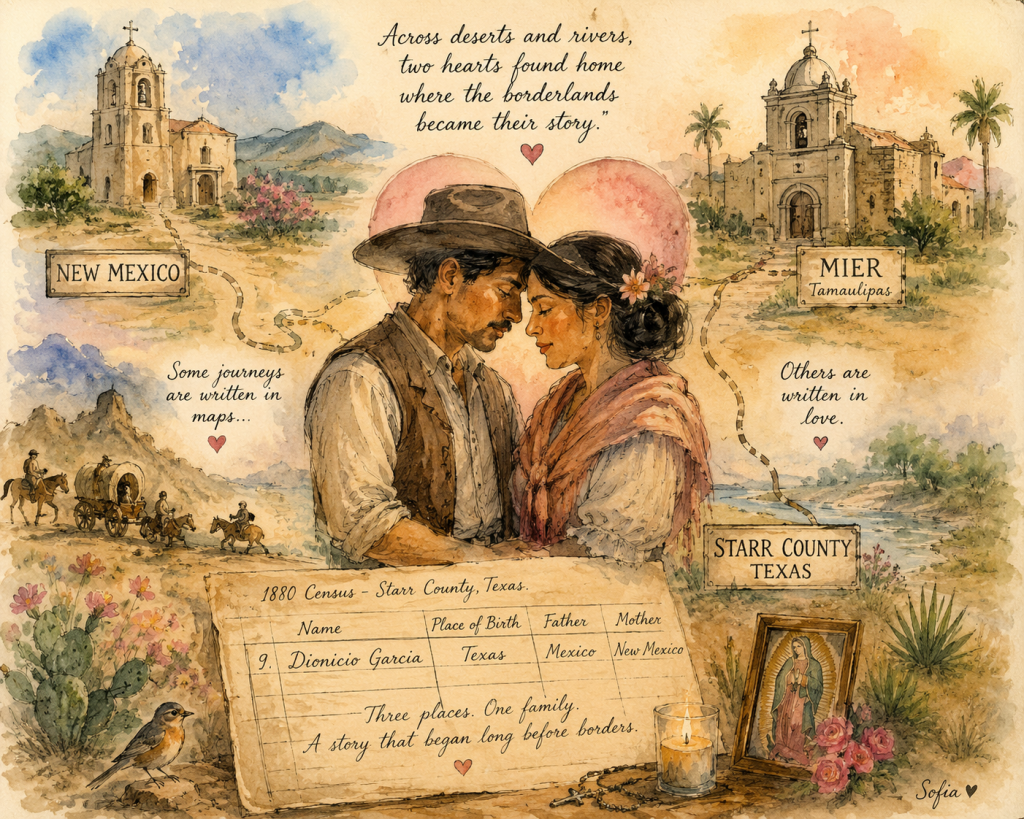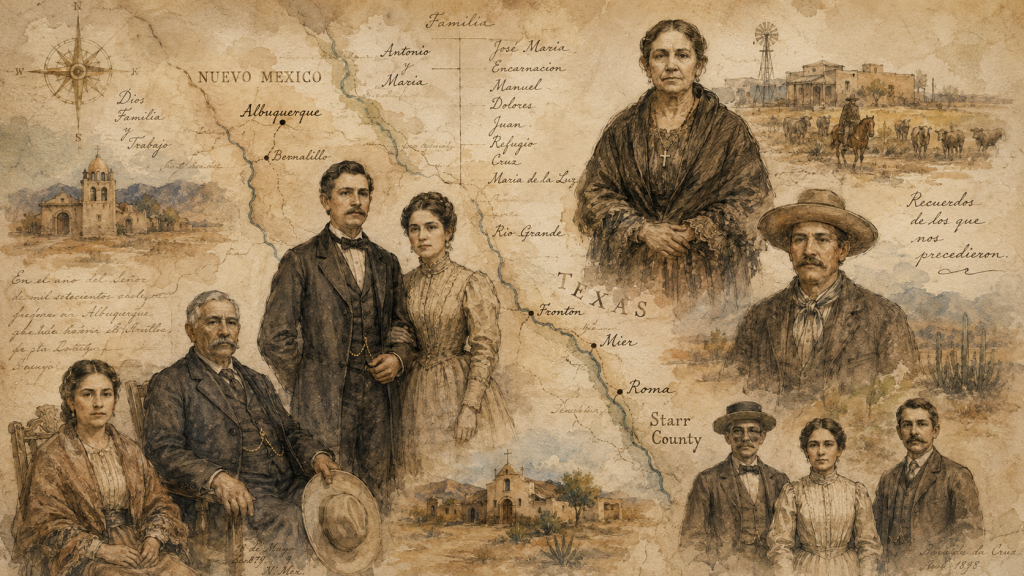
My parents are from Starr County, and we visited our grandparents, our uncles, and our cousins, but I never realized we had such a historic fort in Rio Grande City. I would have stopped years ago, probably more than once. This story is based on historical facts, and I tried to give life to a few of the soldiers who were stationed at Ringgold Barracks. Anyone who can visit this fort that played such an important part in Tejano history and the Civil War. Many of the soldiers stationed there were born in Ireland.
Links to census and other information below.
The Census Taker Came Before the War: Ringgold Barracks, 1860
Four census pages preserve a small community on the Rio Grande just months before Texas seceded, and the men recorded there were scattered by war.
Chapter One — The Census Taker Came Before the War
In August 1860, a census taker sat down at Ringgold Barracks on the Rio Grande and began writing names.
He could not have known that he was taking a photograph of a world about to disappear.
He wrote down soldiers. He wrote down washerwomen. He wrote down children. He recorded where they had been born and, when appropriate, what they did for a living. Then he moved to the next line.
The four Ringgold census sheets in the Starr County records contain 141 people. Three of the sheets are filled with forty entries. The fourth stops after twenty-one. On the original page, the enumerator drew his line across the remaining space and wrote one word:
Concluded.
But nothing was concluded.
Texas was still in the Union.
Abraham Lincoln had not yet been elected president.
The bombardment of Fort Sumter was still months away.
Robert E. Lee was still an officer in the United States Army.
And the young men whose names filled those sheets could not know that some of them would soon be fighting hundreds of miles away in Virginia.
History remembers generals.
The census remembers privates.
John F. Coffey was twenty-four, born in Ireland. So was twenty-four-year-old Robert Newton. John Callahan was thirty-five. Mathew Birney was twenty-six. M. Hallihan was twenty-five. Patrick McHayle was twenty-five. Daniel O’Brien was twenty-five. All were listed as privates.
Another page begins with Thomas Clancy, twenty-five, Ireland; Owen Connell, twenty-five, Ireland; then men from what the census recorded as “America,” followed again by Daniel Donovan, Peter Hay, John Goldwin, John Gilhey and Thomas Hamilton—most of them Irish immigrants serving as privates in the United States Army.
Most of the people recorded at the barracks were soldiers, and a remarkable share of them were immigrants. Ireland dominates the birthplace column, followed by Germany, with smaller numbers from England and Scotland and from places within the United States.
These were not generals deciding the fate of nations.
They were mostly young men trying to make lives.
Some had crossed an ocean before they ever reached the Rio Grande.
And some had brought families with them.
Orderly Sergeant James Robinson, forty, was born in Ireland. Immediately after him the census records Mary Robinson, twenty-five, also born in Ireland. Then came William C. Robinson, four, and John Robinson, two.
The children had been born in Texas.
A few lines farther down was Corporal William Harnell, thirty-two, Irish-born; B. Harnell, twenty-eight, listed as a washerwoman and born in Ireland; and two young children, Mary and William, both born in Texas.
On another page, Irish private James McCormick appears beside Jane McCormick, twenty-eight, a German-born washerwoman.
And on the last Ringgold page appears perhaps the clearest picture of domestic life inside what we call a military post. John Connelly, twenty-four, an Irish private, is followed by Mary Ann Connelly, twenty-eight, an Irish-born washerwoman. Then came John H. Connelly, three, and Elizabeth Connelly, one.
Later on that same sheet were Daniel Jeffries, thirty-five, an Irish private, and Catherine Jeffries, thirty-seven, an Irish washerwoman. Then James, eighteen; Matthew, eleven; Davis, five; and William, three.
All four younger Jeffries were born in Texas.
The census does not explicitly tell us the relationships among people merely because they share a surname and appear together, so we should not manufacture family trees from adjacency alone.
But the pattern is unmistakable.
The word barracks makes us imagine rows of soldiers.
The census gives us babies.
Chapter Two — The Border Was New. The People Were Not.
Ringgold’s story did not begin when the United States Army arrived.
That is important.
The Army arrived in somebody else’s country.
Spanish settlement and ranching along this part of the Rio Grande went back generations. Spanish and Mexican governments issued land grants and porciones throughout the region. Settlements in what became Starr County were established in the eighteenth century, and ranching based on cattle and sheep became the foundation of the regional economy. By the middle of the nineteenth century, communities such as Roma-Los Saenz were already established. (Texas State Historical Association)
For the people who lived there, the Rio Grande had not always been the hard national dividing line we see on a modern map.
Families, land, commerce and communities stretched across it.
After the Texas Revolution, Mexico and the Republic of Texas disputed the territory. The Treaty of Guadalupe Hidalgo ended the Mexican-American War in 1848 and fixed the Rio Grande as the international boundary in this region. That same year, the United States Army established the post that became Ringgold Barracks. (Texas State Historical Association)
So the simplest description of what happened in 1848 is also one of the most important:
The border was new. The people were not.
On October 26, 1848, two companies of the First U.S. Infantry arrived at Davis Landing. The Army leased thirty-three acres from Rio Grande City founder Henry Clay Davis. The installation was first called the Post at Davis Landing, then Camp Ringgold and Ringgold Barracks. The more permanent name Fort Ringgold came later. (Texas State Historical Association)
It stood on a bluff above the Rio Grande. From there, a soldier could look south and see Mexico. Nearby Rancho Davis became Rio Grande City. (University of Texas at Rio Grande Valley)
The Army had planted a United States military post directly into an old Spanish-Mexican ranching society.
For the next decade, the two worlds lived beside one another, traded with one another, depended upon one another, and sometimes collided violently.
One of those collisions had a name.
Juan Nepomuceno Cortina.
Chapter Three — Cortina Comes Up the River
Juan Cortina was born in Tamaulipas in 1824 into a cattle-ranching family. His mother inherited portions of a large land grant that included property around Brownsville, and the family moved into the lower Rio Grande country.
After 1848, Cortina objected to what he saw as mistreatment of Mexican-descent landowners under the new order in Texas. (University of Texas at Rio Grande Valley)
How Cortina should be remembered depends partly upon whose history one is reading.
To many Anglo Texans of the period, he was an outlaw and raider.
To many Tejanos, he became a symbol of resistance to dispossession and unequal treatment.
He was capable of violence, and his grievances were real.
Both belong in the story.
In September 1859, after shooting Brownsville marshal Robert Shears, Cortina and a group of armed men seized Brownsville. A local force known as the Brownsville Tigers tried to defeat him and failed. Texas Rangers tried next and also failed. Then another Ranger force under John Salmon “Rip” Ford joined U.S. Army troops. (University of Texas at Rio Grande Valley)
Cortina retreated upriver.
That brought the war to Rio Grande City.
On December 27, 1859, U.S. troops and Rangers attacked Cortina’s force in the Battle of Rio Grande City and defeated it. Cortina escaped into Mexico. He tried again on February 4, 1860, when his men attempted to capture the steamboat Ranchero at La Bolsa Bend. Soldiers from Ringgold Barracks were aboard the steamer protecting its cargo. Cortina was defeated again. (University of Texas at Rio Grande Valley)
Ringgold was no longer simply a fort looking across an international border.
It had become part of a war over what that border meant.
And the crisis brought one of the most famous names in American history to the Rio Grande.
Robert E. Lee.
Chapter Four — Two Lees on the Border
The name Robert E. Lee now carries the Civil War behind it.
In 1860 it did not.
Lee came to Ringgold as an officer of the United States Army in connection with the Cortina crisis. He had previously visited the post in 1856 on court-martial duty and returned in 1860 after the fighting at La Bolsa. (University of Texas at Rio Grande Valley)
The wooden commandant’s quarters that still stands at Ringgold dates from the 1850s. UTRGV notes that Lee generally preferred sleeping in his tent while in the field, but that he may have stayed as a guest of the commandant in the house that eventually acquired the popular name “Robert E. Lee House.” (University of Texas at Rio Grande Valley)
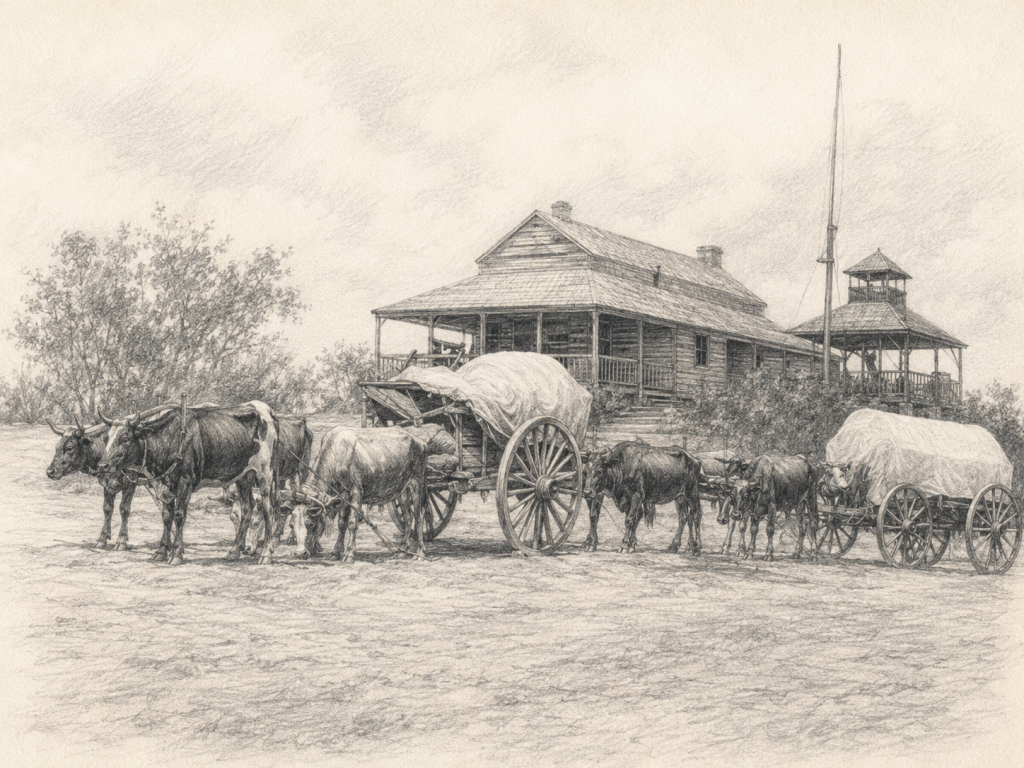
That distinction matters.
We do not need legend when the real story is already remarkable.
Lee stood at Ringgold in 1860 wearing the uniform of the United States.
Less than a year later, Texas would secede.
Soon afterward Lee would resign from that Army and eventually command the Army of Northern Virginia.
The old wooden house therefore witnessed something more interesting than the later mythology surrounding its famous visitor. It belonged to the last months of an American Army that was itself about to split apart.
And our Starr County census may contain another Lee whose story is almost as remarkable.
On a separate census page in this project—not one of the four Ringgold Barracks pages, but a page labeled Rancho de Guajardo—the enumerator recorded a forty-six-year-old Pennsylvania-born Army captain whose name our transcription reads “Th. D. Lee.”
We cannot be 100 percent certain of the identification.
But the evidence strongly suggests that the man was Captain Arthur Tracy Lee of the Eighth U.S. Infantry.
Arthur Tracy Lee was born in Northumberland, Pennsylvania, in 1814—making him forty-six in 1860. He was a captain. He had served at Ringgold Barracks. He also served briefly in the Cortina War. Age, birthplace, rank, time, and place line up. The problem is the initials as we have transcribed them, which is why the identification should remain qualified rather than presented as fact. (Texas State Historical Association)
Arthur Tracy Lee gives us another doorway into this lost world.
He was not merely an Army officer. He was an artist.
At least thirty of his surviving watercolors depict Texas. He painted the Rio Grande, Rio Grande City, Brownsville, and military posts across the state. (Texas State Historical Association)
Then came secession.
Arthur Tracy Lee’s company was at Fort Stockton. He remained loyal to the United States. Confederate authorities arrested and paroled him in San Antonio in April 1861. Eventually exchanged, he returned to active Union service with the Army of the Potomac.
On July 2, 1863, he was seriously wounded at Gettysburg. (Texas State Historical Association)
A man who had looked across the Rio Grande and painted Texas would end up bleeding on a battlefield in Pennsylvania.
But he was not the only man from our census whose road may have led east.
Chapter Five — The Irish Boys
Look again at those Ringgold pages.
Thomas Fleming was twenty years old.
Robert Anderson was nineteen.
John F. Coffey was twenty-four.
M. Hallihan was twenty-five.
Patrick McHayle was twenty-five.
Daniel O’Brien was twenty-five.
Thomas Flynn was twenty-five.
James O’Byrne was twenty-four.
They appear one after another in a federal census because the Army had carried them to the Rio Grande.
The census tells us where they were born.
It does not tell us why they left.
For the Irish men, many had grown up in a country transformed by famine, poverty and enormous emigration. Somehow their individual roads crossed the Atlantic, entered the United States Army and ended at a rough military post where Spanish was spoken around them, and Mexico could be seen across the river.
The second Ringgold page reads almost like an immigrant company roll. Thomas Clancy, Owen Connell, Daniel Donovan, John Goldwin, John Gilhey, Thomas Hamilton, James Higgins, Edward Hunter and others appear as Irish-born privates.
On the next page, the census gives us Englishmen, Germans, Irishmen and American-born soldiers living together. It also gives us Thomas Fleming, twenty, an Irish musician, beside Robert Anderson, nineteen, an English musician.
One can imagine the sounds of Ringgold better after reading that.
Boots.
Horses.
Wagons.
Commands.
Children.
English spoken in half a dozen accents.
Spanish from the town and ranches beyond the barracks.
And somewhere, two young Army musicians whose job was to make themselves heard over all of it.
But there is a danger when writing about census records.
Names invite invention.
It would be easy to give these men thoughts they never recorded, wives they may never have had, motives we cannot prove, and heroic endings they may not deserve.
The better approach is to follow the paper.
And when we did that, several names reappeared.
Two years later.
In Virginia.
At Gaines’ Mill.
Chapter Six — From Ringgold to Gaines’ Mill
On June 27, 1862, the 5th United States Cavalry rode into one of the most desperate fights of its history at Gaines’ Mill, outside Richmond.
The regiment had been known before the war as the 2nd U.S. Cavalry. The War Department redesignated it the 5th Cavalry in August 1861. Before the Civil War, its companies had been scattered across Texas. (Benning)
Company H had been based at Camp Cooper in West Texas before the war, an important caution because we cannot simply declare every matching name in its later rolls to be one of our Ringgold men.
But then the names begin to pile up.
Our Ringgold census records:
John F. Coffey, 24, Ireland.
M. Hallihan, 25, Ireland.
Bern Hart Miller, 29, Germany.
Thomas McDermott, 30, Ireland.
The Company H casualty records at Gaines’ Mill contain:
John T. Coffey.
Michael Hallahan.
Bernhardt Miller.
Thomas McDermott. (Benning)
A separate Starr County census page at Rancho de Guajardo contains James D. Cairns, twenty-six, Irish-born, and Sergeant Thomas Bennett, twenty-nine, Irish-born. Company H’s Gaines’ Mill records also include James D. Cairns among the wounded, while Sergeant Thomas Bennett appears among the missing. (Regular Cavalry in the Civil War)
That is too striking to ignore.
It is also not enough to abandon caution.
Spelling changed constantly in nineteenth-century records. Some names were common. Men’s units and assignments changed. The census does not itself give us regimental numbers.
So the responsible conclusion is not that every one of these matches has been proved.
It is that several are very strong probable identifications, and one is especially compelling.
Thomas McDermott.
The Army’s own historical research into Company H describes a Private Thomas McDermott born in County Galway, Ireland. He had first enlisted in the Army in 1848, eventually becoming a first sergeant before leaving the service. In 1859, he reenlisted in Company H of the 2nd Cavalry.
At Gaines’ Mill, he was severely wounded. (Benning)
Our census has a thirty-year-old Irish-born Private Thomas McDermott at Ringgold in 1860.
We cannot be 100 percent certain without putting the enlistment record directly beside the original census and closing every remaining gap.
But this is a very strong identification.
And if it is our Thomas McDermott, his story does not end at Gaines’ Mill.
He survived.
After a long hospitalization, he returned to service and was appointed an ordnance sergeant, responsible for arms, ammunition, and military stores. He remained in the Army for the rest of his life.
Thomas McDermott died in uniform at Key West, Florida, on June 7, 1886. (Benning)
Twenty-six years separate the census taker’s pen at Ringgold from McDermott’s death in Key West.
That is a life.
The other probable matches take us onto the same battlefield.
The Army research lists John T. Coffey, Bernhardt Miller and Michael Hallahan among Company H soldiers wounded at Gaines’ Mill who recovered quickly enough to return to duty before the end of August 1862. (Benning)
Our Ringgold page has John F. Coffey rather than John T. Coffey, so that one requires particular caution.
But Bern Hart Miller becoming Bernhardt Miller is difficult to dismiss casually.
And M. Hallihan beside an Army record for Michael Hallahan is exactly the kind of spelling variation common in records of immigrants whose names were repeatedly written down by strangers.
At Gaines’ Mill, five companies of the 5th Cavalry—only about 220 enlisted men—were ordered into a desperate charge as Confederate forces broke through the Union line. They rode across open ground under heavy fire. Men and horses fell. Of the seven officers present, six were killed, wounded or captured. The regiment suffered fifty-five casualties. (Benning)
There is an extraordinary geographical reversal hidden inside that battle.
Some of the men who had been standing on the Texas-Mexico border in 1860 were probably now fighting in Virginia for the United States.
And the Confederate breakthrough they were trying to stop included John Bell Hood’s Texas Brigade. (Benning)
Texas had followed them east.
They could not escape it.
Chapter Seven — The Barracks Changed Flags
While some of its former soldiers went east, Ringgold itself went to war.
Texas seceded in 1861, and Confederate forces occupied Ringgold.
Late in 1863, Union troops returned to the Rio Grande Valley and seized it.
Then Confederate forces under John S. “Rip” Ford and Santos Benavides, a Tejano Confederate officer from Laredo, took it back. Ringgold remained in Confederate hands until the end of the war. (University of Texas at Rio Grande Valley)
The names alone show why the Civil War on the Rio Grande cannot be squeezed neatly into a simple North-versus-South story.
Rip Ford had fought beside United States troops against Cortina before the war.
Now Ford fought the United States.
Cortina, meanwhile, returned to the north bank after the Civil War began and again pursued his own political and territorial grievances. Confederate Santos Benavides defeated him in Zapata County in May 1861 and drove his force back across the river. (University of Texas at Rio Grande Valley)
The old divisions remained beneath the new war.
Tejano against Tejano.
Former United States officers against the United States.
Immigrant soldiers from Ireland fighting to preserve the Union.
Men who had served together in the prewar Army choosing different flags.
On the border, the Civil War did not replace the conflicts that were already there.
It landed on top of them.
Chapter Eight — The River Became a Lifeline
Then the Rio Grande acquired another role.
It became one of the Confederacy’s most important routes to the outside world.
The Union Navy could blockade Texas ports.
But the Rio Grande was an international waterway shared with Mexico. Merchants moved Confederate cotton to the border, placed it aboard Mexican-registered steamboats and carried it downriver toward the Mexican port of Bagdad, where it could be transferred to ocean-going vessels. Interfering directly with Mexican commerce risked widening the war internationally. (University of Texas at Rio Grande Valley)
Upstream, Roma became one of the great transfer points.
It stood at the farthest practical inland point for steamboat navigation. Wagons arriving from the Texas interior unloaded cotton there. The bales went onto riverboats and then down the officially neutral Rio Grande toward Bagdad and international markets. UTRGV describes the trade as crucial to financing the Confederate war effort. (University of Texas at Rio Grande Valley)
Imagine that river from the porch of the old wooden commandant’s house at Ringgold.
Before the war, soldiers could watch steamboats moving along it and look beyond them into Mexico. (University of Texas at Rio Grande Valley)
During the war, those boats carried something much larger than freight.
They carried the economic life of a rebellion.
Cotton went out.
Goods came back.
Wagons rolled toward the river.
Merchants made fortunes.
Armies fought over towns and crossings.
And Ringgold, founded to watch a new international border, found itself sitting beside a river the United States could not completely control.
Epilogue — The Names Remain
The Ringgold that survives today is not entirely the Ringgold those census soldiers knew.
The prewar installation was comparatively crude. The Texas State Historical Association describes its construction before the Civil War as flimsy. Major rebuilding began in 1869, and the frame and brick structures that eventually gave the post its more permanent appearance largely belong to that later period. (Texas State Historical Association)
That is why the old wooden commandant’s house matters.
It reaches backward.
It stood when Cortina was fighting along the river.
It stood when Robert E. Lee came through wearing the uniform of the United States.
It stood when Irish privates, German soldiers, washerwomen and Texas-born children occupied the little world around Ringgold Barracks. (University of Texas at Rio Grande Valley)
A later photograph shows wagons and animals gathered in front of it.
Those wagons belong to a later time.
The house does not.
The house knew them.
And now, because of four census pages, we know some of them too.
John F. Coffey, twenty-four.
M. Hallihan, twenty-five.
Bern Hart Miller, twenty-nine.
Thomas McDermott, thirty.
James Robinson and Mary Robinson, with William and little John.
John and Mary Ann Connelly, with their two small children.
Daniel and Catherine Jeffries, surrounded by Texas-born children.
Young Thomas Fleming, the twenty-year-old musician.
The census taker did not know that Texas would soon leave the Union.
He did not know that Ringgold would fly one flag, then another, then another.
He could not know that a man who may have stood before him as Thomas McDermott would be shot down in a cavalry charge at Gaines’ Mill and still serve another twenty-four years.
He could not know that a Pennsylvania captain whose name he may have written incorrectly would later be wounded at Gettysburg.
He did not know Robert E. Lee would become Robert E. Lee.
He did not know that the quiet river below the barracks would soon carry cotton that helped sustain the Confederacy.
He was not writing history.
He was filling out a government form.
That may be why the document is so powerful.
Generals wrote reports defending their decisions.
Politicians wrote speeches explaining what they believed.
Armies recorded victories and defeats.
The census taker asked a simpler question:
What is your name?
And for 141 people at Ringgold Barracks in the summer of 1860, somebody answered.
More than 160 years later, those answers are still there.
The census taker arrived before the war did.
And because he did, the people of Ringgold are not entirely gone.
Links
Link to table where one can search names of all people listed on the 1860 Census.
.
Starr County 1860 census