In September 1856, white residents of Colorado County, Texas, became convinced that hundreds of enslaved people were preparing to rise against them.
The alleged plan was terrifying if you were a slaveholder. The enslaved men would seize guns and horses, attack the white population, and then fight their way south.
Their destination was Mexico.
That last part is the key to the story.
Mexico had abolished slavery. By the 1850s, enslaved people in Texas understood that the Rio Grande did not merely mark an international boundary. On the other side was a country where slavery was illegal. The National Park Service has documented how enslaved Texans escaped south, sometimes aided by Tejanos and other Mexicans who provided information, shelter or routes toward the border. (National Park Service)
In Colorado County, that made Mexicans dangerous.
Not because they were entering Texas.
Because they might help enslaved Texans get out.
Panic in Colorado County
Colorado County lay along the Colorado River west of Houston. Cotton plantations were spreading rapidly through the county during the 1850s, and slavery was spreading with them.
The county had only 2,257 residents in 1850. By 1860 it had grown to 7,885 people, including 3,559 African Americans. Slaveholding was widespread. More than 300 people owned enslaved workers, and four slaveholders owned more than 100 people each. (Texas State Historical Association)
Nearly half the people living in the county were enslaved.
That helps explain the fear.
Late in August 1856, local whites began investigating rumors that enslaved people were organizing a rebellion. A committee was created. Dozens of enslaved people were arrested and packed into the county jail. Some were tortured during interrogations. One later account by a formerly enslaved man said there had been no rebellion at all and that a supposed confession had been invented to satisfy a slaveholder. (Nesbitt Memorial Library)
Whether there was a genuine plot has never been established.
The punishment was real.
Three enslaved men accused of being ringleaders were hanged on September 5 without an ordinary trial. Others were whipped. According to the local county history, two died after being beaten so severely. (Nesbitt Memorial Library)
Then the investigation turned toward another population.
The Mexicans.
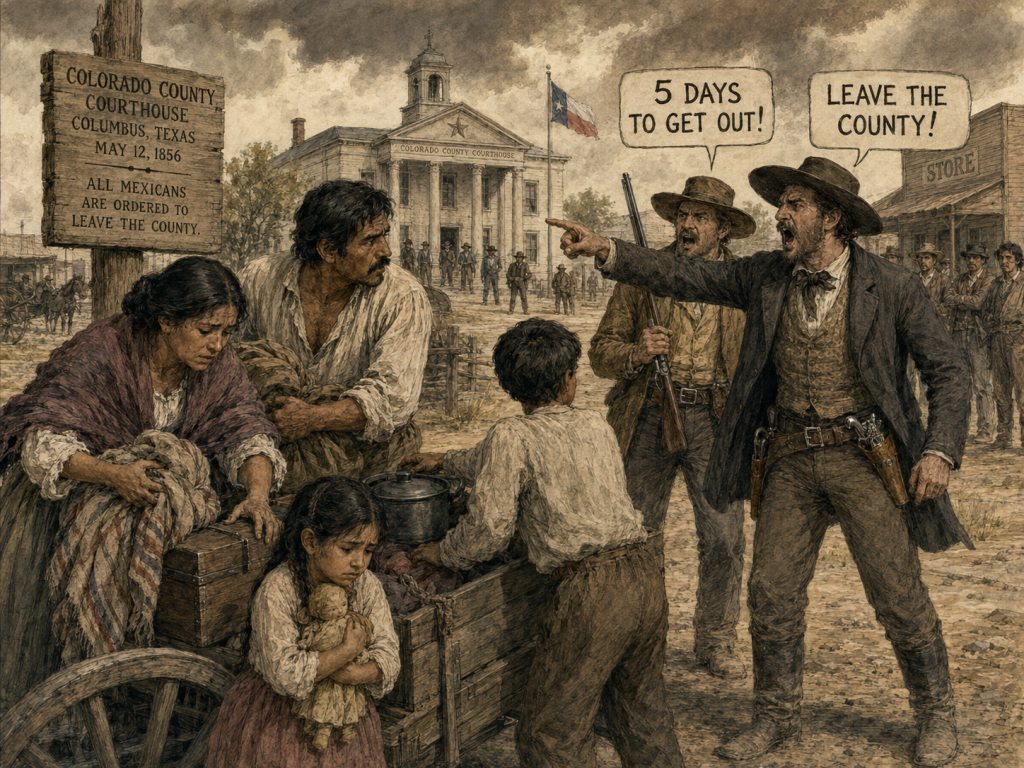
Five Days to Get Out
The white committee blamed Mexican abolitionists for encouraging the alleged rebellion.
The response was extraordinary.
Colorado County residents adopted a resolution that would, in the words preserved in the historical record, “forever” prohibit Mexicans from entering the county. Mexicans who could be found were arrested and expelled. Others apparently left before they could be removed. (Nesbitt Memorial Library)
The Texas State Historical Association describes the episode as an extralegal campaign in which investigating committees executed Black men and evicted the Mexican population, accusing Mexicans of encouraging unrest among enslaved people. TSHA also cautions that the episode may reveal more about growing anti-Mexican hostility in Texas than about the existence of an actual slave rebellion. (Texas State Historical Association)
It is worth being precise about what happened.
I have found no evidence that the Texas Legislature passed a law expelling Mexicans from Colorado County, nor that this was an ordinary county ordinance adopted through normal government.
This was something more primitive.
A frightened white community formed a vigilance committee, asserted its authority, and ordered a population out.
In 1856 Texas, that could be enough.
Why Mexico Frightened Slaveholders
Americans are taught the Underground Railroad as a movement north.
For enslaved Texans, north could be the wrong direction.
Mexico was closer.
The National Park Service tells the story of Sandy, an enslaved twenty-two-year-old who escaped from near Houston in 1858 despite wearing an iron collar and shackles. His goal was Mexico. Other accounts recalled that enslaved Texans understood a simple geography: walk south, cross the Rio Grande, and slavery no longer had legal authority over them. (National Park Service)
Mexico had abolished slavery without exception in 1837. By the 1850s, word of that freedom had spread through enslaved communities in Texas. Mexicans and Tejanos were among the people through whom that information could travel. (National Park Service)
Texas slaveholders understood the danger just as clearly.
They even sent Texas Rangers across the border to capture people who had escaped into Mexico, despite the fact that American fugitive-slave law did not operate there. (National Park Service)
The Rio Grande was therefore more than a border.
To one side, it represented property.
To the other, freedom.
Colorado County Was Not Alone
That same year, about seventy miles closer to the Gulf Coast, white residents of Matagorda County did essentially the same thing.
Matagorda County was becoming one of Texas’s plantation centers. Wealthy planters were importing increasing numbers of enslaved Black workers to grow cotton and sugar along the Colorado River and Caney Creek. (Texas State Historical Association)
By 1860, Matagorda County contained only 3,454 people.
2,107 of them were enslaved.
The enslaved population substantially outnumbered the free population. (Texas State Historical Association)
In 1856, white residents expelled what the Texas State Historical Association describes as the county’s entire Mexican population.
Again, slavery was at the center of the accusation.
A contemporary newspaper complained that Mexican men associated with enslaved Black women on plantations, sometimes formed relationships with them, stole horses, and attempted to take the women with them to Mexico. The newspaper’s complaint was revealing because it treated escape to Mexico not merely as theft of property but as a threat to the plantation system itself. (Texas State Historical Association)
The white residents’ solution was not to prosecute particular Mexicans for proven crimes.
They ordered the Mexicans out.
All of them.
The Border Story Turned Upside Down
There is something almost disorienting about reading this history today.
Modern political debate treats the Texas-Mexico border almost entirely as a story about people coming north.
But in antebellum Texas, slaveholders were terrified of people going south.
The problem was not that Mexico might send people into Texas.
The problem was that Mexico offered something Texas refused to give almost half the population of counties like Colorado and Matagorda:
freedom.
Mexicans could make that freedom more reachable.
They knew the roads.
They knew where the river crossings were.
They spoke the language on the other side.
Some worked on or around plantations.
Some formed relationships with enslaved people.
Some evidently helped people escape.
And even the possibility that they might help was enough to make every Mexican in a county suspect.
What Became of Them?
The historical record tells us surprisingly little about the individual Mexicans who were driven from Colorado County.
That silence is part of the story.
The men who formed the committees left records.
The plantation owners left deeds, tax rolls, and probate files.
The people they enslaved were often reduced in official records to numbers.
And the Mexicans expelled from the county largely disappear behind a phrase:
every Mexican.
A search of the 1860 Colorado County census does find at least one man with a Spanish surname whose birthplace was recorded as Mexico.
That proves almost nothing about the 1856 expulsion.
A Spanish surname and a Mexican birthplace do not tell us his ancestry, complexion, social standing, or how the white residents of Colorado County would have regarded him. He might have arrived after the expulsion. He might have returned. He might have had connections that protected him.
The census cannot answer those questions.
What it can tell us is that four years after local whites attempted to exclude Mexicans permanently, their supposedly permanent racial boundary was already less absolute than the language of the order suggested.
“Order” Had a Meaning
There is a temptation to treat the Colorado County episode as a strange outbreak of frontier hysteria.
It was more than that.
The community was protecting an economic system.
By 1860, Colorado County produced more than 14,000 bales of cotton and had become one of the state’s major cotton-producing counties. Its prosperity rested heavily upon enslaved labor. (Texas State Historical Association)
Matagorda County was the same story on an even more concentrated scale. Its plantations produced cotton and sugar while enslaved people constituted most of the county population. (Texas State Historical Association)
When white residents talked about restoring peace and order, they were not describing a neutral social condition.
Their order required enslaved Black people to remain enslaved.
It required Mexicans not to help them leave.
And when Mexicans were perceived as threatening that system, the easiest answer was to remove the Mexicans.
The Forgotten Southern Underground Railroad
The better-known Underground Railroad points north toward Ohio, Pennsylvania, New York and Canada.
Texas had another one.
It pointed south.
There were no neat tracks and probably no single organized network stretching from plantation to border. People escaped however they could. They followed roads, rivers, ranches and rumors. Some received help. Others walked alone.
The destination was what mattered.
Mexico.
That fact changes the way the 1856 expulsions should be understood.
Colorado County’s white residents were not simply expressing prejudice against Mexicans, although anti-Mexican hostility was clearly present.
They were also reacting to something much more threatening.
Mexicans represented a connection between enslaved people and a country that rejected the legal foundation of the plantation economy.
That made the Mexican laborer, ranch hand, traveler, or neighbor potentially dangerous even if he had committed no crime.
He knew where freedom was.
And perhaps he might tell somebody else.
The Story We Forgot
Colorado County’s order did not make Texas history books the way the Alamo did.
Neither did the expulsion in Matagorda County.
The people driven out left few monuments.
There is no famous painting of Mexican families packing what they could carry.
No schoolchild memorizes the date.
Yet the episodes tell us something important about Texas before the Civil War.
The Mexican border was once feared for exactly the opposite reason it is feared in modern politics.
It was an escape route.
Mexico was where enslaved Texans hoped to become free.
And some white Texans considered the Mexicans living among them dangerous because they might help make that freedom possible.
In 1856, Colorado County decided there was a simple solution.
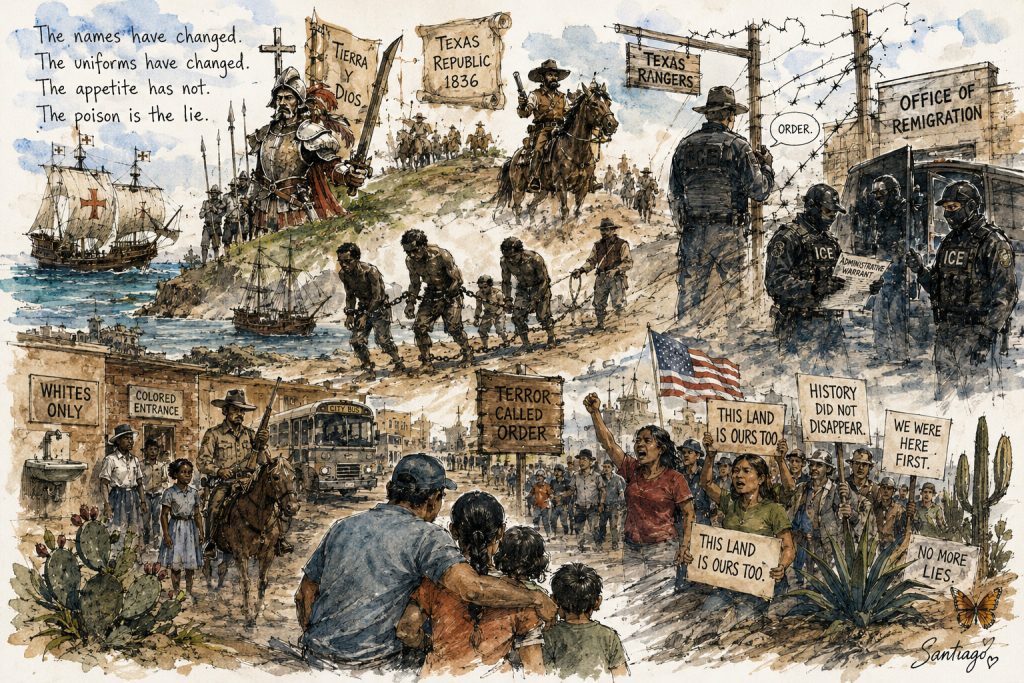
Order all the Mexicans out.
Matagorda County followed the same logic.
The names of most of the people expelled have faded.
The reason they were feared has not.
They weren’t afraid Mexicans were coming to Texas.
They were afraid the enslaved were going to Mexico.