Recuerdos de un Chicano
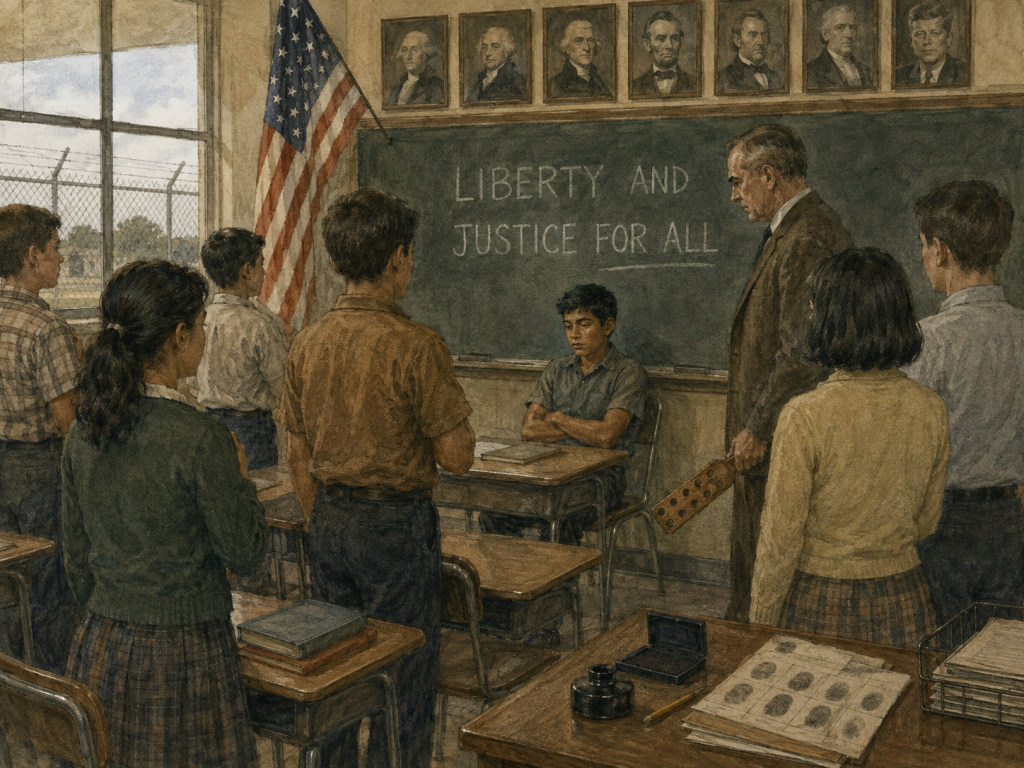
When I was a boy, a teacher asked the class a question adults often ask children.
What do you want to be when you grow up?
Children are supposed to dream when they answer. A fireman. A doctor. A baseball player. Maybe an astronaut.
When my turn came, I said I wanted to be President of the United States.
The teacher looked at me and told me something I have remembered for the rest of my life:
“A Mexican will never be President of the United States.”
I do not remember every lesson that teacher taught me.
I remember that one.
I was being taught two versions of America at the same time.
There was the America in our textbooks, where anybody could grow up to be president. We learned about freedom and democracy. We were told everyone was equal before the law. Every morning we pledged allegiance to a country promising “liberty and justice for all.”
Then there was the America outside the textbook.
In that America, a Mexican boy needed to understand that some dreams were not intended for him.
The Fence
By junior high, some lessons did not require words.
They built a six-foot chain-link fence around our school.
We were told it was there to keep people out.
We knew what it also did.
It kept us in.
Perhaps there were perfectly reasonable explanations for the fence. Schools need security. Children should not wander off campus. Strangers should not be able to walk onto school property.
But a six-foot chain-link fence looks different depending on which side of it you are standing.
Our school was supposed to prepare us to enter the world.
Somebody had surrounded it with a fence.
Fingerprinted
I remember another incident from those years.
Someone broke into the school.
I do not remember every detail anymore, and I do not want to improve my memory simply because decades have passed. What I remember is that afterward many of the boys — perhaps all of us — were fingerprinted.
I remember putting my fingers down.
Nobody had shown that I had broken into anything. Nobody had shown that the other boys had either.
We were simply there.
So we became the pool of suspects.
Americans are taught a beautiful principle:
Innocent until proven guilty.
That day it felt more like:
Fingerprint them until we find the guilty one.
Maybe other schools did the same thing. Maybe they did not. I do not know, and I will not claim what I cannot prove.
I know what I remember happening at my school.
And I remember how it felt.
Liberty and Justice for All
Then came the pledge.
At some point I began thinking seriously about the words we repeated every morning.
The Pledge of Allegiance ends with a promise:
“With liberty and justice for all.”
I had decided that was not true.
Not for everyone.
Not for us.
So one morning when the class stood for the pledge, I remained seated.
The teacher told me to stand.
I refused.
I was paddled.
The next morning we did it again.
The class stood.
I remained seated.
The teacher ordered me to stand.
I refused.
I was paddled again.
This went on for roughly half the school year.
Every morning we repeated the argument.
The school had authority.
The teacher had a paddle.
But I had made up my mind.
I was not going to say words I did not believe.
Eventually the teacher understood that paddling me was not changing anything.
He offered a compromise.
Would I at least stand with the other students?
I agreed.
I would stand.
But I would not say the pledge.
And that was the end of it.
Looking back, I consider that the first political battle I ever won.
The teacher could make me hurt.
He could not make me believe.
Eventually, he stopped trying.
What a Child Sees
I do not remember sitting down as a boy and developing some grand theory about discrimination against Mexican Americans.
Children usually do not think that way.
They notice things.
They notice who lives where.
They notice who gets treated differently.
They notice what teachers expect from them.
They notice fences.
They notice when everybody who looks like them becomes a suspect.
And they notice when an adult tells them that a particular door will always be closed.
I had been told that a Mexican would never become president.
Then every morning I was supposed to promise allegiance to a country offering liberty and justice to everyone.
Those ideas did not fit together.
I was young enough to believe that words ought to mean what they said.
Perhaps that was my problem.
Or perhaps it was my education.
Proud to Be Brown
Years later, when I became involved with La Raza Unida, its message did not seem strange to me.
Be proud to be brown.
That sounds simple today.
It was not always simple for a Mexican-American kid growing up in the world I knew.
There were constant little messages telling us where we belonged and where we did not.
Sometimes nobody needed to say them aloud.
Sometimes a teacher did.
La Raza Unida said something different.
Your family matters.
Your neighborhood matters.
Your history matters.
Your voice matters.
Your vote matters.
You do not have to apologize for being Mexican American.
By then I already knew something about resisting authority.
A teacher had taught it to me with a paddle.
A Door That Still Hasn’t Opened
More than sixty years have passed since a teacher told me that a Mexican would never become President of the United States.
So far, no Mexican American has.
And there is another door that has never opened.
No Mexican American has ever served as a justice of the United States Supreme Court.
The country came close.
President George W. Bush seriously considered Alberto Gonzales, a Mexican American who had served on the Texas Supreme Court and later became White House counsel and attorney general, for a seat on the U.S. Supreme Court.
Had Bush nominated him and had the Senate confirmed him, Gonzales would have become the first Hispanic justice in the Court’s history.
But Gonzales faced strong opposition from conservatives who did not consider him reliably conservative enough, particularly on abortion.
Bush did not nominate him.
Instead, the two Supreme Court vacancies of his presidency ultimately went to John Roberts and Samuel Alito.
We know what came afterward.
Roberts became chief justice.
Alito became one of the Court’s most reliably conservative members.
Together they became central figures in the transformation of the Supreme Court.
The Mexican-American justice never happened.
Sonia Sotomayor eventually became the first Hispanic justice, an historic achievement in its own right. But Sotomayor is Puerto Rican.
The particular barrier I had encountered as a little Mexican-American boy remains.
Was My Teacher Right?
No.
That is important.
The fact that no Mexican American has yet become president does not make my teacher right.
The fact that no Mexican American has yet sat on the Supreme Court does not make her right either.
It tells us something different.
Some doors can remain closed for a very long time.
That is why telling a child he can never walk through one of them is so destructive.
A teacher does not know which child sitting in front of her might become a lawyer, a judge, a governor, a senator — or president.
Her job should not be to tell him which dreams his ancestry has disqualified him from having.
The America in the Pledge
I never became President of the United States.
My teacher was right about that much.
But she was wrong about something more important.
I had every right to believe that I could.
That is supposed to be part of the bargain America makes with its children.
Work hard.
Learn.
Participate.
Dream.
Nobody promises that the dream will come true.
But the country should at least promise that your surname, your neighborhood, or the color of your skin does not determine which dreams you are permitted to have.
That is why I still remember the pledge.
I was not rejecting America.
I was asking America to mean what it said.
Liberty and justice for all.
Those were not my words.
They were America’s.
I simply noticed that the promise and the reality did not always match.
So I sat down.
They paddled me.
I sat down again.
Eventually the teacher stopped trying to make me say it.
I stood.
I remained silent.
And a Mexican-American boy who had once been told he could never be president learned something that stayed with him much longer than anything written on the blackboard:
Authority could tell me where it thought my place was.
It could not make me accept that place.