Company E Goes to War
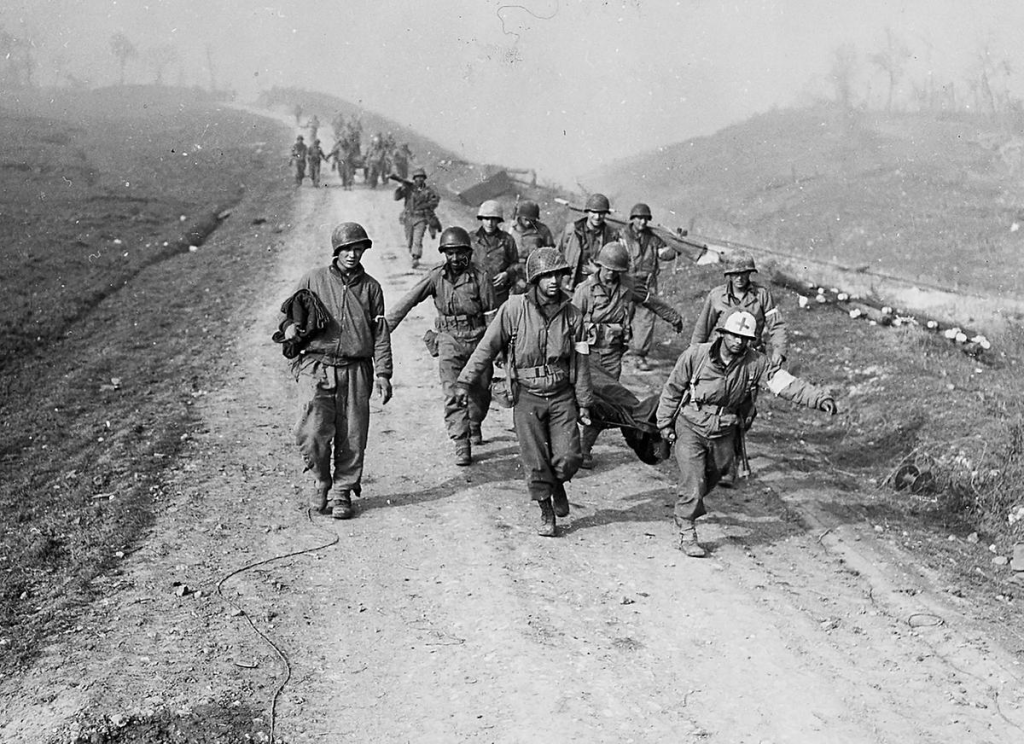
By the time Company E left Texas, its men had already proven they could shoot.
They had achieved 100 percent weapons qualification. Their rifle team had won the 141st Infantry Regiment championship eight consecutive years.
They had also learned something else.
An American uniform did not necessarily protect a Mexican American from being told:
“No Mexicans or dogs.”
Now the men were leaving Texas.
In April 1943, Company E and the 36th Infantry Division deployed to North Africa. Five months later, on September 9, 1943, they landed with Allied forces at Salerno, Italy. (The National WWII Museum)
The Mexican-American company that Texas once hoped to “Americanize” was about to find out what America expected of it in war.
Salerno
Salerno was Company E’s first major combat.
The landing nearly failed.
German forces counterattacked with enough force to threaten the Allied beachhead, and the fighting became one of the first brutal tests for the 36th Infantry Division. (Texas Military Forces Museum)
Among the men leading Company E soldiers was Gabriel Navarrete.
Back at Camp Bowie, Navarrete had passed the written Officer Candidate School examination three times and had been rejected after the oral examination three times.
The reason he remembered being given was his accent.
At Salerno, nobody asked how he pronounced his words.
Navarrete was leading an advance squad when he was wounded. Afterward, the Army commissioned him as an officer. (The National WWII Museum)
The Army had finally decided that the man with too much of an accent could lead soldiers.
Combat had settled the question.
North Through Italy
Salerno was only the beginning.
The Allied armies began pushing north through Italy, where German forces had prepared a series of defensive lines across mountains, valleys, and rivers.
Company E fought through terrain that favored the defenders.
At Monte Rotondo, overlooking the Liri Valley and San Pietro, the company took heavy shelling. German positions on higher surrounding ground could look down on the Americans, and Company E suffered serious casualties. (The National WWII Museum)
Then came San Pietro.
The fighting there in December 1943 was another costly step toward the German defensive line around Cassino.
Company E was already losing men who had trained together for years.
One was Pfc. Lorenzo Macias, an original Texas National Guardsman who had been with the unit since it was federalized in 1940.
He was killed on December 23, 1943. (The National WWII Museum)
The old Company E was being reduced one man at a time.
Chapin Is Wounded
During the fighting around San Pietro, Capt. John L. Chapin was wounded on December 16, 1943.
The wound might have sent him home.
That would have been understandable.
Chapin had already taken his men through training, North Africa, Salerno, and some of the hardest fighting in Italy.
Instead, he returned to Company E.
According to accounts preserved by the Texas Military Forces Museum, Chapin told others that he had brought his men overseas and intended to take them back to Texas or die trying. (Texas Military Forces Museum)
The story carries more weight because of what came next.
Chapin learned that the 36th Division had been ordered to cross the Rapido River.
He left the hospital and returned to his men. (Texas Military Forces Museum)
The Rapido
The 36th Infantry Division’s assault across the Rapido River, January 20–22, 1944. Company E crossed with the 141st Infantry Regiment in the northern sector. Source of map
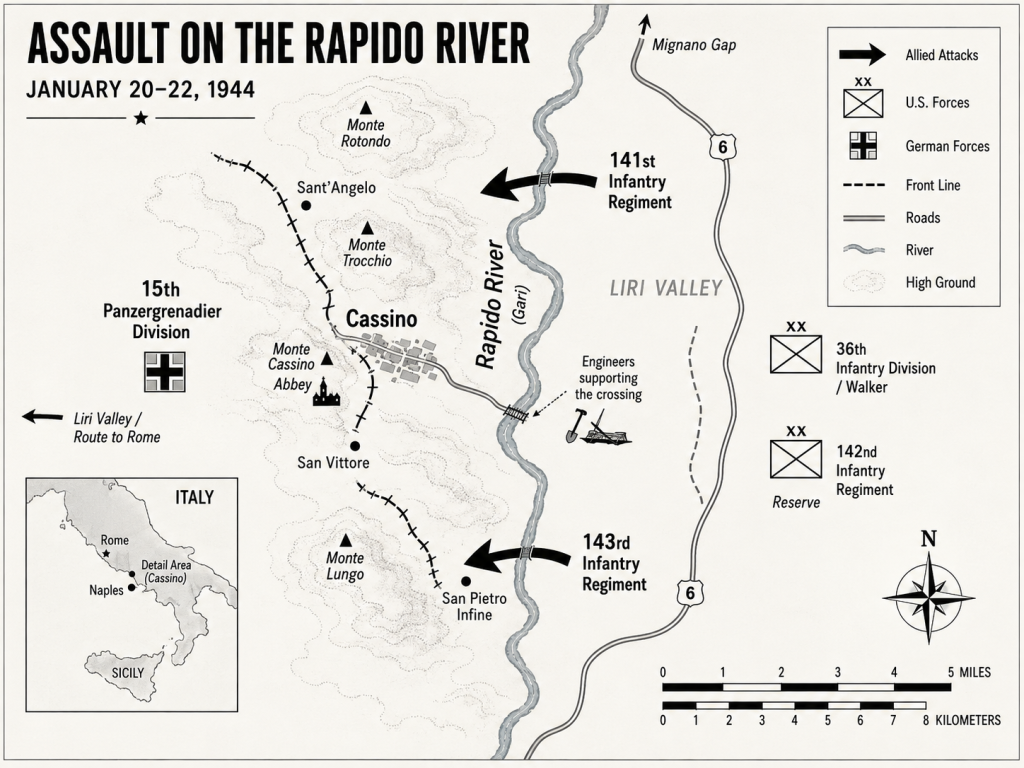
By January 1944, the Germans had built the Gustav Line across central Italy.
The Rapido River area formed part of that defensive system near Cassino.
The Germans had prepared for an attack.
The approaches were exposed.
The riverbanks were mined.
Barbed wire blocked movement.
German artillery, mortars, and machine guns covered the crossing areas from prepared positions. (The National WWII Museum)
The mission went to the 36th Infantry Division.
Its commander, Maj. Gen. Fred L. Walker, did not like the plan.
Walker understood river crossings unusually well. During World War I, he had fought at the Marne, where German troops attempting to cross against defended positions were slaughtered.
Now he was being ordered to send his own men against a defended river.
On January 20, 1944, Walker wrote in his diary:
“We might succeed, but I do not know how we can.” (The National WWII Museum)
The order remained.
The 36th would attack.
Mark Clark’s Order
Above Walker was Lt. Gen. Mark W. Clark, commander of the U.S. Fifth Army.
Clark wanted the 36th Division to force a crossing as Allied forces prepared for the landing at Anzio.
Walker believed the attack was badly conceived and warned about the difficulty of crossing directly into the German defenses.
He was overruled.
The 141st and 143rd Infantry Regiments were ordered forward. (The National WWII Museum)
This point would matter greatly after the war.
The soldiers were not simply remembering a battle they had lost.
Many believed they had been ordered into an attack that senior officers already had reason to believe could end disastrously.
Into the River
Company E went forward with the 141st.
This was infantry combat at its worst.
Men had to reach the river under fire, get boats and equipment across, break through wire and mines, and then establish positions on ground already covered by German weapons.
The Germans knew where the Americans had to go.
They waited.
Artillery came down around the crossing areas.
Machine guns swept the approaches.
Mortars exploded among the infantry.
Men drowned.
Men were wounded and could not be brought back.
Others crossed only to become trapped on the German side without enough support.
The Rapido became a killing ground. (The National WWII Museum)
Captain Chapin Crosses With Them
John Chapin could have been somewhere else.
He had been wounded only weeks earlier.
He could have been in a hospital.
Instead, he was back with Company E.
And when his men went toward the river, Chapin went with them.
The Texas Military Forces Museum account says Company E managed to get men across and push through German wire, but the survivors became pinned down. Relief came too late. (Texas Military Forces Museum)
Chapin was killed during the fighting.
He was later awarded the Silver Star posthumously. (Texas Military Forces Museum)
Years earlier in Brownwood, Chapin had stood beside his Mexican-American soldiers when a hamburger restaurant refused to serve them.
Now he died beside them in Italy.
That helps explain why they never forgot him.
Forty-Eight Hours
The attack continued.
The result was catastrophic.
Within roughly 48 hours, the 36th Infantry Division suffered more than 2,000 men killed, wounded, or captured, according to accounts of the battle. The 141st and 143rd Infantry Regiments took the worst of the losses. (The National WWII Museum)
But the figure for Company E is even harder to absorb.
According to historian Dave Gutierrez, 154 men of Company E went into the Rapido operation.
Only 27 came back.
The others had been killed, wounded, or captured. (The National WWII Museum)
Those numbers deserve to stand alone.
154 men.
27 returned.
Roll Call
On January 23, 1944, Company E held roll call.
Only 27 enlisted men answered.
There were no officers left. (The National WWII Museum)
This was not merely another bad day for the company.
The original Company E—the Mexican-American unit that had trained together, won rifle championships together, endured Brownwood together, and fought its way from Salerno through the Italian mountains—had effectively been destroyed.
The survivors could not simply continue as before.
The remains of Company E were combined with other men, and replacements began arriving. (The National WWII Museum)
The name Company E remained.
But the old company was gone.
Remember the Eight Rifle Championships
There is a reason the beginning of this story matters.
Before the war, Texas officials had spoken of using Company E to “educate, train, and Americanize” Mexican-American young men.
Those supposedly unfinished Americans became one of the regiment’s best shooting companies.
They won eight straight rifle championships.
They achieved 100 percent weapons qualification.
Then, when war came, America sent them to Salerno.
To San Pietro.
And finally to the Rapido.
At Brownwood, some Texans would not let them eat at the front counter because they were Mexican.
At the Rapido, nobody questioned whether they were American enough to go first.
Was It Necessary?
The anger over the Rapido did not disappear when the war ended.
The men of the 36th Division remembered what happened.
So did their officers.
In January 1946, veterans meeting again in Brownwood demanded a congressional investigation into the Rapido attack.
They called it a “colossal blunder.” Contemporary reporting described their demand that Congress examine whether Gen. Mark Clark had unnecessarily sacrificed the division. (TIME)
These were not antiwar protesters looking back from a distance.
They were the men who had crossed the river.
They were officers who had watched their companies disappear.
They wanted to know why.
Congress investigated.
The inquiry did not result in punishment for Clark, and military authorities defended the decision as necessary under the circumstances. But the argument over the Rapido never completely disappeared. (The National WWII Museum)
The veterans themselves made sure of that.
Company E Paid the Price
Historians can continue debating strategy.
They can argue about Anzio.
They can discuss the Gustav Line.
They can study Clark’s decisions and Walker’s objections.
For Company E, the result was much simpler.
Before the Rapido:
154 men.
Afterward:
27 enlisted men answered roll call.
No officers.
Capt. John Chapin was dead.
The Mexican-American company that Texas once believed needed to be taught how to become American had paid one of the highest prices America could ask.
And the war was not over.
Some of those 27 men would keep fighting.
One of them was a young Mexican-American soldier from South Texas named Ramon Gutierrez.
His war—and what happened when men like him finally came home—is the next part of the story.