There will be three parts to the story; this is the first part, and the second and third parts include where an all-American Japanese unit comes to help the 141st. They were discriminated against, but not only did they serve; they served with distinction. Where are the movies about these brave men? Why isn’t America told about them in the history books?
They Were Americans. Texas Said They Needed to Be Americanized.
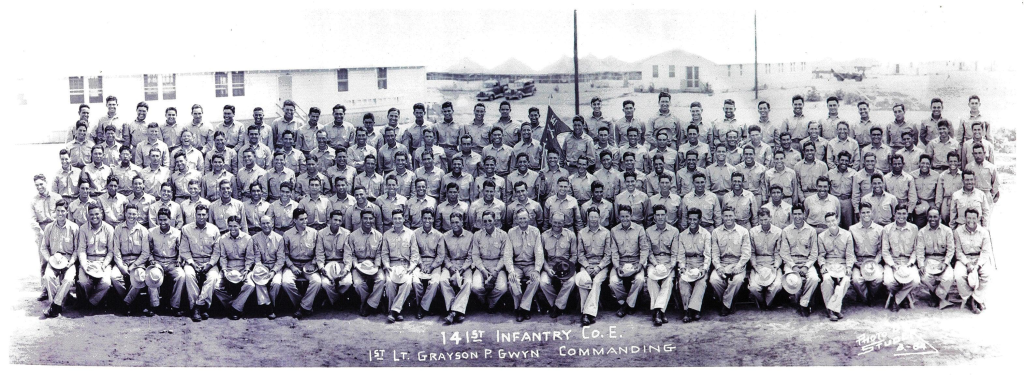
The 141st Infantry Regiment — “First Texas”
The 141st Infantry Regiment was part of the 36th Infantry Division, the Texas Division. Its history reached deep into Texas military tradition, and by World War II it was a Texas National Guard regiment preparing for another war overseas.
The regiment was federalized on November 25, 1940. Its men trained at Camp Bowie near Brownwood and later at other camps around the country before sailing for North Africa in 1943. Eventually they would land at Salerno and begin the long, bloody campaign through Italy. (The National WWII Museum)
But one company within the 141st was different.
Company E.
Company E had been organized in El Paso and received federal recognition on November 21, 1923. Its enlisted ranks were Mexican American. The idea behind the company reflected the thinking of the time: Colonel Will Jackson described its purpose as an opportunity to “educate, train and Americanize” El Paso’s Mexican-American youth. (The National WWII Museum)
There was an obvious problem with that idea.
They were already Americans.
They were young men from El Paso, many born in the United States, living in a state where Mexican Americans could be citizens on paper and still face segregated schools, restricted jobs, and open discrimination. (The National WWII Museum)
America organized a military company partly to teach Mexican Americans how to become Americans.
Then it handed them rifles.
They Could Shoot
Company E quickly developed a reputation that had nothing to do with anybody’s theory about Americanization.
The men could shoot.
The company became one of the first in the regiment to achieve 100 percent weapons qualification. Its rifle team won the regimental championship eight consecutive years. (The National WWII Museum)
That is worth stopping over.
Eight straight years.
Whatever anyone thought about their Spanish, their surnames, their neighborhoods, or their Mexican ancestry, the targets did not know the difference.
Company E kept winning.
By the time the United States began preparing seriously for war, these men were not some social experiment waiting to be turned into soldiers.
They were already one of the best-trained companies in the regiment.
Camp Bowie Changed the Company
When the Texas National Guard was called into federal service, Company E moved to Camp Bowie near Brownwood in early 1941.
Then something important happened.
Mexican-American soldiers arriving from other parts of Texas were assigned to Company E. According to historian Dave Gutierrez, the 36th Division also pulled Mexican Americans from other units and placed them in Company E. (The National WWII Museum)
What had begun as an El Paso Mexican-American company became a concentration of Mexican-American soldiers from around Texas.
Pablo Segura remembered that the company’s noncommissioned officers spoke both English and Spanish. That made Company E useful for training recruits who spoke little or no English. (Voces)
The Army had created a strange situation.
It regarded these men as needing Americanization, yet depended upon them to help train other American soldiers.
And outside the gates of Camp Bowie, they were about to learn how little an Army uniform could sometimes mean.
“No Mexicans or Dogs”
This part of the story matters.
It is easy, more than eighty years later, to reduce discrimination to a sentence in a history book.
Mexican Americans faced discrimination.
Period. Move on.
But people who lived through that Texas remembered something more specific.
They remembered the signs.
They remembered being refused service.
They remembered the back doors.
For older Mexican-American families, “No Mexicans” is not an abstract phrase from some distant period. Parents remembered those words. Some of their children remember that world too.
The soldiers of Company E encountered it while wearing the uniform of the United States Army.
Pablo Segura remembered going into Brownwood and trying to buy a Coke.
They would not serve him.
He recalled the reason:
“No, you’re still Mexican.” (Voces)
Still Mexican.
The uniform apparently did not change that.
Neither did citizenship.
Neither did the fact that these young men were training to fight whatever enemy the United States might send them against.
One incident became part of Company E’s history.
The Hamburger Joint
Gabriel Navarrete had just been promoted to sergeant.
Some of the men went into Brownwood to celebrate. They entered a hamburger restaurant and discovered the message in the window:
“No Mexicans or dogs allowed.” (The National WWII Museum)
The soldiers were told that if they wanted food, it would be handed to them through the back door.
Think about that picture.
American soldiers.
In American uniforms.
Preparing to fight for the United States.
And in Texas, they were being told to go around back because they were Mexican.
The men were furious.
According to Gutierrez’s account, some wanted to tear the place apart.
Navarrete stopped them.
He told the men to leave and return to camp. (The National WWII Museum)
Then Capt. John L. Chapin became involved.
Captain Chapin
Chapin was Anglo.
He was also the commander who would become so closely identified with his Mexican-American soldiers that decades later, when El Paso wanted to honor someone from Company E by naming a high school after him, surviving veterans chose John L. Chapin. (The National WWII Museum)
The Brownwood incident helps explain why.
Chapin did not simply tell his men that discrimination was unfortunate and send them back to training.
He went to the restaurant with a colonel.
They confronted the management.
Why, they wanted to know, were American soldiers being refused service?
The response was essentially unchanged: the restaurant did not serve Mexicans.
The colonel answered that these men were Americans and soldiers.
The restaurant still refused. (The National WWII Museum)
So the Army answered in a language the restaurant understood.
Money.
The colonel placed the establishment off-limits to soldiers.
No soldiers were to eat there.
With thousands of servicemen around Camp Bowie, losing military customers mattered. According to Gutierrez’s account, the restaurant was also fined before soldiers were again allowed to patronize it. (The National WWII Museum)
The Mexican-American soldiers had been told to use the back door.
Their captain made sure the United States Army stopped coming through the front one.
That is the kind of thing men remember.
Why They Remembered Chapin
Chapin’s relationship with Company E went beyond one restaurant.
He spoke Spanish and had earned the men’s confidence. Accounts of his service say he passed up opportunities for advancement because he feared that leaving Company E might put his soldiers under an officer who did not understand them or respect them. Surviving Company E veterans later insisted that the new El Paso high school be named for him. (Dallas News)
That does not make the discrimination disappear.
It makes the history more truthful.
This was not a simple story in which every Anglo was the enemy and every Mexican American was treated alike.
It was a story about a system and a society where prejudice was normal enough for a restaurant to turn away uniformed soldiers — and about individuals who decided they would not accept it.
Chapin was one of them.
His soldiers knew the difference.
Gabriel Navarrete’s Accent
The same Gabriel Navarrete who stopped his angry soldiers from wrecking the restaurant wanted to become an officer.
His fellow soldiers thought he should.
The Army’s written examination apparently agreed.
Navarrete took the Officer Candidate School test and passed the written examination.
Then came the oral examination.
He was rejected.
He tried again.
Passed the written test again.
Rejected after the oral examination again.
Then he did it a third time.
Three written tests.
Three passes.
Three rejections.
According to Gutierrez, each time Navarrete was told essentially the same thing:
He had too much of an accent. (The National WWII Museum)
The paper did not hear his accent.
The men interviewing him did.
Later, after Navarrete proved himself in combat and was wounded at Salerno, the United States Army commissioned him as an officer. (The National WWII Museum)
Apparently the accent became less important after bullets started flying.
Pablo Segura Heard the Same Thing
If Navarrete’s experience stood alone, somebody might dismiss it as one unfair board or one bad officer.
But Pablo Segura remembered almost exactly the same thing.
Segura had grown up poor in El Paso. He joined the Civilian Conservation Corps and later the Texas National Guard, in part because Guard drill pay could help him save enough money to continue college. (Voces)
At Camp Bowie, after experiencing discrimination in Brownwood, he applied for Officer Candidate School.
He took the oral examination.
The answer was no.
Segura asked why.
“You have too much of an accent.” (Voces)
Later Segura applied to the Army Air Corps.
This time he passed.
He remembered confronting the same major who had previously rejected him and asking whether his accent had somehow improved so much in six months.
Segura went on to become an Army Air Corps navigator and second lieutenant. After the war he completed his engineering degree, moved to Houston, worked as a metallurgist and became active in LULAC, serving as a Houston chapter president in 1974. (Voces)
The man whose accent supposedly made him unsuitable to be an officer became one anyway.
What Was the Real Test?
Company E exposes one of the contradictions of Mexican-American life in Texas during that period.
The measurable tests often said the men were good enough.
100 percent weapons qualification.
Eight consecutive rifle championships.
Written OCS examinations passed.
But then came another kind of test.
A restaurant owner looked at them.
An officer listened to them speak.
Someone heard an accent.
Someone saw a Mexican face.
Someone saw a Spanish surname.
And suddenly citizenship was not enough.
The Army could classify them as Americans.
The restaurant could still call them Mexicans.
The country could put a rifle in their hands.
Someone could still tell them to go around back.
They Did Not Need to Become Americans
That is why the original purpose of Company E sounds so different today.
“Educate, train and Americanize.”
Train them?
Certainly. Every soldier needed training.
Educate them?
Perhaps.
But Americanize them?
Company E’s history eventually answered that question.
These young men did not have to surrender their Spanish, their Mexican surnames, their barrios, or their families to become Americans.
They already were.
They could be Mexican and American at the same time.
Pablo Segura would eventually say it better than any historian could:
“You don’t have to lose your roots to be a proud American.” (Voces)
And Then America Asked More
By 1943, the men who had been refused Cokes in Brownwood were crossing the Atlantic.
The men once told to use the back door of a Texas restaurant would land under fire in Italy.
Gabriel Navarrete would prove in combat that he could lead.
John Chapin would stay with the company he had refused to abandon.
And soon Company E would reach a river in Italy where the question would no longer be whether these Mexican-American Texans were American enough.
America was about to ask them to prove it with their lives.
That is Story Two.