Arizona Became a State — Then It Found a Way to Keep Mexican Americans From Voting
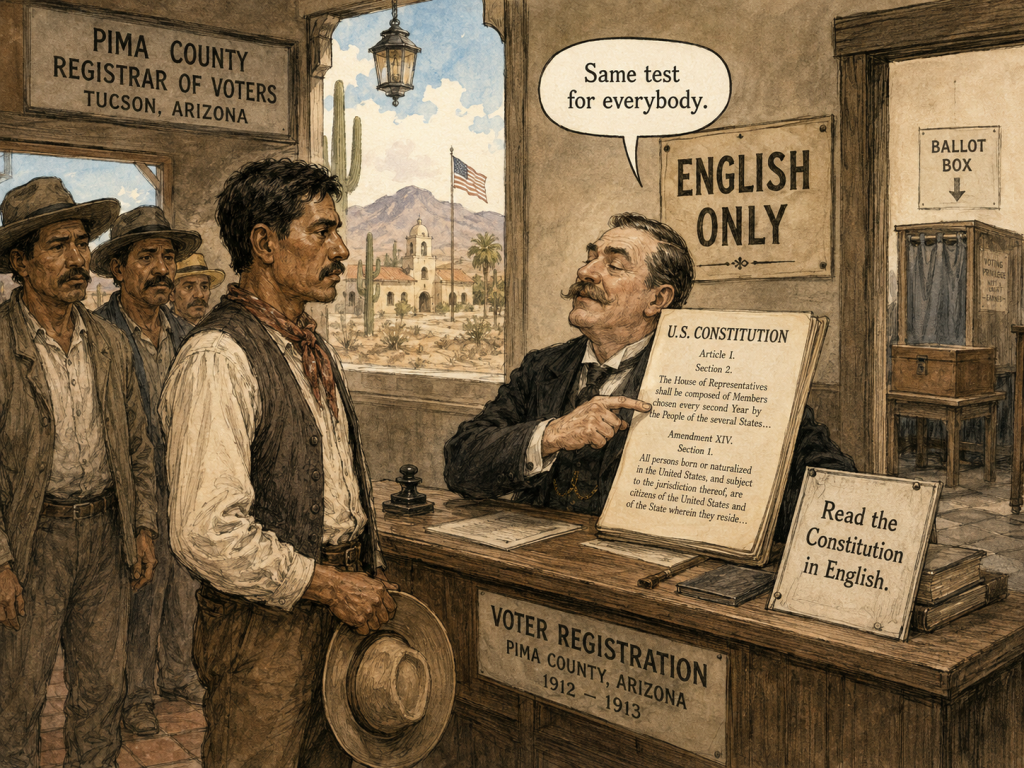
Arizona became the 48th state on February 14, 1912.
It did not take long for the new state to decide that some of its citizens were voting too much.
The target was Mexican Americans.
Arizona did not pass a law saying “Mexicans cannot vote.” That would have been too obvious.
Instead, it passed something that sounded perfectly fair:
Everybody had to prove they could read English.
The Law Applied to White People Too
That is what made the law clever.
On paper, Mexican Americans were not singled out. A white voter and a Mexican-American voter faced the same requirement.
Arizona law said a voter had to be able to read the U.S. Constitution in English well enough to show that he was not being prompted or simply reciting something he had memorized. He also had to be able to write his name. (Wikimedia Commons)
If someone challenged the voter, the procedure became even more interesting.
Sections of the Constitution were printed on separate cards. The cards could be mixed in a container, and the challenged voter had to draw one at random and read it aloud in English. (Wikimedia Commons)
It looked neutral.
It was not.
They Said What They Wanted
We do not have to guess why Arizona adopted the English literacy requirement.
The Ninth U.S. Circuit Court of Appeals, reviewing Arizona’s long history of voting discrimination more than a century later, described the original 1909 territorial literacy test as having an explicit purpose: limiting what political leaders called the “ignorant Mexican vote.”
After Arizona became a state, the new state government renewed the literacy requirement in 1912. (Justia Law)
They knew exactly who the law would hurt.
Many Mexican residents could read and write Spanish. That did not matter.
The test was not really asking whether a citizen understood government, paid taxes, obeyed the law, or knew enough to choose a representative.
It asked whether he could read English.
It Worked
The University of Arizona has examined what happened after the 1912 literacy requirement was adopted.
The result was dramatic.
The university says the law reduced the number of eligible Mexican voters by about one-third, leaving Mexican voters at only about 13 percent of registered voters. (Arizona Exhibits)
Think about that.
No sign had to say:
NO MEXICANS ALLOWED TO VOTE.
No sheriff had to stand at the courthouse door and turn away every brown man.
The state simply established a qualification that everyone supposedly had to meet and chose a qualification that disproportionately eliminated the voters it wanted eliminated.
The law did the discrimination for them.
Even the Fight for Women’s Suffrage Had a Mexican Angle
There is another uncomfortable part of Arizona history.
Long before statehood, some supporters of women’s suffrage argued that giving women the vote could help dilute Mexican political power.
William Herring, president of Arizona’s 1891 constitutional convention, argued that women’s suffrage could help “offset the ignorant Mexican vote.” (Arizona Exhibits)
That does not mean the women’s-suffrage movement itself was simply an anti-Mexican movement. Many women fought for the vote because they believed women deserved equal citizenship.
But it shows how openly Arizona politicians discussed Mexican voting power.
Mexicans voting was not some accidental side issue.
Politicians were thinking about how to reduce their influence.
A Law Can Be Equal on Paper and Unequal in Practice
This may be the most important part of the story.
If Arizona had passed a law saying only Mexican Americans had to read the Constitution, the discrimination would have been obvious.
Instead, everybody took the same test.
That gave defenders of the system an easy answer:
How can the law discriminate? White people have to pass it too.
Because lawmakers knew who was more likely to fail it.
A rule does not have to contain the word Mexican to have Mexican Americans as its target.
Sometimes the most effective discrimination is written without mentioning race or ethnicity at all.
And It Did Not End Quickly
Arizona’s literacy restrictions did not disappear after one election.
Federal courts have described literacy testing as part of a much longer history that kept Hispanic, Native American and Black citizens from full participation in Arizona elections. (Justia Law)
The original target had been Mexican voters.
Once the machinery existed, other minorities could encounter it too.
That is another lesson history keeps teaching.
A government creates a tool to keep one group from exercising power.
Eventually somebody discovers the tool works on other groups too.
Some Things Change. Some Do Not.
The language of politics changes.
Politicians learn which words they can no longer say publicly. Laws become more sophisticated. Lawyers learn how to write restrictions that sound reasonable.
But the political calculation is very old:
Who is voting?
Who are they voting for?
And is there a legal way to make fewer of them vote?
Arizona answered those questions more than a century ago.
The state did not have to tell Mexican Americans they were forbidden to vote.
It simply told everyone they had to pass the same English test — while its political leaders already knew exactly which voters they wanted the test to eliminate.
Sometimes discrimination does not need a sign saying “No Mexicans Allowed.”
Sometimes all it needs is a rule written to sound fair.