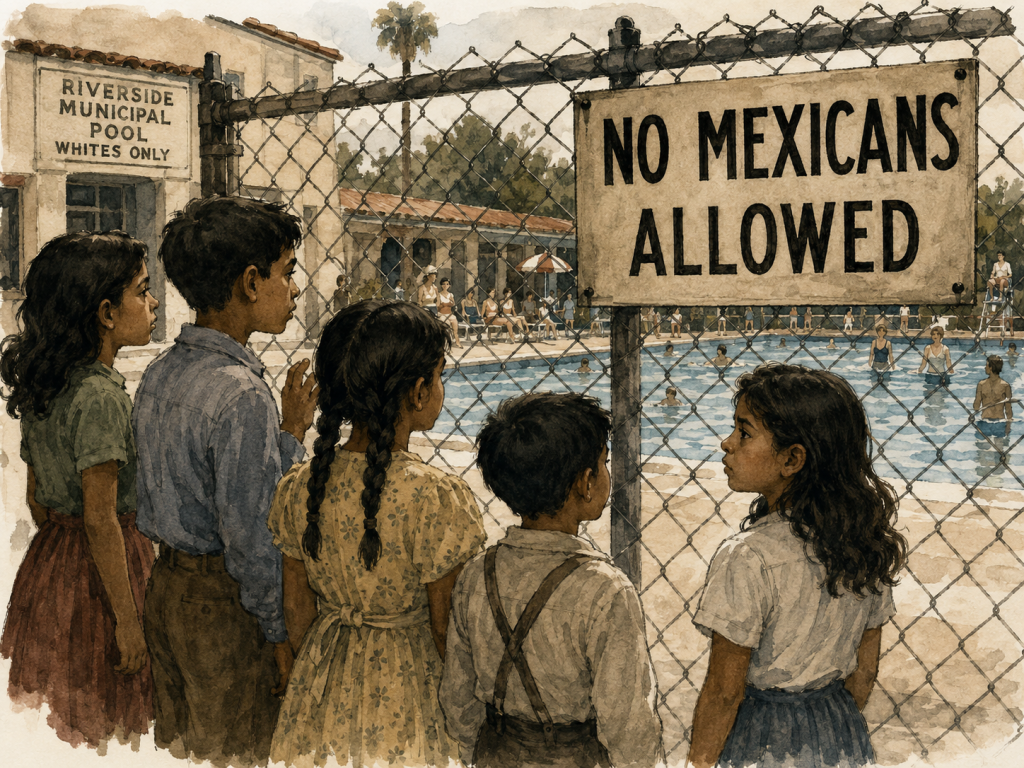
In San Bernardino, California, Mexican Americans helped pay for the city’s public swimming pool with their taxes.
But they were not allowed to use it like everyone else.
During the 1940s, Mexican Americans were permitted to swim at the city’s pool only on the day before the water was scheduled to be drained. City officials defended the discrimination with an argument as insulting as it was simple: Mexicans were too dirty to use the pool with everyone else. (Los Angeles Times)
This was California—not Alabama or Mississippi.
And it happened while thousands of Mexican Americans were serving in the United States military during World War II.
You Paid for the Pool. You Couldn’t Use It.
The pool was part of San Bernardino’s public park system. Mexican-American residents paid taxes supporting the park, bathhouse, and swimming facilities.
Yet for years, people of Mexican or Latin descent were denied equal access.
The discrimination was not something later historians had to guess about. In the federal court record, Judge Leon Yankwich found that Mexican and Latin residents had been excluded solely because of their ancestry. He also specifically found that the plaintiffs helped financially support the public facilities from which they were excluded. (Justia Law)
The court even addressed the excuse behind the segregation. It found that the plaintiffs were healthy, had no infectious diseases, and posed no danger to other swimmers. (Justia Law)
In other words, the supposed problem wasn’t hygiene.
The problem was that they were Mexican.
The Mexicans Fought Back
Among those who challenged the city was Ignacio Lopez, a Mexican-American newspaper editor and civil-rights activist.
He was hardly the caricature that segregationists wanted Californians to imagine. Lopez was a college graduate, a taxpayer and an American citizen. He had worked for the federal government’s Office of War Information and served as a Spanish-language director for the Office of the Coordinator of Inter-American Affairs. (Justia Law)
He was joined by Rev. R. N. Nunez, a Catholic priest of Mexican ancestry, and Eugenio Nogueroa, a Puerto Rican-born newspaper editor, Army veteran, and American citizen.
Students Virginia Prado and Rafael Munoz were also among the petitioners. (Justia Law)
They did not go to court only for themselves.
They sued on behalf of approximately 8,000 American citizens of Mexican and Latin descent living in the area. (Justia Law)
Their attorney was David C. Marcus.
The defendant was San Bernardino Mayor William C. Seccombe, along with members of the city government responsible for enforcing the policy.
The case became Lopez v. Seccombe.
The Judge Said No
On February 5, 1944, the federal court ruled that San Bernardino’s treatment of its Mexican-American citizens was unconstitutional.
Judge Yankwich found that denying them equal access violated their constitutional rights and ordered that they receive the same accommodations, privileges, and treatment as other American citizens using the park and swimming pool. (Justia Law)
It sounds obvious today.
They were Americans.
They paid taxes.
It was their swimming pool too.
But somebody had to go to federal court to make California officials recognize it.
Before Mendez, There Was Lopez
Most people who know Mexican-American civil-rights history know Mendez v. Westminster, the landmark California case that attacked the segregation of Mexican-American schoolchildren.
Lopez came first.
Three years later, when the federal appeals court decided Mendez in 1947, Judge William Denman specifically pointed to Lopez v. Seccombe. He wrote that the Mendez decision was following the precedent established in the San Bernardino case. (Justia Law)
Yet Mendez became famous while Lopez largely disappeared from popular memory.
Even today, professors in the Inland Empire report that many students arrive knowing nothing about a major civil-rights victory that happened in their own backyard. (Los Angeles Times)
The Part We Forget
We often tell the history of segregation as though it happened somewhere else.
The South had its segregated lunch counters, schools, and buses.
California had sunshine, Hollywood and beaches.
California also had communities where Mexican children attended separate schools, Mexican families faced discrimination in businesses and public places, and Mexican Americans could be told they were too dirty to swim in a pool their own taxes helped maintain.
That is why Lopez v. Seccombe matters.
The victory was not handed to Mexican Americans by enlightened government officials.
Mexican Americans forced the government to recognize rights they already had.
And sometimes the civil-rights movement did not begin with a march or a famous speech.
Sometimes it began on a hot California day when somebody simply wanted to go swimming.
https://law.justia.com/cases/federal/district-courts/FSupp/71/769/1674780/?utm_source=chatgpt.com