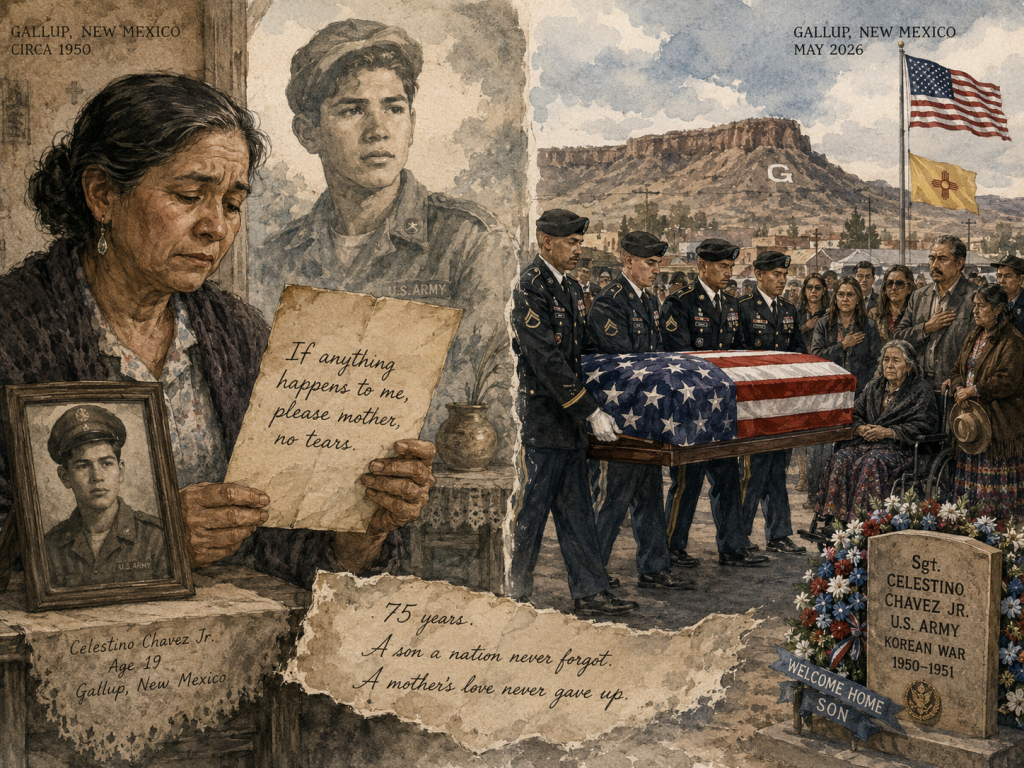
Three days before one of the worst battles of the Korean War, 19-year-old Celestino Chavez Jr. wrote home to his mother in Gallup, New Mexico.
His letter ended with nine words:
“If anything happens to me, please, Mother, no tears.”
His mother, Lupita Chavez, received the letter on November 27, 1950.
Three days later, her son was badly wounded at the Chosin Reservoir.
Two days after that, he disappeared.
For more than 75 years, Celestino Chavez never came home.
In April 2026, he finally did.
A Mexican-American Kid From Gallup
Celestino Chavez Jr. was born in Gallup, New Mexico, in 1931. The New Mexico National Guard identified him as Mexican American and one of eight children born into a farmworker family. He attended public schools and later Cathedral High School in Gallup.
Military service already ran through the family.
His three older brothers — Faustino, Frank and Urban Chavez — had all served in the U.S. Army during World War II. Celestino watched them go off to war and wanted to follow them.
He did not wait long.
On January 10, 1949, six weeks before his 18th birthday, Celestino enlisted in the Army.
His mother reportedly did not want him to go.
He went anyway.
Korea
By late 1950, Chavez was serving with Battery D, 15th Anti-Aircraft Artillery Automatic Weapons Battalion, 7th Infantry Division.
Then came Chosin.
The Battle of the Chosin Reservoir has become legendary in American military history. In bitter winter conditions, U.S. and other United Nations forces were surrounded and attacked by vastly larger Chinese forces in North Korea.
On November 30, 1950, Chavez was manning an anti-aircraft weapon when he was seriously wounded.
He could have left.
He did not.
According to the citation that accompanied his posthumous Silver Star, there was no one available to replace him, so Chavez remained at his weapon despite his wound.
He kept firing.
Only after the enemy attack had been broken did blood loss finally overcome him. He collapsed from the gun carriage and was evacuated to an aid station.
He was 19 years old.
Then He Disappeared
Being wounded did not end Celestino’s ordeal.
On December 2, he was being transported toward Hagaru-ri when enemy forces ambushed the convoy.
Chavez disappeared.
The Army found no evidence that he had been taken prisoner and no evidence that he had survived. In 1953, the Army issued a presumptive finding of death.
Back in Gallup, his family was left with something military families have endured in every war:
No body.
No grave.
No final goodbye.
Just the last letter.
Please, Mother, no tears.
His Name Stayed Behind
Celestino Chavez became the only serviceman from Gallup still unaccounted for from the Korean War, according to contemporary records later cited by military officials. His name was placed among the missing at the National Memorial Cemetery of the Pacific in Honolulu.
Years became decades.
His mother died without seeing her son come home.
The Korean War itself gradually became what is often called America’s Forgotten War.
Celestino became one of its forgotten soldiers.
But the United States never officially stopped looking.
Fifty-Five Boxes
Then, in 2018, something happened that finally opened a path home.
Following the June summit between President Donald Trump and North Korean leader Kim Jong-un, North Korea turned over 55 boxes believed to contain the remains of American servicemen killed during the Korean War.
The remains arrived at Joint Base Pearl Harbor-Hickam in Hawaii on August 1, 2018.
Inside those boxes were pieces of a mystery that had begun nearly seven decades earlier.
Scientists with the Defense POW/MIA Accounting Agency began the painstaking work of determining who those men had been.
They used anthropological examination, military and circumstantial evidence, mitochondrial DNA, mitochondrial genome sequencing, and nuclear DNA analysis.
One set of remains finally produced an answer.
Celestino Chavez Jr.
He was officially accounted for on April 15, 2025.
His family was eventually given the complete identification report.
Then arrangements began for a journey that had been delayed for three-quarters of a century.
Gallup Was Waiting
On April 15, 2026 — exactly one year after his identification — Celestino Chavez Jr. was buried in Gallup with full military honors.
Soldiers from the 7th Infantry Division and members of the New Mexico National Guard participated in the ceremony. His surviving nephew received honors recognizing Chavez’s service.
Family members, military leaders, and state officials gathered as the young soldier who had disappeared in Korea finally returned to the town he had left as a teenager.
He came home with the Silver Star, Purple Heart, and Korean Service Medal, with two Bronze Service Stars recognizing the service he had performed before disappearing.
Celestino Chavez was no longer missing.
“No Tears”
There are thousands of stories about soldiers going to war.
This one began with three brothers who served in World War II and a younger Mexican-American boy who could hardly wait until he was old enough to follow them.
It passed through one of the most brutal battles of the Korean War.
It survived inside military records, a mother’s memory, DNA, and 55 boxes of human remains returned from North Korea.
And it ended in Gallup, New Mexico, 75 years later.
Celestino Chavez had asked his mother for one thing if something happened to him.
No tears.
That may have been too much to ask.
But after 75 years, her son was finally home.