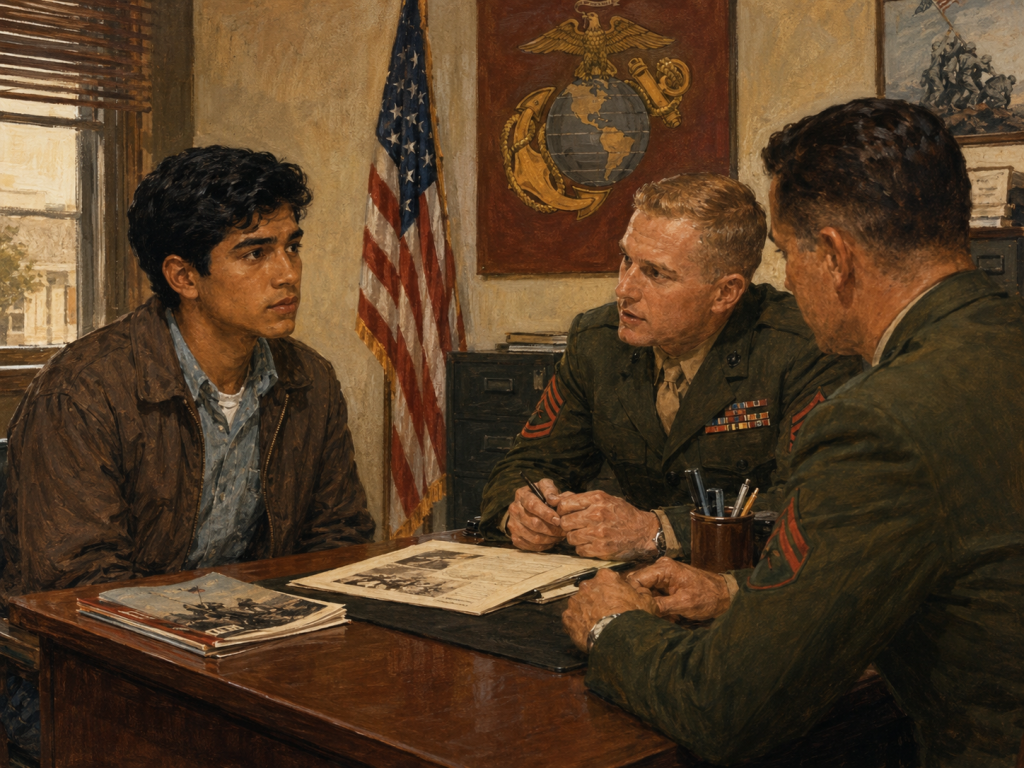
I know how to take tests. I have taken hundreds of them during my lifetime. I know when I have done well, and I know when I have walked out of a test wondering whether I survived it.
When I took the Marine officer examination, I walked out confident.
I had done well.
Months later, the Marines told me I had failed.
I did not believe them then.
More than fifty years later, I still don’t.
I asked them for my score.
They refused to give it to me.
I Had Wanted to Be a Marine Since I Was 17
This was not the first time I had tried to join the Marines.
When I was 17, I went to a Marine recruiter and tried to enlist. Because I was underage, my parents had to sign. They refused.
At the time, I was taking automotive mechanics. I had started the program in January 1967 and would not finish until May 1969.
The Marine recruiter told me something I still remember:
“Finish the class. We need mechanics more than we need people with guns.”
That made sense. Vietnam was consuming men, trucks, equipment, and machinery. Marine Corps records show that a Maintenance Battalion was established in Vietnam in February 1967, just after I began my automotive training, and Marine histories from the war document the enormous role played by motor transport and maintenance units.
So I finished the course.
I wasn’t trying to stay away from the Marines. I was trying to become more useful to them.
The Government Record Is Still There
For years, this story existed mostly in my memory.
Then I decided I wanted my Selective Service records.
Getting them turned into a battle of its own. It took me nearly two years of requests, waiting, paying fees, and pushing before the records finally arrived.
There I was.
Barrera, Manuel J. — line 24.
The old Selective Service classification sheet preserves the changes in my draft status during those years. It includes my II-S student deferment while I was in school. The document does not tell me what happened to my Marine officer examination, and it does not contain the score the Marines refused to give me. But it establishes that these events occurred during the exact period I remembered.
The record matters because memories can change over fifty years.
Paper does not remember.
It just sits there.
Then I Wanted to Become an Officer
By then I was no longer the 17-year-old kid trying to get his parents to sign an enlistment form.
I was going to college.
I decided I wanted to become a Marine officer.
I took the examination.
I remember sitting for that test. More importantly, I remember walking away from it. I was confident I had done very well.
I am not claiming that I never failed a test in my life. I did. I am saying that after taking hundreds of examinations over the years, I learned to recognize the difference between doing badly, barely getting through one, and knowing the material.
I knew I had done well on that Marine test.
Then months passed.
Finally, I was told I had failed.
I wanted to know my score.
They would not tell me.
That bothered me then. It bothers me more today.
My Name Was Manuel Barrera
There was something else I knew about myself.
I had a strong South Texas accent.
I grew up surrounded by Spanish and English. Sometimes the two languages met somewhere in the middle. My accent was strong enough that it was one of the reasons I chose Oklahoma State University instead of staying much closer to home. I thought that if I remained in South Texas, I would continue speaking the same way.
I knew people judged you by an accent.
And nobody had to ask whether I was Mexican-American.
My name was Manuel Barrera.
So when the Marines told me I had failed an examination I believed I had passed, a question entered my mind.
Was it really the test?
Or was there something else?
The Numbers I Didn’t Know Then
At the time, I had no way to look inside the Marine Corps and see who was becoming an officer.
Today we can.
A Government Accountability Office report later compiled Defense Department personnel statistics going back to 1971. GAO defined “minority” to include Hispanics, along with Black, Asian, Pacific Islander, American Indian, and Alaska Native service members.
In 1971, there were only 591 minority officers in the entire Marine Corps.
They represented 2.7 percent of Marine officers.
Not Hispanics alone.
Every minority group combined.
That is the Marine officer corps I was trying to enter.
The Marines Knew They Had a Problem
This is not a case where someone fifty years later has decided the Marines must have had a racial problem.
The Marine Corps knew it had one.
The Corps’ own official history says that in the late 1960s it began an intensive effort to increase minority representation among officers. In 1969, Headquarters Marine Corps established an Equal Opportunity Branch whose mission included ensuring equal treatment regardless of race, color, creed, or national origin.
The Corps created a Special Assistant to the Commandant for Minority Affairs. It formed a civilian advisory committee on minority affairs. In 1972, it established the Marine Corps Human Relations Institute in San Diego and began requiring human-relations training throughout the Corps.
The official history records something even more revealing. Marine officials were making a deliberate effort to recruit more minority officers because there were so few of them.
By September 1973, for example, there were only 378 Black officers on active duty — 2.03 percent of the Marine officer corps — while Black Marines made up more than 17 percent of the enlisted force.
The surviving Marine history documents the problem most thoroughly for Black Marines. It does not give me a rejection rate for Mexican-American officer candidates.
But the broader numbers include Hispanics, and they tell us something important.
The Marine Corps’ officer ranks were overwhelmingly non-minority, and the Corps itself was taking extraordinary steps to change that.
So What Happened to Me?
I don’t know.
That may be the most important sentence in this story.
I cannot prove that someone rejected me because I was Mexican-American.
I cannot prove that someone heard my South Texas accent and decided that I didn’t sound like a Marine officer.
I cannot prove that somebody looked at the name Manuel Barrera and put my application in a different pile.
The Marines could have proved something very easily.
They could have shown me my score.
They didn’t.
Instead, they told me I had failed and refused to tell me how badly I supposedly had failed.
So I was left with my own memory of the examination.
And now, more than fifty years later, I also have something I did not have then: the historical record.
I know that minorities made up only 2.7 percent of Marine officers in 1971.
I know that Hispanics were included in that tiny percentage.
I know that the Marine Corps itself was creating equal-opportunity offices, minority recruiting programs, and human-relations programs because it knew there was a problem.
And I know what I knew when I walked out of that examination room.
I had done well.
I Still Want My Score
Maybe the Marines were right.
Maybe somewhere on that examination I made mistakes I did not recognize.
I have always allowed for that possibility.
But there is another possibility, and after looking at the history of the Marine Corps of that period, I no longer believe it is unreasonable to ask about it.
I was a young Mexican-American from South Texas with a Spanish surname and a strong accent, trying to enter an officer corps in which minorities were almost invisible.
They told me I failed.
They would not show me the score.
So the question that bothered that young man more than fifty years ago is still the question the old man asks today:
Did I fail the Marine officer examination?
Or did I fail somebody’s idea of what a Marine officer was supposed to look and sound like?