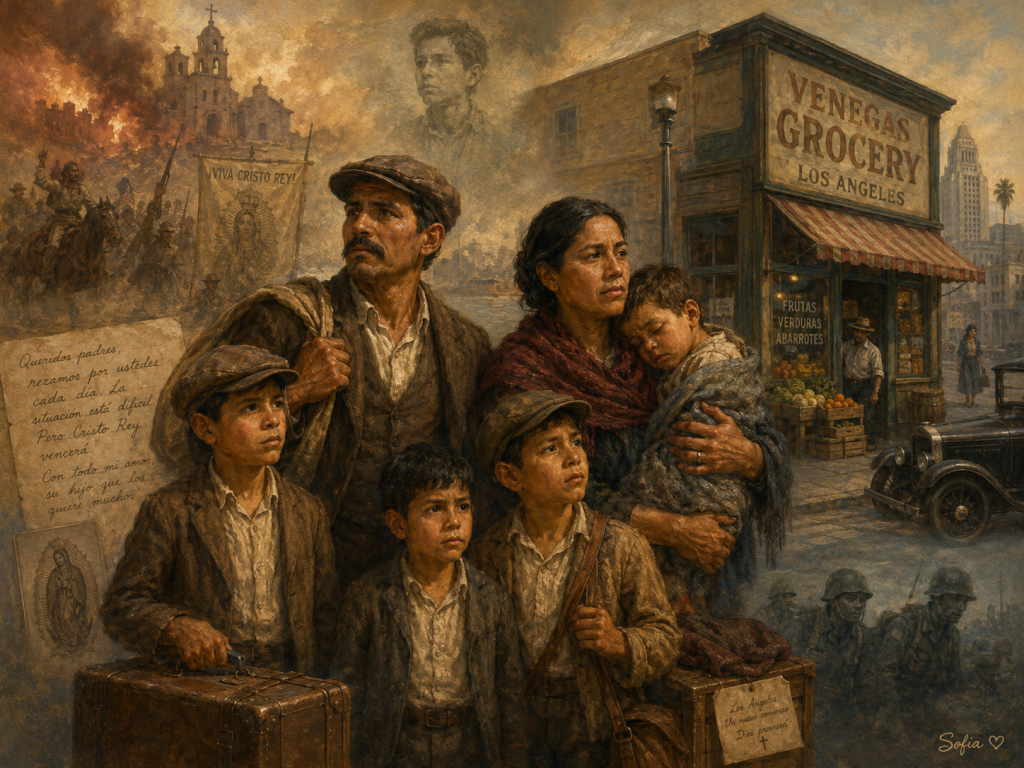
In 1927, Miguel Venegas left behind a life that, by most standards, had been a good one.
He had a wife, Dolores, four young sons, a successful store, ranch property, and family in Jalisco, Mexico. He was not leaving because he had dreamed all his life of moving to Los Angeles.
He was leaving because remaining in Mexico had become dangerous.
Miguel had become involved with the Cristeros, Catholics who took up arms against the Mexican government during a conflict that most Americans today have probably never heard of: the Cristero War.
Miguel fled first.
Dolores and the children stayed behind.
For several months, a family was divided by a war.
A War Almost Forgotten
The Cristero War erupted in 1926 after the Mexican government began aggressively enforcing constitutional restrictions on the Catholic Church. Churches closed, priests were expelled or went into hiding, and armed rebellion spread through parts of western Mexico, particularly Jalisco.
The conflict was about religion, but it was also the latest battle in a much older struggle over political and economic power between the Mexican government and the Catholic Church.
Miguel Venegas joined the Cristero cause.
His brother Alfonso did too.
That decision would change the family forever.
By 1927, Miguel believed his life was in danger. He left Jalisco and headed north, reaching Los Angeles in June.
The man who had owned property and operated a business in Mexico found his first work in California washing dishes.
Dolores Follows
Four months later, Dolores came north with their four boys.
Imagine that journey without knowing how the story would end.
She was leaving her home, her relatives, and almost everything familiar to her. Waiting in Los Angeles was not prosperity. Miguel was trying to survive in a new country, and the family had to begin again.
Dolores still had cattle in Mexico. She sold them, and the money helped the couple buy a small grocery store at 805 California Street in Los Angeles.
The store became their foothold.
Their surviving letters, now preserved by Loyola Marymount University, let us see something immigration statistics cannot show.
They let us hear the family.
In a 1928 letter, Miguel reduced the immigrant experience to a few words:
“The only problem here is making a living.”
It sounds almost humorous until you understand everything contained in that sentence.
They had escaped Mexico.
Now they had to survive America.
A Mother’s Life Between a Store and a House
Dolores wrote home too.
Her letters describe days consumed by the grocery store, the house, and the children. At night she prayed the rosary. Sometimes she tried to sew before going to bed. She worried because exhaustion kept her from answering letters from Mexico.
The children still talked about going back.
They wanted to see their grandparents and relatives in Jalisco.
California was where they lived.
Mexico was still home.
That small detail may say more about the first generation of immigrants than pages of history. Adults can decide that a family must leave. Children only know that the people they love are suddenly far away.
And there was another absence hanging over the Venegas family.
Miguel’s brother Alfonso had disappeared.
What Happened to Alfonso?
Alfonso Venegas had supported the Cristero rebellion with something more dangerous than a rifle.
He operated a small printing press producing material for the Cristero cause.
Mexican federal troops eventually discovered the operation near San José de Gracia. According to later historical research based partly on the family’s recollections, troops machine-gunned the building.
Alfonso and another man were killed.
But his family did not know exactly what had happened.
For roughly thirty years, the Venegases lived without final confirmation of Alfonso’s fate.
It was not until around 1960 that a witness finally told them what had happened.
By then, an entire generation of Venegas children had grown up hearing about the uncle who never returned.
Their daughter María Teresa later remembered how strongly Alfonso remained part of the family’s consciousness. To them, he was not simply a relative who had died long ago.
He was a martyr.
Then Came the Depression
The Venegases had barely established themselves when America collapsed into the Great Depression.
Their customers struggled to pay.
In a December 1931 letter, Miguel described seeing people begging on Los Angeles streets and families seeking help from La Placita, the historic church at the center of the Mexican community.
America had offered refuge from one kind of danger.
It could not protect them from poverty.
Earlier that year, the family had faced a more personal fear.
Miguel wrote home that his six-year-old son Guillermo might have tuberculosis.
For a parent in 1931, before modern antibiotics transformed the treatment of tuberculosis, those words carried a frightening meaning.
Guillermo survived.
And then history did something families sometimes experience without noticing its irony until years later.
The sick little Mexican boy whose parents had fled to the United States grew up.
And America sent him to war.
Their Sons Went to Fight for America
When the United States entered World War II, three Venegas sons served.
Guillermo went to the South Pacific.
Ricardo served in Alaska.
José Miguel became a crewman aboard a B-17 bomber and flew 33 combat missions over Europe.
Years later, another son, Juan José, served in the Korean War and returned with a Purple Heart.
Their parents had fled Mexico because of war.
Then Dolores watched her sons leave home to fight America’s wars.
That is the part of immigration history that often disappears.
Governments may question whether immigrants belong. Neighbors may question whether they are truly American. Politicians may spend years arguing about borders and citizenship.
Then war comes.
And somebody’s son gets on the ship.
Another Family Was Being Taken Away
During World War II, the Venegas story crossed another American story.
Japanese-American neighbors who were being forced from their homes during the government’s wartime incarceration asked Miguel Venegas to manage their Bunker Hill apartment building while they were gone.
Think about that for a moment.
A Mexican man who had fled political and religious violence in his own country was now watching the United States remove another family from its home because of its ancestry.
The Japanese-American owners trusted Miguel with what they were being forced to leave behind.
History rarely arranges itself more neatly than that.
Ten Children
Miguel and Dolores eventually raised ten children.
The family that had arrived divided and frightened grew roots in California.
Their children went to school. Some went to college. They entered professions. They fought in wars. They married and produced another generation.
In 1969, more than forty years after Dolores arrived in Los Angeles with four small boys, the Mexican-American community honored her as Mexican Mother of the Year.
That same year, Miguel and Dolores celebrated their 50th wedding anniversary.
They had not forgotten Mexico.
They eventually built another home in Jalisco and divided some of their later years between the two countries. Miguel helped finance a Red Cross hospital and a school there.
The family had crossed a border.
They never completely erased it.
The Daughter Who Saved the Letters
One of the children born after the family reached Los Angeles was María Teresa Venegas.
She was born in 1930.
She grew up, earned a doctorate, and became a professor.
And then she did something that allowed the rest of us to know her parents.
She saved their letters.
The correspondence, photographs, immigration papers, business records, and family albums eventually became the Venegas Family Papers at Loyola Marymount University.
In those papers, Miguel and Dolores are no longer simply names in an immigration record.
We can see them worrying about money.
We can see Dolores becoming exhausted.
We can hear the children asking to return to Mexico.
We can see a father fearing that his little boy has tuberculosis.
We can follow that boy until he becomes a soldier fighting in the Pacific.
The daughter preserved the voices her parents had sent across the border almost a century ago.
One Last Journey
Dolores died in 1991.
She had been married to Miguel for more than seventy years.
The following year, Miguel Venegas did something remarkable.
He had lived in the United States since 1927. His children were Americans. His sons had fought America’s wars. He had operated businesses, raised a family and spent most of his adult life in California.
In 1992, at about 95 years old, Miguel became a citizen of the United States.
He died two years later.
There is something almost unbearably human about that ending.
The young man who fled Jalisco because someone wanted him dead had arrived in Los Angeles and washed dishes.
He and Dolores built a grocery store.
They survived the Depression.
They waited decades to learn what happened to Alfonso.
They worried over sick children.
They sent sons to World War II and Korea.
They raised ten children.
And sixty-five years after Miguel first crossed into the United States, the old man finally raised his hand and became an American citizen.
The Venegases did not begin their American story because they wanted to leave Mexico.
History pushed them out.
What they did afterward was build another home.