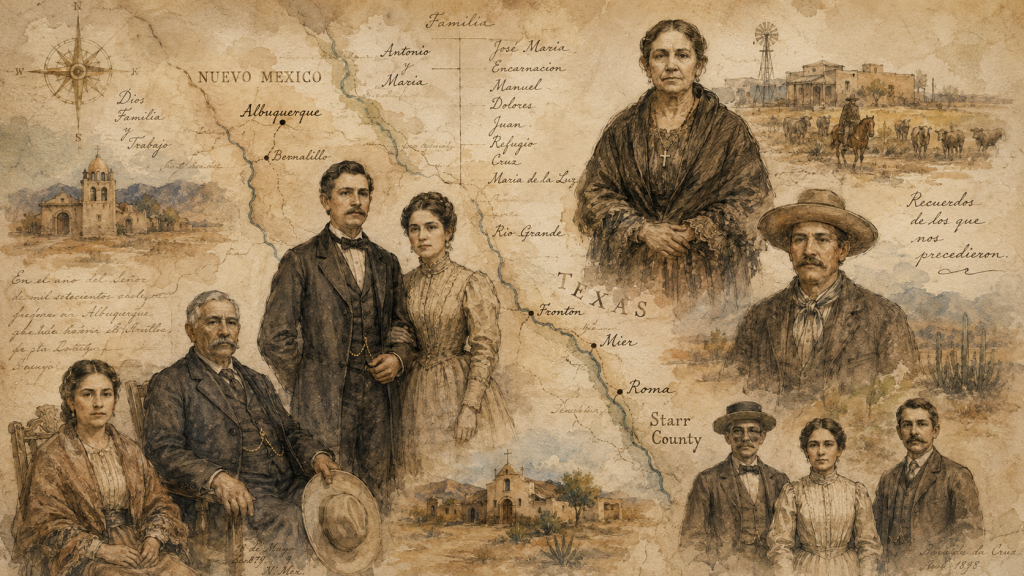
A factionalized family history based on the Barrera records, Starr County land records, and the history of the Garza War.
The river was not very wide.
That was the strange thing about it. A man could stand on one side and see the country on the other. The mesquite looked the same. The dust was the same. The people spoke the same Spanish. Families lived on both banks and had for generations.
Only the government said one side was Mexico and the other was the United States.
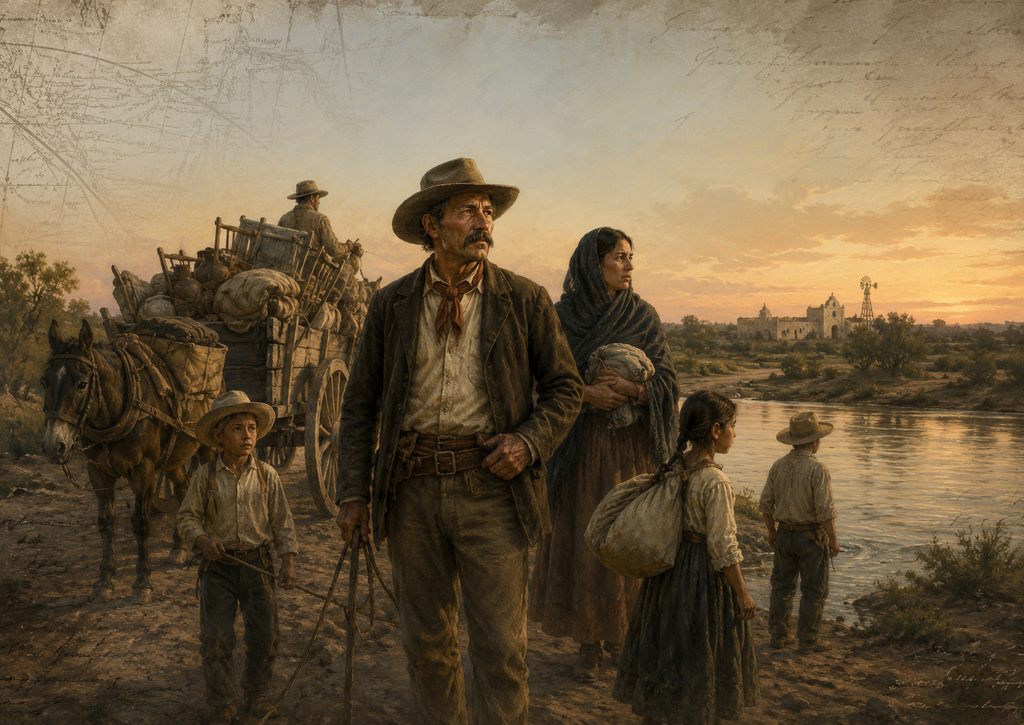
Sometime around 1890 or 1891, José Aniceto Barrera decided that his family would live on the American side.
He was about fifty years old.
Men of fifty did not usually gather up a wife, children, animals, and belongings and begin again without a reason.
Aniceto did not call a family meeting.
There was no reason to explain politics to children.
He spoke to his wife.
There had been talk for months. Men were angry with Porfirio Díaz. Newspapers crossed the river. So did rumors. Catarino Garza had friends and followers throughout the border country. Men rode between ranches and towns. Conversations stopped when strangers approached.
Something was coming.
Exactly what Aniceto knew cannot be recovered. No letter survives saying that he supported Garza. No document tells us that he attended a meeting or carried a rifle for anyone.
But people living along the river did not need newspapers from Mexico City to tell them when trouble was building.
They heard it from brothers, cousins, merchants and ranch hands.
And Aniceto had family on the other side.
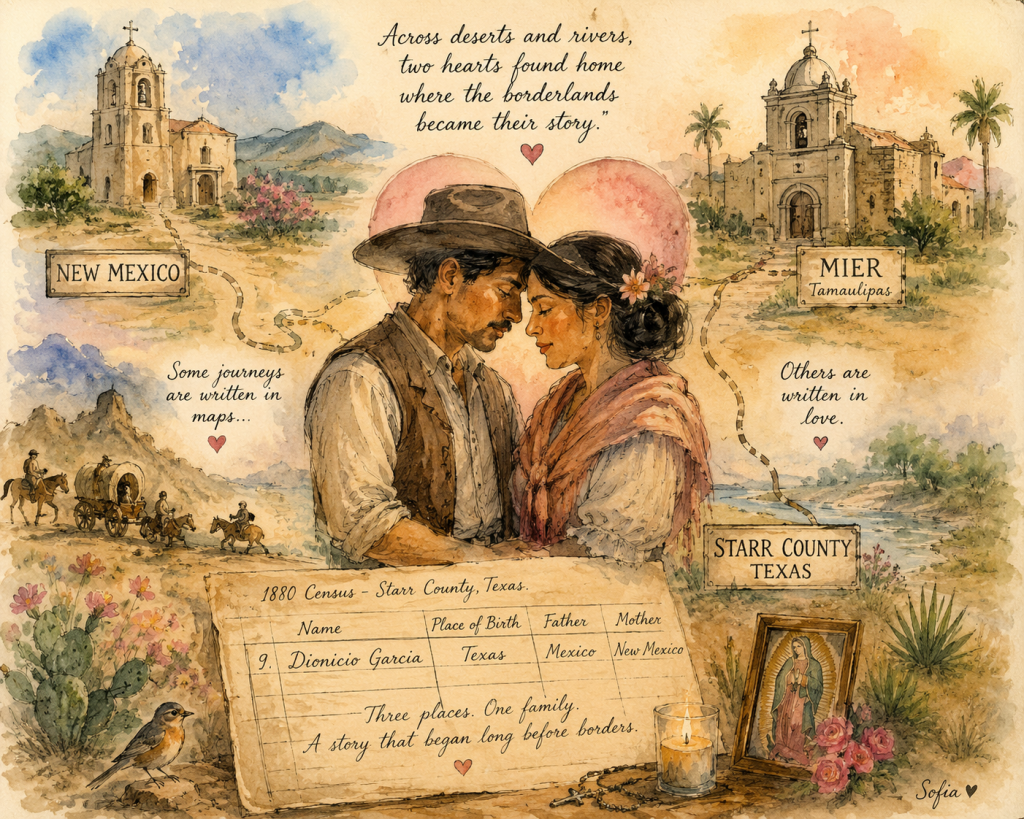
His Barrera relatives had been appearing in Roma records since at least the 1860s. The move north was not a journey into a strange country. Roma was part of the same world Aniceto already knew.
There was something else on the Texas side.
Land.
Exactly how Aniceto acquired it remains a mystery.
Perhaps it came through his mother. Perhaps through his wife or her family. Perhaps it was one small piece of the maze of inherited interests created when old Spanish grants were divided among children, grandchildren, and cousins until nobody could explain the ownership without drawing a family tree.
Whatever the answer, the land was real.
By 1893, Aniceto would sign a document in Roma selling a field in Porción 69, the old Antonio Sánchez Spanish land grant.
He did not describe himself as a newcomer buying his first piece of Texas.
He called the field his property.
That fact changes the story.
Maybe Aniceto was not coming to Texas looking for land.
Maybe he was coming to land already waiting for him.
One evening, his wife watched him outside.
He had been quieter than usual.
“You heard something.”
It was not really a question.
Aniceto looked toward the river.
“We should go.”
“To Roma?”
“To the other side.”
She knew what that meant. There would be packing. Children complaining. Animals to move. Things that could not be carried would have to be left behind.
“For how long?”
Aniceto did not answer immediately.
That may have been because he did not know.
People who leave before wars seldom know they are leaving forever.
“Until things settle.”
It was probably the same sentence thousands of Mexican families would use twenty years later when revolution swept across northern Mexico.
Until things settle.
Some went back.
Many never did.
The children were told what children needed to know.
They were moving.
Felipe was about twelve or thirteen. Old enough to understand that something important was happening, but perhaps too young to know why.
There were relatives near Roma. There was work. There was land. They would not be alone.
The Rio Grande was crossed every day by people who barely thought of it as an international journey. Families visited families. Livestock wandered where politics said they should not. Men worked on one side and slept on the other.
But moving an entire household was different.
Someone had decided that the safer place was north of the river.
If Aniceto knew that Garza’s revolt was coming, his decision made sense.
Move the wife.
Move the children.
Secure what property you can.
Stay close enough to watch Mexico from across the river.
And wait.
In September 1891, Catarino Garza’s followers began crossing from Texas into Mexico in armed expeditions against the Díaz government.
Then the border country filled with soldiers.
Mexican troops hunted rebels on one side. United States soldiers and Texas Rangers pursued them on the other. Ranches were searched. Men disappeared into the brush. Everyone seemed to know somebody involved, suspected of being involved, or related to somebody involved.
Whether Aniceto had crossed months earlier or only shortly before the fighting began, the decision suddenly looked wise.
His family was already north of the river.
Two years later, on June 12, 1893, Aniceto Barrera appeared in Roma and sold Antonio S. Ramirez a field in Porción 69.
The price written into the document was ten dollars.
The deed does not explain how Aniceto got the property.
That missing piece bothered me at first.
I searched for the deed that put the land in his hands.
I could not find it.
Perhaps there never was one.
Land along the lower Rio Grande did not always pass neatly from seller to buyer. Some of it descended through families whose claims reached back to Spain. A man could inherit a fraction from his mother, another fraction through marriage, and later obtain the interests of brothers, sisters, and cousins.
Years afterward, Aniceto’s oldest son, Inocencio, would accumulate hundreds—and perhaps considerably more—acres, often using quitclaim deeds. He was gathering pieces of ownership scattered among people who possessed some inherited interest in the land.
That may be another clue.
But it does not solve the mystery.
And perhaps it should not.
My mother remembered something much simpler.
The Barreras had money. They had property.
Family memories sometimes preserve what government records lose.
She did not know which ancestor signed which deed. She did not need to.
The family knew that the Barreras had owned land.
And here, more than a century later, is Aniceto in 1893 selling a piece of it.
So we are left with a fifty-year-old man standing somewhere near the Rio Grande around 1890 or 1891.
Behind him was Mexico.
Ahead of him were relatives, property, and another government.
Around him were whispers that political trouble was coming.
We cannot prove that the Garza War caused Aniceto Barrera to move his family.
We cannot prove that he knew beforehand what was going to happen.
We do not even know the exact year he crossed. The 1900 census recorded it simply as 1890. It could easily have been 1891.
But we know what he did.
At an age when most men were settled into the life they expected to keep, Aniceto packed up his entire family and moved them across the Rio Grande.
Soon afterward, men began shooting.
And three years later, the records find him exactly where he had chosen to go—
in Starr County,
with family nearby,
and with land that he already called his own.
Maybe that was coincidence.
Or maybe Aniceto Barrera saw the ocean pulling away from the beach before everyone else understood what it meant.