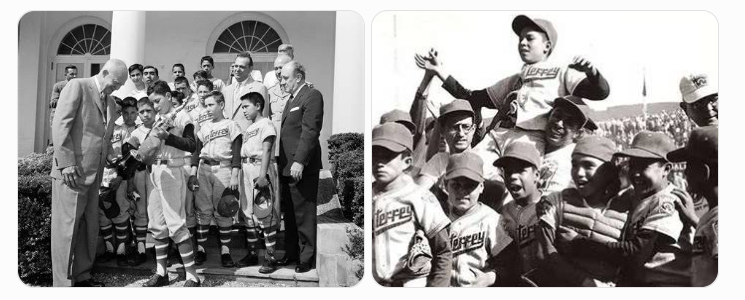
Click on the image above for more on the Little Giants
In August 1957, before they became world champions, before Ángel Macías threw the most famous game in Little League history, a team of small boys from Monterrey, Mexico, came through Corpus Christi.
They were already attracting attention by then. They were smaller than many of the American teams they faced; they had little money, and they had begun their tournament run with no realistic expectation that it would carry them all the way to Williamsport.
But they kept winning.
And Corpus Christi became one of the stops on that unlikely journey.
Two games, two shutouts
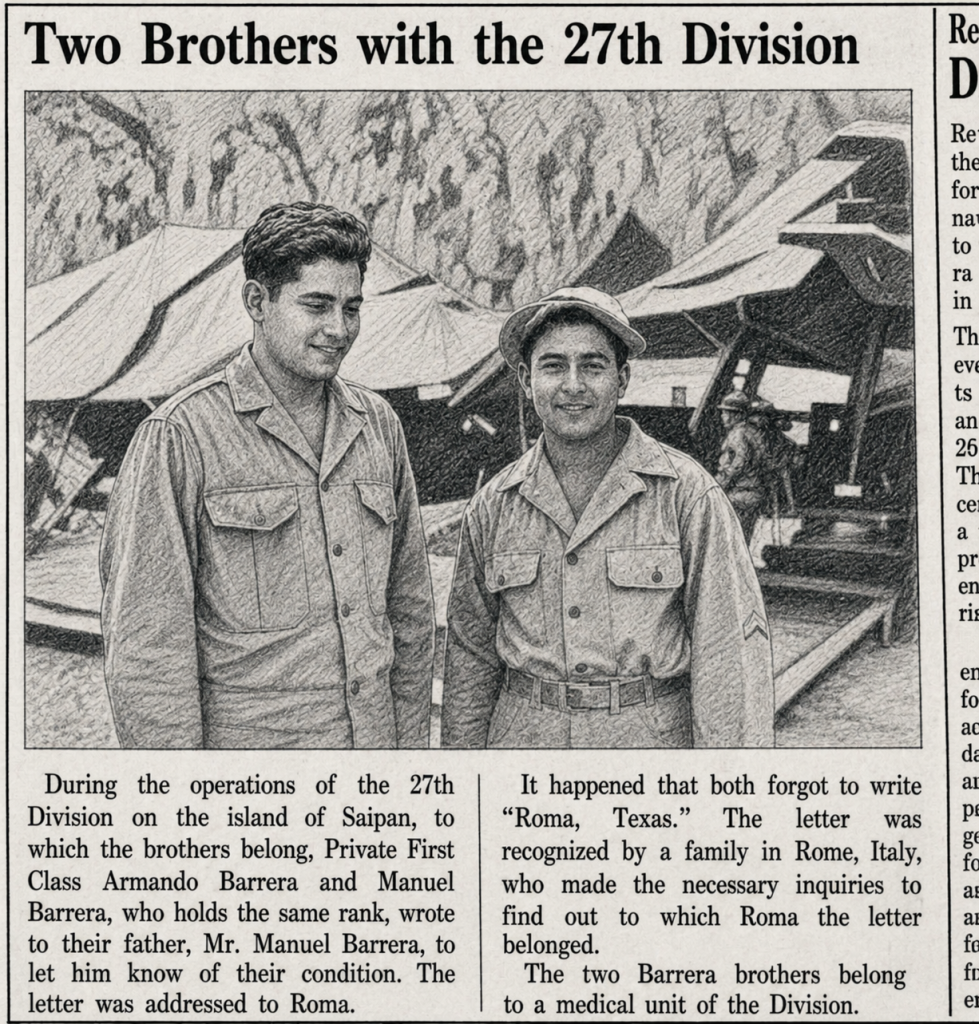
The Monterrey Industrial Little League team came to Corpus Christi for the next stage of tournament play after advancing out of the Rio Grande Valley.
They played at Universal Little League Field.
In the first game, Monterrey defeated Mexico City, 5–0, behind a complete-game shutout by Enrique Suárez, who was also one of the team’s best hitters.
Then they defeated the Houston All-Stars, 6–0, with Ángel Macías throwing another complete-game shutout.
Two games.
Eleven runs scored.
None allowed.
Those victories sent Monterrey north to Fort Worth, where the boys would continue their remarkable march through Texas.
Corpus came out to watch
A Google archival search of contemporary accounts describes something more than an ordinary Little League tournament at Universal Field.
The bleachers filled. Late-arriving spectators crowded around the perimeter to watch. The little Mexican team had begun attracting a following, in part because the boys were noticeably smaller than many of their opponents and yet played disciplined, remarkably effective baseball.
According to that search, the atmosphere became increasingly enthusiastic as Corpus Christi spectators adopted the Monterrey boys as favorites. People crowded close to the field, cheered loudly, and watched a youth tournament begin to feel like something considerably bigger.
The accounts also describe collections being taken to help the poorly funded team continue its journey. Hats were passed, and spectators contributed coins and bills for food and travel.
Those details come from an AI-assisted Google search of historical material rather than a surviving clipping we have personally examined, so Google deserves the credit for recovering that description. The basic tournament record—the games, scores, pitchers, and Corpus Christi stop—has been independently confirmed from other sources.
For those of us who remember the visit, however, the description rings true.
It was big news in Corpus Christi.
The boys stayed with the Marines
The Corpus stop also gave the Monterrey players something they had not always enjoyed earlier in the trip: dependable food and a place to sleep.
They were housed at the Corpus Christi Naval Air Station, where they slept in Marine barracks and ate at the base.
Players remembered the food years later.
That detail sounds almost humorous now, but it mattered. These were children traveling on a shoestring. Earlier in the tournament, the team had struggled with basic expenses as unexpected victories kept extending what had been planned as a short trip.
They had not packed for a journey to Pennsylvania.
They had packed for a few baseball games in Texas.
Universal Little League survived
Universal Little League itself has another Corpus Christi story.
Years after the Monterrey boys passed through, the league lost its original playing field. Marcos Noyola, a longtime West Oso educator and a former Universal Little League player, helped secure state land for a new Universal Little League park in the late 1960s.
That effort helped keep the league alive.
Universal Little League remains part of Corpus Christi youth baseball today, more than sixty years after Noyola and others helped give it a permanent home.
History sometimes remembers people for things their classmates never knew they would someday do.
Noyola deserves credit for helping make sure generations of Corpus Christi children still had a Universal Little League field on which to play.
Corpus noticed them
I remember when the Monterrey team came to Corpus Christi.
I was a boy, and it was big news.
That is one of those memories that does not appear neatly in tournament brackets. The record books show scores, pitchers, and championships. They do not show what people in a city were talking about around the dinner table or what children heard adults discussing.
By the time the Monterrey boys reached Corpus, people had begun paying attention.
Here was a team of Mexican boys beating everybody put in front of them.
They were not supposed to become one of the most famous Little League teams in history.
At that point, nobody knew they would.
That is what makes the Corpus stop interesting.
We were seeing the story before we knew how it ended.
They kept going north
After Corpus Christi, Monterrey traveled to Fort Worth.
They won there too.
Then they continued through the regional tournament system and eventually reached the Little League World Series in Williamsport, Pennsylvania.
Their path was unusual because in 1957 Mexico did not yet have the direct international route into Williamsport that later teams would have. Monterrey had to advance through the Texas and southern United States tournament structure.
A team from Mexico had, in effect, played its way through Texas.
And it kept winning.
August 23, 1957
On August 23, Monterrey faced La Mesa, California, for the Little League World Series championship.
Ángel Macías took the mound.
He retired all 18 batters he faced.
No hits, no walks, and nobody reached base.
Monterrey won, 4–0.
Macías had thrown a perfect game in the championship game of the Little League World Series, something that has never been duplicated.
The Monterrey Industrial team became the first team from outside the United States to win the Little League World Series.
The boys who had passed through Corpus Christi only weeks earlier were suddenly famous.
Before they were legends
Years later, their story became a book, a movie, documentaries, and a permanent part of Little League history.
The film The Perfect Game introduced their story to another generation.
But before Williamsport, before the movie, and before anybody called them legends, they were simply a group of Mexican boys riding north through Texas and trying to win the next baseball game.
Corpus Christi was part of that journey.
They played at Universal Little League, shut out two opponents, slept at the Navy base, ate with the Marines, and moved on.
Corpus Christi came out to watch them.
I remember that.
And then the little team from Monterrey kept going until there was nobody left to beat.
For Monterrey Industrial Little League, 1957, the roster was:
- Ricardo Cantú
- Baltazar Charles
- Jesús Contreras
- Alfonso Cortez
- Francisco Dávila
- Gerardo Elizondo
- José González Lovas
- Ángel Macías
- José Maiz
- Roberto Mendiola
- Mario Ontivero
- Fidel Ruiz
- Rafael Estrello Sena
- Enrique Suárez
- Norberto Villarreal
- César Faz, manager/coach
Little League’s official 1957 World Series roster page lists those names under Monterrey Industrial.
_________
What became of the Little Giants?
The perfect game made Ángel Macías famous, but there were fourteen boys on the Monterrey team. They did not disappear when the television cameras left Williamsport.
They went home, grew up, found jobs, raised families, built businesses and, in several cases, remained connected to baseball for the rest of their lives. Their adult lives are part of the story because what happened in 1957 was not the accomplishment of one remarkable pitcher. It was the accomplishment of a team.
Ángel Macías remained closest to professional baseball. After his Little League fame, he signed with the Los Angeles Angels organization and spent time in the minor leagues before continuing his career in Mexico. He later played for Mexican professional clubs, including the Broncos de Reynosa and Sultanes de Monterrey.
Baseball remained part of his life long after his playing days ended. He worked with the Mexican Baseball Academy and helped develop younger players. In 2017, sixty years after the perfect game, Little League inducted him into its Hall of Excellence.
Macías died in 2025 at the age of 84.
But another member of the team may have had an even greater influence on Mexican baseball after his playing days ended.
José “Pepe” Maiz became a highly successful businessman. Professional baseball reportedly interested him after the championship, but his father wanted him to enter the family construction business.
He did.
Years later, Maiz became one of the important figures in Mexican professional baseball as an owner and executive with the Sultanes de Monterrey. He also remained a major supporter of youth baseball and Little League in Mexico.
The little boy who once traveled through Texas wondering how the team was going to pay for its next meal eventually became one of the men helping finance baseball for another generation of Mexican children.
Little League inducted Maiz into its Hall of Excellence in 2005.
Then there was Enrique “El Cubano” Suárez.
Corpus Christi has a particular reason to remember him.
Before Ángel Macías pitched the second shutout here, Suárez took the mound against Mexico City and beat them 5–0. He was not merely the pitcher. He was also one of Monterrey’s strongest hitters and batted cleanup.
Suárez remained involved in baseball after growing up. Later accounts identify him with the Mercado de Abastos youth league in Monterrey, helping other children play the game that had changed his own life.
That means one of the two boys who pitched Monterrey’s Corpus Christi shutouts eventually spent part of his adult life helping another generation of children learn baseball.
Jesús “El Coronel” Contreras followed a similar path.
Contreras was not originally the starting catcher. His opportunity came after teammate Norberto Villarreal injured his foot during the tournament run. Contreras stepped into the lineup and became part of the championship team.
As an adult, he became a youth baseball coach.
And years later, something rather beautiful happened: he returned to Williamsport as a coach.
The boy who had once arrived there as an improbable Mexican Little Leaguer came back helping another generation make the same journey.
Contreras died in March 2025 at age 80.
Other teammates followed lives that were less famous but tell us just as much about what became of the Little Giants.
Roberto Mendiola built a career with Teléfonos de México and eventually retired from the company.
Gerardo González worked for Mexico’s Comisión Federal de Electricidad, the national electric utility, before retiring.
Mario Ontiveros spent his working career with Grupo Vitro, one of Monterrey’s major industrial companies.
Rafael Estrello worked as a traveling salesman.
Ricardo Treviño went into the jewelry business and owned ranch property.
They became businessmen, industrial workers, utility employees, salesmen, coaches, and fathers.
In other words, they became adults.
That sounds ordinary only because we know how extraordinary their childhood had been.
They continued to find one another
The bond created during the summer of 1957 did not disappear.
Decades later, surviving members continued gathering for reunions and commemorations. They appeared together at baseball events and were repeatedly honored in Monterrey.
In 2010, more than half a century after their championship, several of the former players were still gathering publicly and telling the story.
By 2021, reports identified six surviving members of the team: Rafael Estrello, Mario Ontiveros, Enrique Suárez, Jesús Contreras, Ángel Macías and José Maiz.
They were old men by then.
But when photographs were taken, and somebody mentioned Williamsport, they were once again the boys from Monterrey.
Several lived long enough to see their story become something none of them could have imagined in 1957: books, documentaries, historical exhibits and the motion picture The Perfect Game.
They lived long enough to understand that what had happened during those few weeks was not simply a childhood baseball tournament.
They had become part of Mexican and American sports history.
One night in Corpus Christi
There is even a small memory from their stay in Corpus Christi that helps bring the boys back down from legend to childhood.
While Monterrey was housed at the military barracks at the Corpus Christi Naval Air Station, the boys slept in bunk beds.
According to a later account attributed to manager César Faz, one of the players, Baltazar Charles, rolled out of an upper bunk during the night.
Faz spent the rest of the night worrying that another boy would fall.
The next morning, they were expected to behave like the young guests of a military installation. The boys swept, mopped, and made their beds.
Then they went back to the baseball field.
That detail may tell us more about them than another line in the tournament standings.
We know what happened afterward, so it is easy to picture them as the Little Giants, already headed toward history.
They weren’t.
They were children.
One fell out of bed.
Their manager worried about them.
They cleaned the barracks in the morning.
Then somebody handed them baseball gloves, and they went out and shut out another team.
The other thirteen boys mattered too
The history of the 1957 championship inevitably centers on Ángel Macías.
That is understandable.
A perfect game in a world championship is the kind of performance that turns one player’s name into history.
But Macías could not have won a championship by himself.
Somebody had to catch the pitches.
Somebody had to make the plays behind him.
Somebody had to score the four runs against La Mesa.
And before Macías ever took the mound in Williamsport, Enrique Suárez and the rest of his teammates had helped get Monterrey through the Valley, Corpus Christi, Fort Worth and the Southern tournament.
Every time the team advanced, fourteen Mexican boys advanced together.
Some became famous.
Most did not.
But all of them were world champions.
And for two games in August 1957, before anybody knew what they were about to become, Corpus Christi got to watch them on their way.