Introduction
More than a decade before Motown became a national symbol of Black music and Black-owned enterprise, Mexican-American musicians and businessmen in the Rio Grande Valley had already built much of the same machinery.
By the late 1940s, South Texas had independent record labels, recording studios, radio connections, jukebox distribution, touring bands, and a large Mexican-American audience buying the music. Ideal Records in San Benito and Falcon Records in McAllen were already recording and distributing Mexican-American artists years before Berry Gordy founded Motown in Detroit in 1959.
But almost none of that entered the American story.
There were no major movies about it, few national histories, and little in schoolbooks to tell later generations that a sophisticated Mexican-American music industry had been operating along the Texas-Mexico border before Motown even existed.
So before we remember what the Valley sounded like in the early 1960s, it is worth remembering this:
The music was there. The industry was there. The audience was there. What was missing was a country willing to remember it.
_______
It is Saturday night, somewhere in the Rio Grande Valley, about 1962.
Maybe you are in McAllen, Pharr, Mercedes, Harlingen, San Benito, Mission, or Brownsville. You are seventeen or eighteen, Mexican-American, and you want to go where the music is.
Your parents might call it música mexicana. Years later, historians will divide it into conjunto, orquesta, Tejano, norteño, rock, and Chicano soul.
You don’t care.
You know what you like.
And in the Valley, there was plenty to like.
The accordion was still king
You could not grow up in South Texas without knowing the sound of the accordion.
Narciso Martínez, the legendary “El Huracán del Valle,” had helped transform the instrument decades earlier. Valerio Longoria had taken conjunto another step, adding drums, singing boleros and rancheras, and making the music sound more modern.
Tony de la Rosa brought still more change.
Ruben Vela, raised around Relampago and Mercedes, was another favorite. He had been performing since he was young and was already appearing regularly on Valley radio during the 1950s. By the early sixties, he was touring and recording.
This wasn’t old music being kept alive for a cultural festival.
This was dance music.
On Saturday night people packed themselves into cars and drove from one Valley town to another to hear it.
At places like the outdoor dances remembered around Brownsville, Harlingen, and San Benito, families came together. Children ran around. Young men watched the girls. Girls watched the boys while pretending they weren’t.
And then the accordion started.
Everybody knew what came next.
And then came Paulino Bernal
If you were young in the Valley in the early sixties, Paulino Bernal was not some historical figure whose music belonged to your grandparents.
He was young too.
Paulino and his brother Eloy had already made Conjunto Bernal one of the most successful conjunto groups in the Southwest. Their harmonies and Paulino’s accordion playing pushed the music beyond the simpler conjunto arrangements that had come before them.
By about 1960, Conjunto Bernal relocated to McAllen.
Soon Paulino helped create Bego Records, and McAllen became not merely a place where Mexican-American music was heard but one of the places where it was being made, recorded, and distributed. Bego would record artists including Carlos Guzmán, Ruben Vela, and Little Joe Hernández.
Paulino was a musician, producer, promoter, and businessman.
He understood something important:
There were millions of Mexican Americans who wanted their own music, and somebody had to record it and put it in their hands.
Carlos Guzmán and another sound
Then there was Carlos Guzmán.
His career stretched back to 1958. With Los Fabulosos Cuatro, he became part of what people who were actually there remembered as one of the hottest acts in the Rio Grande Valley during the 1960s.
That matters because the Valley story becomes distorted if we remember only the accordion.
Young Mexican Americans were hearing romantic ballads, orchestras, electric guitars, rhythm and blues, and rock-and-roll alongside the rancheras and polkas.
The musical categories that historians would later put into separate boxes were not necessarily separate inside a teenager’s head.
If it sounded good, you listened.
If you could dance to it, even better.
Down in San Benito, there was a young man named Baldemar
In San Benito, there was another young Mexican-American musician trying different sounds.
His name was Baldemar Huerta.
Soon America would know him as Freddy Fender.
He had grown up in a migrant farmworker family and had sung on Harlingen radio as a boy. By the late 1950s, he was recording under several names, including El Bebop Kid.
Listen to what he was recording between 1959 and 1964, and you hear the Valley changing.
There were rancheras and Mexican songs.
But there were also Spanish-language versions of American hits associated with Fats Domino, Don Gibson, and other rock, country, and rhythm-and-blues performers. He recorded songs such as “Ya Me Voy,” based on “Ain’t That a Shame,” “No Estés Soñando,” based on “I Hear You Knocking,” “Que Soledad,” based on “Oh Lonesome Me,” and “Acapulco Rock.” Those recordings came out of the South Texas record business, including Ideal’s operation in San Benito.
That tells us something about being young and Mexican in the Valley.
You didn’t have to choose between being Mexican and listening to rock-and-roll.
You did both.
The Valley had its own record industry
This may be the part of the story that younger generations know least.
McAllen and San Benito weren’t waiting for New York, Los Angeles, or Nashville to decide Mexican Americans deserved records.
They made their own.
Falcon Records had been established in McAllen in 1948 by Arnaldo Ramírez. It became one of the most important Mexican-American recording companies in the country, recording performers from Texas as well as northern Mexico.
Ideal Records, closely connected with Paco Betancourt’s Rio Grande Music Company in San Benito, was another powerhouse. By 1960, its San Benito operation was pressing 45s and LPs. Betancourt’s business had also serviced more than a hundred jukeboxes years earlier—a reminder of how important the jukebox was in spreading music.
A singer could record in South Texas.
A record could be pressed in South Texas.
A distributor could put it into record stores and jukeboxes.
And Mexican Americans could decide for themselves whether it became a hit.
They did not need permission from the major American record companies.
Turn on the radio
Radio tied it all together.
KGBS, which became KGBT in Harlingen, had been broadcasting into the Valley for years. Arnaldo Ramírez himself had worked there as a Spanish-language announcer and disc jockey before creating Falcon Records. Across the river, the powerful Mexican stations added another layer to the sound coming through the radio.
The river divided two countries.
It did not divide the radio waves.
A young person in the Valley could hear music from Texas, Mexico, and the rest of America without moving from the kitchen table.
That mixture mattered.
And don’t forget the kids with electric guitars
Somewhere during all of this, Mexican-American teenagers started plugging in electric guitars.
Groups such as Noe Pro and the Valiants, along with other Valley rock and rhythm-and-blues bands, began creating yet another South Texas sound.
This generation had heard Elvis, Fats Domino, Little Richard, and the rhythm-and-blues coming across American radio.
But they had also grown up hearing rancheras, boleros, conjunto, and Mexican popular music.
They did not throw one culture away to acquire the other.
They mixed them.
That mixture would eventually help produce what later generations called Tejano, Chicano rock, and Chicano soul.
But again, the teenagers dancing to it didn’t need a professor to give it a name.
The road connected everything
None of these musicians stayed home.
Bands traveled.
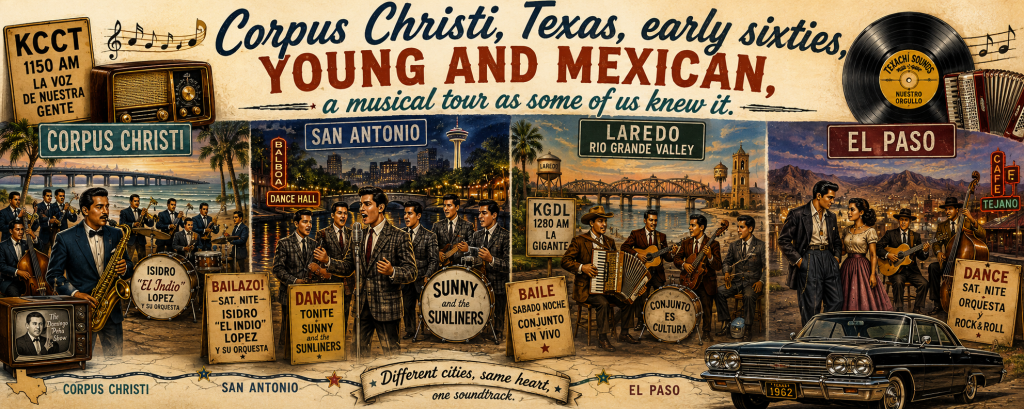
They played Corpus Christi, San Antonio, Laredo and towns throughout Texas. Successful acts headed west through Arizona and California and north toward Chicago and other Mexican-American communities.
Paulino Bernal even developed touring caravans in which musicians moved from city to city, one group following another around a circuit.
The road was part of how Mexican-American culture spread.
Before cassette tapes, cable television, or the internet, musicians themselves carried the music.
They arrived in somebody’s town with accordions, bajo sextos, saxophones, drums, and electric guitars.
People heard a song.
Somebody bought the 45.
A jukebox operator put it in a machine.
A disc jockey played it.
Another musician learned it.
A family carried it somewhere else.
And the music kept moving.
It was still changing
And just before our early-sixties tour ends, another chapter begins.
In 1963, Paulino Bernal heard two young musicians playing across the river in Reynosa.
They were Cornelio Reyna and Ramón Ayala.
Bernal invited them to record for Bego Records. They became Los Relámpagos del Norte, one of the most influential norteño groups on either side of the border.
Think about that for a moment.
You could be a young Mexican-American in McAllen in the early sixties and hear Paulino Bernal, Carlos Guzmán, Ruben Vela, and Freddy Fender.
And before long, Ramón Ayala was entering that same world.
Nobody knew yet which names would someday be called legends.
They were simply the people making the music.
Young and Mexican in the Valley
That may be the hardest thing to recreate sixty years later.
Today we tend to put the music into museums, documentaries, and categories.
Back then it was simply part of life.
It came from a radio sitting in the kitchen.
From the jukebox in a restaurant or cantina.
From a 45 spinning on somebody’s record player.
From a dance somewhere outside town where the floor might be dirt and the night air was hot.
From an accordion.
From a saxophone.
From an electric guitar.
From Mexico across the river.
From San Benito, McAllen, Mercedes, Harlingen, Brownsville and Pharr.
Some of the musicians spoke Spanish. Some sang in English. Some did both.
Some played music their grandparents would recognize.
Others were inventing sounds their grandparents probably wouldn’t.
But it belonged to the same people.
We were Mexican-American.
And that was what the Valley sounded like when we were young.