A Different History of Molina
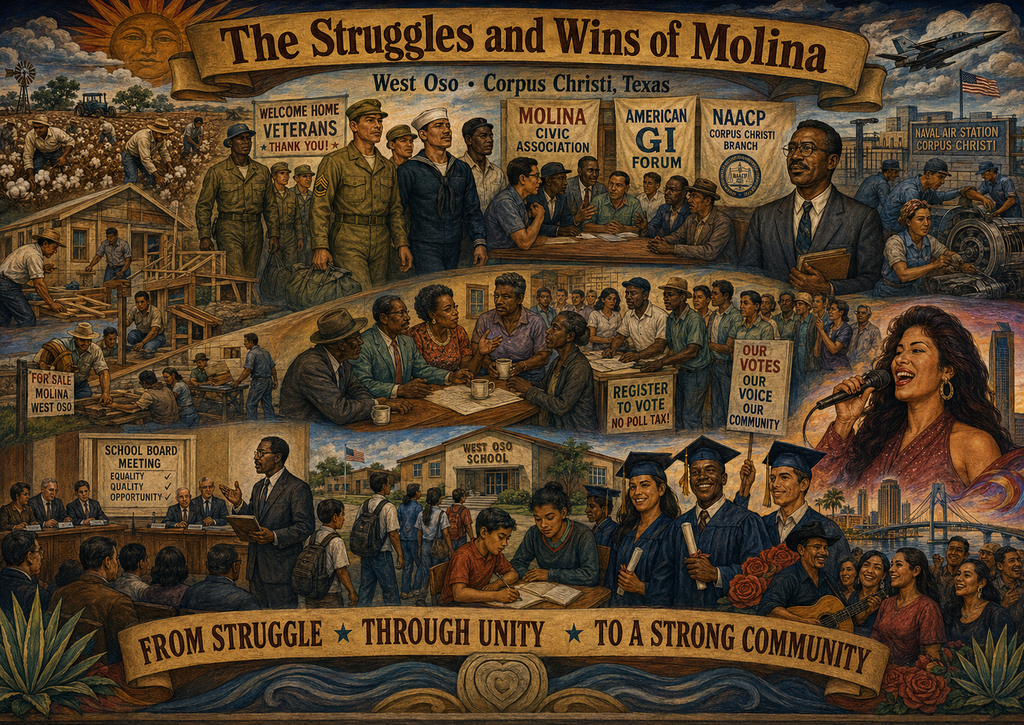
The history of the Molina Addition is usually told as the history of a poor neighborhood on the west side of Corpus Christi.
That description is true, but badly incomplete.
Molina was a place where African-American and Mexican-American families lived together in an otherwise heavily segregated South Texas city. It was populated in part by working families and returning World War II and Korean War veterans. It lacked many of the things other neighborhoods took for granted: paved streets, plumbing, good schools, parks, and political influence.
But Molina developed something much more important.
Political power.
By the late 1950s and early 1960s, Black and Mexican-American residents were organizing together to take control of the public institutions that had failed them. Their most dramatic victory came in 1963, when Molina voters overturned the old Anglo establishment that controlled the West Oso Independent School District.
A newspaper called it the West Oso School Board Revolution.
It deserves to be remembered as something more: one of the clearest early examples of sustained Black-Brown coalition politics in the Texas civil-rights era.
That distinction matters. Historian Brian D. Behnken, who studied African-American and Mexican-American civil-rights movements throughout Texas, concluded that although both communities fought similar discrimination, they were rarely unified. Geography, prejudice, organizational rivalries, and different political strategies often kept the two movements apart.
Molina was different.
Historian Moisés A. Gurrola, whose study of the neighborhood calls Molina a Black-Brown “borderhood,” identified the West Oso struggle specifically as an example of Black-Brown coalition building. In Molina, that coalition was already appearing on election ballots in the 1950s.
A Neighborhood Created by Segregation
Molina emerged in the 1940s on the outskirts of Corpus Christi. The Paul Cox Land Company sold or leased partially completed homes to Mexican-American and African-American workers, including returning World War II and later Korean War veterans who could finish building the houses themselves.
This produced something unusual in segregated Corpus Christi. Mexican Americans historically had been concentrated on the west side, while African Americans were concentrated largely on the north side. Molina brought Black and Mexican-American working families into the same developing community.
They did not arrive in an equal city.
Corpus Christi was both a South Texas borderlands city and a city shaped by the legacy of the Confederacy and Jim Crow. Housing, employment, public accommodations, and education reflected racial divisions. Gurrola argues that Molina existed at the intersection of the discrimination directed toward Mexican Americans and the discrimination directed toward African Americans.
The neighborhood itself was neglected. Residents fought for indoor plumbing, sewage, paved streets, and safer surroundings. Even after Corpus Christi annexed Molina in 1954, basic improvements came slowly.
Molina learned an important lesson early: if the neighborhood wanted something, it often had to organize to get it.
Veterans Came Home to Another Fight
The presence of veterans is important to this history.
Welder Brown, who would become one of Molina’s most important Black political leaders, had served in the Army during World War II. Jimmie Jones, another later Molina resident, served with the Tuskegee Airmen organization during the war. The Molina Veterans Society has identified more than fifty veterans associated with Molina who served during World War II.
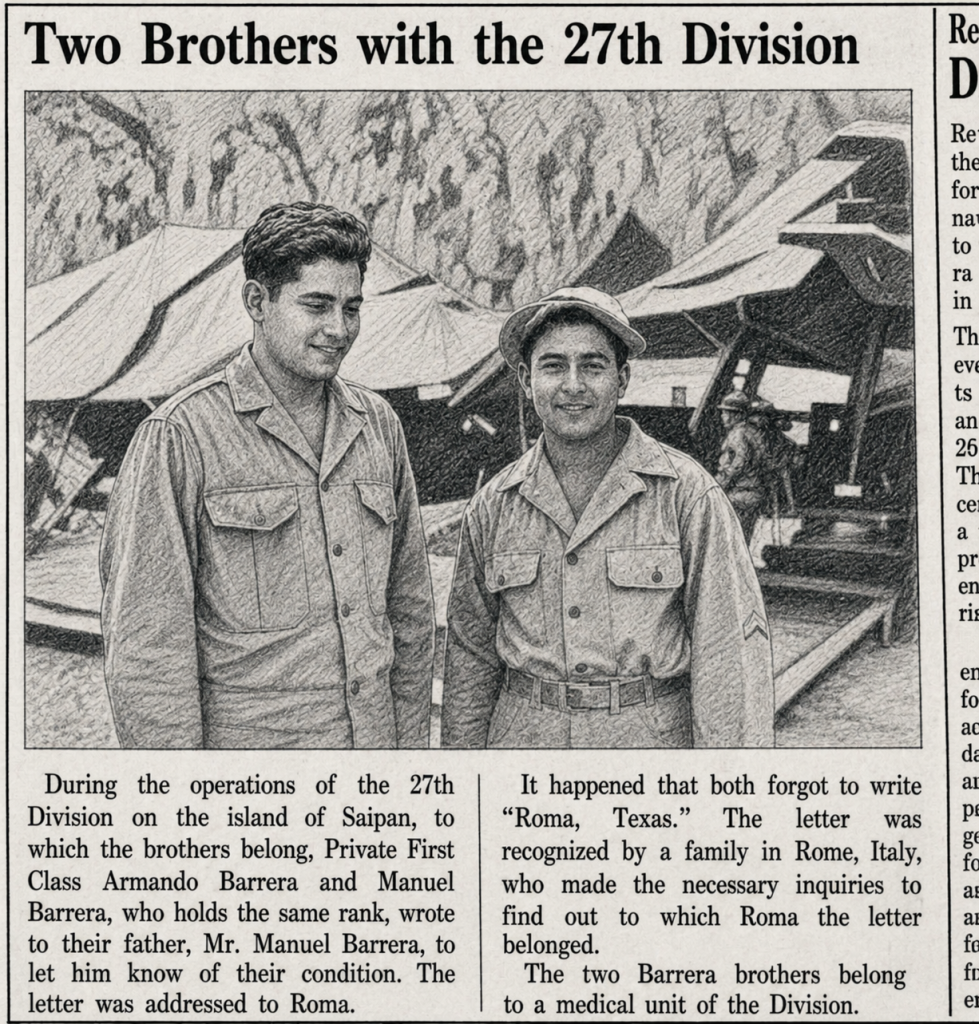
Among Molina’s Mexican-American veterans was Manuel Barrera Sr., who had served in the Pacific during World War II.
Men had gone overseas to fight fascism and defend democracy and returned to communities where voting was obstructed, schools were segregated or unequal, and minority families were often treated as incapable of governing themselves.
The contradiction was difficult to miss.
The American G.I. Forum had been founded in Corpus Christi in 1948 by Dr. Héctor P. García precisely in this world of returning Mexican-American veterans demanding the rights they believed their citizenship and military service had earned.
Manuel Barrera Sr. became a member of the G.I. Forum.
Dr. García was also the Barrera family’s doctor.
For the Barrera children, therefore, names that later appeared in civil-rights histories were not distant historical figures. They belonged to the world around them.
Black Children, Brown Children, and the Same System
The argument that Molina’s Black and Mexican-American residents merely imagined discrimination becomes impossible when West Oso is placed within the history of South Texas education.
Only about twenty miles away, Mexican-American parents challenged the Driscoll school district. Even after explicit Mexican schools became legally indefensible, Driscoll used a system of “beginners,” “low first,” “high first,” and segregated second-grade classes that could force Mexican-American children to spend as many as four years completing the first two grades.
The system was supposedly about language.
Then the evidence showed that Mexican-American children who spoke English—and in one striking instance a child who could not even speak Spanish—were still being placed in the Mexican classes.
In Hernandez v. Driscoll CISD, a federal court condemned the practice in 1957 as unreasonable racial discrimination.
The same regional pattern eventually reached Corpus Christi itself.
In 1968, Black and Mexican-American parents sued Corpus Christi ISD in Cisneros v. Corpus Christi Independent School District. In 1970, federal Judge Woodrow Seals found that official action had produced unconstitutional segregation of both Black and Mexican-American students. The Fifth Circuit affirmed the central ruling in 1972 and recognized Mexican Americans as an identifiable ethnic-minority group entitled to Fourteenth Amendment protection.
Molina therefore was not operating in a racial vacuum.
Its residents were living inside a South Texas educational system in which Black and Mexican-American children repeatedly found themselves separated, neglected, or placed at a disadvantage while overwhelmingly Anglo governing bodies controlled the schools.
The children of Molina understood something that courts would spend years putting into legal language:
Black and Brown children were often being treated by the same system as children who mattered less.
Seven Miles to High School
By 1961, West Oso ISD had become approximately 79 percent Mexican American, 12 percent Black and only 9 percent Anglo.
Yet the political power of the district remained largely in the hands of rural Anglos.
One example was impossible for Molina parents to ignore. Mexican-American high-school students from Molina traveled roughly seven miles, by bus or sometimes on foot, to attend the old West Oso High School. The district also brought truancy cases that disproportionately affected migrant families whose children could not always make that journey.
The American G.I. Forum approached the West Oso board in 1956 seeking a new high school closer to Molina.
The board said there was no money to build one there.
That bus ride was not theoretical to Manuel Barrera Jr. He rode it.
He graduated before the new Bear Lane high school opened. His younger brother, who graduated in 1970, belonged to the generation that finally benefited from the new campus.
“You People Aren’t Educated Enough”
There is another part of the West Oso story that does not appear in school-board minutes.
Manuel Barrera Jr. remembers an Anglo member of the West Oso school board coming personally to the Barrera home before the election that would overturn the old board.
The trustee wanted Manuel Barrera Sr. to oppose what Molina was preparing to do.
His argument was revealing.
The minorities, he told Barrera, did not have enough education to run a school board.
There is no need to speculate about whether paternalism existed inside the old political structure. One of its representatives came into a Molina family’s home and stated the argument directly.
The people demanding political power, he believed, were not qualified to exercise it.
Years later, Manuel Barrera Sr. himself would be asked to run for the West Oso school board.
He declined.
He had little formal education and believed that because he was not well educated, he should not sit on a school board.
The irony is painful.
A man trusted by his neighbors, active in the G.I. Forum and involved in organizing voters, had absorbed enough of the old message that when offered a seat at the table, he questioned whether he belonged there.
His son Jorge Barrera eventually did sit at that table. Jorge later became a West Oso school-board member.
The father helped create the political power.
The son eventually held the office.
Walking Molina for the Poll Tax
Voting in Texas still required payment of a poll tax.
For poor families, that mattered. It meant that political participation cost money, and Black and Mexican-American Texans were among those most heavily burdened by a system historically used to reduce minority voting.
Manuel Barrera Jr. remembers walking through Molina with his father while Manuel Sr. encouraged neighbors to buy their poll-tax receipts so they could vote.
That is how political revolutions often look before anybody calls them revolutions.
A father and his son walking from house to house.
One neighbor at a time.
The documentary history confirms the greater effort. Molina residents conducted voter-registration and poll-tax drives and learned how to use carefully coordinated election strategies to increase their power.
A Calculated Barrier: For a farmworker family in 1963, spending nearly two dollars per adult just for the right to vote meant sacrificing real household necessities. It was intentionally designed by the state’s elite to make people think, “Do I buy milk and lard for the week, or do I buy a piece of paper to vote months from now?” [1]
The Strict Deadlines: Your dad had to do that grueling work under intense time pressure. The Texas poll tax had a strict January 31 deadline every year. If he didn’t convince them to buy it by mid-winter, they were completely locked out of the school board elections that happened later in the spring. [1]
The Final Defeat: That relentless block-by-block, door-to-door organizing by men like your father is exactly what laid the groundwork for the courts to step in. The United States finally struck down the poll tax for federal elections with the 24th Amendment in 1964, and the Supreme Court killed it entirely for local and state elections in early 1966. [1]
The G.I. Forum and the Molina Civic Association
There was no single organization responsible for Molina’s transformation.
The American G.I. Forum was already active in the school struggle during the 1950s. In 1956, Molina G.I. Forum members Amador Gutierrez and Mauricio Jiménez ran for two West Oso board seats after the Forum had pressed the district about building a high school nearer Molina. They lost, despite an increased Molina turnout.
Residents then created the Molina Civic Association, or MCA, in the late 1950s.
Its electoral strategy immediately crossed racial lines.
In 1957, the MCA ran three candidates for West Oso trustee:
Amador Gutierrez, Mexican American.
Noe R. Benavidez, Mexican American.
Welder Brown, African American.
All three lost narrowly.
But the significance of that slate should not be missed. In 1957, while Black and Mexican-American civil-rights organizations elsewhere in Texas often resisted formal cooperation, Molina residents were already putting forward a joint Black-Brown slate for control of a public institution.
This was not a coalition invented by historians decades afterward.
They were running together.
1960: Fred Jones and the Fight Over the Ballots
The coalition tried again in 1960.
Welder Brown ran with Fred A. Jones, another African-American Molina activist, and Mexican-American candidate Joe Treviño.
Treviño won.
Brown and Jones lost.
But Brown and Fred Jones charged that the election had been conducted unfairly.
Their accusations were serious. They alleged that registered Molina voters had been denied ballots, that some ballots had been altered in favor of Anglo candidates, and that people who did not live in the district had been allowed to vote at the West Oso High School polling place.
They also complained that voting machines were refused, that Molina voters were given paper ballots, that no booths had been provided for secrecy, and that an ordinary cigar box had been used to collect Molina ballots.
Brown and Jones publicly challenged the election results. Both men were associated with the NAACP.
Fred Jones was also one of Manuel Barrera Sr.’s closest friends.
He visited the Barrera home approximately once a week for years.
The men talked about the things friends talk about—family, neighborhood affairs, everyday life—and politics. West Oso and the G.I. Forum were among those conversations.
Their friendship survived long beyond the political battles.
After Manuel Barrera Sr. died, Fred came to the house expecting to visit him. He had not yet heard that his friend was gone.
When he learned, Fred cried.
“Black-Brown coalition” is useful historical language.
But sometimes the coalition was simply Fred coming over to see Manuel.
Something Unusual Was Happening in Molina
The historical significance of these friendships and political alliances becomes clearer when compared with Texas as a whole.
Behnken’s history of Black and Mexican-American civil rights is titled Fighting Their Own Battles for a reason. He documents repeated occasions when leaders from the two communities refused cooperation even though both confronted racial discrimination.
In 1957, for example, when some Mexican-American activists proposed cooperation with the NAACP against segregationist legislation, LULAC national president Felix Tijerina opposed an alliance with Black activists.
There were exceptions, but broad Black-Brown unity in Texas was difficult and often short-lived.
Molina’s experience therefore deserves greater attention.
By 1957, it had a biracial school-board slate.
By 1960, Black and Mexican-American candidates were again running together.
By 1963, neighborhood organizing had captured the board.
By 1964, Molina elected the district’s first African-American trustee.
By 1966, a largely Mexican-American board made that Black trustee its president.
This was happening before the Black Power and Chicano movements made Black-Brown political unity a national subject of discussion.
Molina was already practicing it.
The 1963 West Oso School Board Revolution
After years of losses, organizing and poll-tax drives, Molina finally broke through in 1963.
Residents elected enough Molina candidates to take control of the seven-member West Oso board.
They did better than necessary.
Five of the seven trustees were now Spanish-surnamed Molina residents.
The shift was so dramatic that a local reporter called it a revolution.
The new majority immediately began changing the district. Board meetings were moved from the old West Oso High School to Molina Junior High. The board began addressing overcrowding and expanded the role of Dr. John W. Skinner, an Anglo educator who had earned the confidence of Molina residents.
Then, in 1963, along with other offices and cities in the State of Texas, WOISD experienced what one reporter called a “revolution.”62 The Molina community held voter registration and poll tax drives that ended with the election of enough Molina residents to the board, giving them the majority. Rather than the four members they hoped for, Molina residents, all Spanish-surnamed, accounted for five of the seven seats on the WOISD school board. The new board made a number of changes on the first evening they met. They relocated the trusteemeeting place from West Oso High School to Molina Junior High School. They voted to convert the library at West Oso High School into classrooms to make room for more of the district’s minority students. Lastly, they assigned Dr. John W. Skinner, then principal of Hellman Elementary School, which was once W.E. Hall Elementary, to the position of assistant superintendent and placed him in charge of personnel, curriculum, and instruction.63 The two remaining Anglo board members, Carl Allen and James Baker, opposed these motions. In fact, they voted against every proposal that the five ethnic Mexican trustees motioned, including trivial ones that called for a new voice recorder in the boardroom.64
Source
The two remaining Anglo trustees, Carl Allen and James Baker, increasingly opposed the new majority.
Then they resigned.
Their resignation letter itself revealed how dramatically power had shifted. They complained that the five “Latin American” trustees belonged to the Molina Civic Association and had retained attorneys connected to it.
The people who once had almost no voice were now being accused of exercising too much influence.
The new majority could have filled the vacancies with two more Mexican Americans.
Instead, it appointed two Anglos, Dan McDonough and James E. Roberts.
That decision matters.
The object had not been to create a Mexican-American version of the old racial monopoly.
The object was representative government.
Welder Brown
In the spring of 1964, James Roberts lost his seat to Welder Brown.
Brown became the first African American elected to the West Oso board and, according to contemporary historical research, the first Black person in Corpus Christi to hold a school-board position.
Brown was not simply “the Black candidate.”
He had political credibility across Molina’s racial lines. He worked with Joe Treviño of the Molina Civic Association and with Carlos Truan. Treviño’s son later remembered Treviño, Truan, and Brown as amistades—close friends.
Brown’s daughter likewise remembered her father’s close relationship with Dr. Héctor P. García.
Then came 1966.
The board chose Welder Brown as its president by acclamation.
A predominantly Mexican-American governing board in South Texas had placed an African-American man at its head.
Brown became the first African-American school-board president in Nueces County.
For a state in which Black and Mexican-American civil-rights organizations often struggled to cooperate, that was no small event.
They Did Not Simply Change the Faces
The new board did not merely replace Anglo officeholders with minority officeholders.
It changed policy.
West Oso integrated its schools more completely, integrated faculties, changed attendance boundaries, and began moving resources toward the population that actually attended the schools. Federal civil-rights reporting noted that West Oso incorporated its Black teachers into formerly all-white faculties in 1964.
Plans also began for something Molina had demanded for years:
a high school nearer the neighborhood.
The new West Oso High School was eventually built at 5202 Bear Lane and opened in September 1969.
Manuel Barrera Jr. had already graduated.
His younger brother, graduating in 1970, attended the new school.
One brother rode away from Molina to high school.
The next generation had the high school brought closer to them.
That is civil-rights history measured not in court decisions, but in miles.
Molina Refuses to Give the Power Back
Another event shows how clearly Molina residents understood what they had accomplished.
During the 1960s, there were repeated proposals to merge West Oso ISD with the much larger Corpus Christi ISD.
Before Molina gained control of West Oso, many residents saw consolidation as a possible escape from their neglected district.
After they gained power, attitudes changed.
By 1967, Molina residents had built a representative school board and achieved a level of integration they feared would disappear if West Oso were absorbed into Corpus Christi ISD.
They voted against consolidation.
The historical record says Molina residents specifically feared losing the representation and integration they had won. They also deeply distrusted Corpus Christi because of the city’s long record of broken promises concerning streets, sidewalks, and other services.
Three years later, Cisneros confirmed in federal court that Corpus Christi ISD was operating an unlawfully segregated system.
Molina had good reason to be suspicious.
The Coalition Went Beyond Elections
Politics in Molina did not stop with the school board.
The G.I. Forum, Molina Civic Association, school board, churches, and other neighborhood groups repeatedly overlapped.
In 1964, Johnny Bilano, chairman of the Molina chapter of the American G.I. Forum, helped organize the West Oso Community Action Group. It worked directly with the school board, MCA, PTAs and religious organizations.
Together they pursued tutoring programs, adult literacy, a community library, recreation, health services, and neighborhood improvements.
That cooperation confirms what Molina residents remember.
People did not necessarily think of themselves as operating within neat organizational boxes.
They were trying to improve Molina.
Building a Place for the Children
The same spirit could be seen outside politics.
Dr. Skinner helped introduce Boy Scouts, Girl Scouts, Little League baseball, and boxing programs into Molina. He eventually trained hundreds of neighborhood boys in boxing.
Manuel Barrera Jr. remembers playing baseball on a field behind Skinner Elementary while he was a Cub Scout.
There was also another baseball field.
A church allowed the neighborhood to use land behind it. Molina families had to turn that land into a usable field.
Manuel Jr. was one of the children who helped.
He remembers cleaning the land.
He remembers helping level it.
Nobody had to explain “community empowerment” to the children.
They wanted somewhere to play ball.
The church supplied the ground. The neighborhood supplied the labor. Even the children helped build the field they would use.
That small story belongs beside the school-board revolution because the principle was the same.
Molina learned to build what others would not build for it.
The Meaning of Manuel Barrera Sr.
Manuel Barrera Sr. never became a famous civil-rights leader.
That may be precisely why his story matters.
History tends to remember the person at the microphone, the lawyer arguing the case, or the candidate whose name appeared on the ballot.
Movements also require the man who walks down the street asking his neighbors whether they have paid their poll tax.
They require the G.I. Forum member who attends the meetings.
They require friendships across racial lines that survive after election season ends.
They require people willing to build the political foundation without expecting their names to appear in history books.
Manuel Barrera Sr. was eventually asked to run for the very school board that Molina had fought to control.
He said no because he believed he lacked enough education.
But the neighborhood evidently disagreed.
They thought enough of his judgment to ask him.
Years later, his son Jorge Barrera served on the West Oso board.
There is a lesson in that family progression.
The first generation fought to make the institution accessible.
The next generation entered it.
Before “Black-Brown Coalition” Had a Name
There were earlier examples of cooperation between Black and Mexican-American people in Texas, particularly in labor struggles, electoral politics and particular civil-rights campaigns. Molina should not be falsely proclaimed the first Black-Brown coalition in Texas.
Its claim is stronger when stated accurately.
Molina was an unusually early, sustained, and successful Black-Brown grassroots political coalition in a state where such coalitions were notoriously difficult to maintain.
It was rooted not in a conference or a national political theory but in geography.
Black and Mexican-American people lived beside one another.
Their children attended the same district.
They saw many of the same inequalities.
They belonged to organizations such as the NAACP, the American G.I. Forum, and the Molina Civic Association, but they also knew one another as neighbors and friends.
In 1957 they ran together.
In 1960 they fought an election together.
In 1963 they captured the government that controlled their children’s schools.
In 1964 they elected Welder Brown.
In 1966 they made him president.
And in 1967 they defended the district they had transformed rather than surrender their newly won power to a larger school system that remained deeply segregated.
That is a remarkable sequence in Texas civil-rights history.
History From the People Who Were There
There is another reason this story can now be told differently.
Much of the documentary record gives us minutes, election results, newspaper accounts, and institutional decisions.
It cannot tell us everything.
It does not tell us what an Anglo trustee said while sitting inside the Barrera home.
It does not tell us what Manuel Barrera Sr. and Fred Jones talked about when Fred came over every week.
It does not tell us what it felt like for a boy to walk the neighborhood beside his father asking adults to pay for the right to vote.
It does not tell us how children cleared and leveled a baseball field behind a church.
Those details survive because somebody remembers them.
That is not inferior history.
It is oral history.
Gurrola’s own study of Molina relied heavily on recollections from people who had been children, teenagers and young adults during the 1950s and 1960s. He concluded that those memories provided something paper records could not: they humanized the history of the neighborhood.
Manuel Barrera Jr.’s recollections belong to that same historical record.
Names may occasionally require checking against a newspaper or school-board roster.
Dates can be recovered from minutes.
But the documents cannot recover a conversation in a living room once everybody who heard it is gone.
That must come from the people who were there.
The Molina That Should Be Remembered
Molina was poor.
It was neglected.
Its families encountered racism.
Its children attended schools governed for years by people who did not represent them.
But that is only the beginning of the story.
Molina was also a neighborhood where returning veterans helped organize their community.
It was a place where the American G.I. Forum, the NAACP, the Molina Civic Association, churches, parents, and neighborhood activists crossed organizational and sometimes racial boundaries.
It was where Black Fred Jones could be one of Mexican-American Manuel Barrera’s closest friends.
It was where an Anglo trustee could come into the Barrera home and argue that minorities lacked enough education to govern—and where those supposedly unqualified minorities soon took control of the school district anyway.
It was where Mexican Americans and African Americans ran together for office before Black-Brown unity became fashionable language.
It was where five Molina candidates captured a seven-member school board.
It was where a largely Mexican-American board eventually chose a Black man as president.
It was where residents refused to surrender political control once they had finally won it.
It was where the people brought a high school closer to their children.
And it was where children helped clear a piece of church land because, if nobody else was going to give them a baseball field, Molina would make one.
The West Oso School Board Revolution was therefore about much more than schools.
It was the moment a community that had repeatedly been told it was poor, backward, uneducated, and incapable of governing itself answered in the only language the old political establishment could not ignore.
They voted it out of power.
That is the Molina that belongs in the history books.