Most people who drive through Uvalde today probably do not know that the town began with a twenty-two-year-old Quaker from New Jersey, or that its founder eventually fled Texas because he could no longer tolerate what Confederate authorities were doing to Union sympathizers.
Even fewer probably know how his story ended.
Reading Wood Black returned after the Civil War, argued that Texas should accept the Fourteenth Amendment, tried to organize Union supporters in the town he had founded—and in 1867 was shot to death inside his own store by a man who had once been his friend and was also his brother-in-law. (Texas State Historical Association)
It is one of those Texas stories in which almost nothing fits the simple version of Texas history.
Uvalde had a history before there was a Uvalde
Even the name carries an older story.
On January 9, 1790, Spanish commander Juan de Ugalde led Spanish troops and Native allies against about 300 Lipan, Lipiyan, and Mescalero Apaches near today’s Sabinal River canyon. The battlefield became known as Cañón de Ugalde. Over time, Ugalde became Uvalde, and both the county and town inherited the name. (Texas State Historical Association)
So Uvalde’s name predates the Republic of Texas, the United States’ annexation of Texas, and the Mexican-American War. It comes from the Spanish colonial struggle for control of the same country where another young outsider would arrive more than sixty years later.
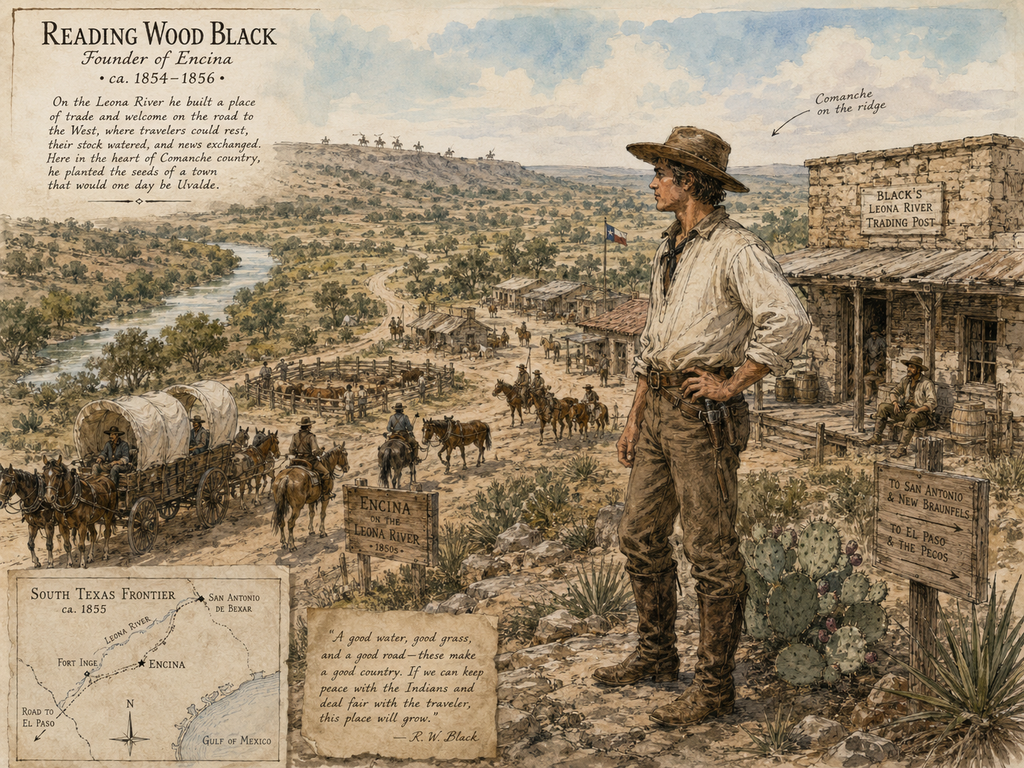
His name was Reading Wood Black.
A 22-year-old Quaker sees a town where almost nobody else does
Black came from a Quaker family in New Jersey. In 1852 he headed for Texas, reportedly influenced by a cousin serving in the U.S. Army. The next year Black and Nathan L. Stratton bought land along the spring-fed Leona River, about a mile above Fort Inge, the federal post established in 1849 to protect the western frontier. (Texas State Historical Association)
There was hardly a town to speak of. But Black understood geography.
Two important routes ran through the region: one west toward California and another southwest toward Fort Duncan and Eagle Pass. Black managed to have the roads redirected so that travelers passed his property and his trading post. Soldiers, ranchers, freighters, emigrants, and traders suddenly had a reason to stop there.
He raised sheep. He opened a store. He operated a lime kiln and rock quarries. He planted a garden and orchard and built a two-story stone house and trading post.
Then he decided to build a town.
In May 1855, Black hired San Antonio surveyor Wilhelm C. A. Thielepape to lay it out. There were broad streets and four central plazas: Fountain Plaza, Market Plaza, Courthouse Plaza, and Town Hall Plaza. Black called his settlement Encina.
This wasn’t somebody stumbling into a settlement and later becoming its most prominent citizen.
Black planned the place.
He established the area’s first school in 1855 and pushed the Texas Legislature to organize Uvalde County. In 1856, Encina became the county seat and took the name Uvalde. Black became a county commissioner and later county judge. (Texas State Historical Association)
He was still only in his twenties.
The Quaker who carried a gun
Black does not fit neatly into another category either.
He was a Quaker and developed unusually friendly relations with some Native peoples, particularly the Tonkawas. He traded with Native people and participated in efforts to negotiate treaties and peace. (Texas State Historical Association)
But this was the Texas frontier, and Black was no absolute pacifist. In 1856 he organized and commanded a militia company that fought Comanches south of Uvalde.
That contradiction tells us something about the world in which Uvalde was born. Black could negotiate with one Native group on one day and organize armed men against another. Fort Inge existed precisely because settlers lived in country that remained violently contested. (Texas State Historical Association)
The racial politics were equally complicated. In 1857 Uvalde County residents adopted restrictions intended to prevent Mexicans from traveling through the county, apparently connected to competition over the profitable freight trade. Yet Black himself soon operated wagon trains between San Antonio and Piedras Negras, Coahuila. (Texas State Historical Association)
Uvalde was never an isolated Anglo frontier town. Mexico, Tejanos, Native peoples, soldiers, German settlers, merchants, and freighters were all part of the landscape.
Then came 1861.
Uvalde said no to secession
Texas voted overwhelmingly to leave the Union.
Uvalde County did not.
The county voted 76 to 16 against secession—more than 82 percent against leaving the United States. Uvalde County had only 506 residents in 1860 and just twenty-seven enslaved people, and historians believe residents were also worried that secession would remove the federal soldiers whose forts protected frontier settlements and commerce. (Texas State Historical Association)
Black personally opposed secession, although his choices at first were pragmatic rather than heroic. He took the required Confederate oath and continued operating his businesses. (Texas State Historical Association)
Then something happened that apparently changed what he was willing to tolerate.
On August 10, 1862, roughly sixty Union sympathizers—mostly German Texans—were making their way toward Mexico when Confederate troops caught them beside the Nueces River. Nineteen Unionists were killed in the fighting. Nine wounded prisoners were subsequently executed. (Texas State Historical Association)
It became known as the Battle of the Nueces, although generations of German Texans remembered it as a massacre.
For Reading Wood Black, it appears to have been the breaking point. The Texas State Historical Association says he was repulsed by the killings and by the activities of Confederate home guards.
He left Uvalde.
And he went to Mexico. (Texas State Historical Association)
The founder of a Texas town had decided that Confederate Texas was no longer a place in which he wanted to live.
He came back
Black remained in Mexico for the war and did remarkably well there. By its end, he reportedly owned about $50,000 in property in Coahuila, a substantial fortune for the period. (Texas State Historical Association)
He could have stayed.
Instead, he came home.
In 1866, voters sent Black to the Texas House of Representatives. The Texas Legislative Reference Library confirms that he represented House District 72, which then included Bexar, Kinney, Maverick, Medina, Uvalde, and other territory. (Texas Legislative Reference Library)
The country was now fighting over what victory in the Civil War actually meant.
Black took an unusually strong position for a white Texas legislator of the period. He urged Texas to ratify the Fourteenth Amendment, warning that refusing it would demonstrate continued disloyalty to the United States. (Texas State Historical Association)
The Texas Legislature refused.
It rejected both the Thirteenth and Fourteenth Amendments in 1866 and resisted granting political rights to formerly enslaved Texans. Congressional Reconstruction followed. (Texas State Library)
Black left the legislature after that short term, but he did not abandon politics.
In September 1867, he attempted to organize a Union League in Uvalde.
That proved far more dangerous.
October 3, 1867
On the morning of October 3, Black was inside the stone store he had built at the center of the town he had created.
G. W. “Tom” Wall came there.
Wall was not some stranger riding into town. Sources identify him as Black’s former friend and brother-in-law. The two men had ended up on opposite sides of the Civil War—Black the Unionist, Wall the Confederate. (Texas Legislative Reference Library)
Wall shot and killed Reading Wood Black.
There were witnesses.
Black was 37 years old. (Texas State Historical Association)
The political motive is strongly present in the historical record, but there is an important qualification. The Texas State Historical Association connects the killing directly to Wall’s anger over Black’s effort to establish the Union League. A National Register history of the site says San Antonio newspapers attributed the killing both to Black’s Unionist politics and to a family dispute. (Texas State Historical Association)
So we cannot know exactly what was in Wall’s mind when he pulled the trigger.
We know what happened afterward.
Tom Wall fled to Mexico.
There is a bitter symmetry to it.
Reading Wood Black had once fled from Texas to Mexico because of Confederate violence.
Five years later, the man who killed him fled from Texas to Mexico.
The town survived the man who created it
Black’s widow continued operating the store and post office after his death. The old stone building eventually burned in 1887. A commercial building erected on the same lot in 1890 still marks the location where Uvalde’s first permanent store once stood and where its founder was killed.
There is a historical marker there today.
But the marker’s few sentences hardly tell the story.
Reading Wood Black came to an almost empty piece of frontier at twenty-two. He redirected roads, opened businesses, created a town, gave it a school, helped create its county government, fought Comanches, negotiated with other Native peoples, traded across the Mexican border, became county judge, opposed secession, fled the Confederacy, returned after the war, served in the Texas Legislature and argued for the Fourteenth Amendment.
Then he tried to organize Union men in the town he had founded.
And somebody killed him for it—or, at minimum, partly because of it.
Uvalde is usually placed inside the familiar story of the Texas frontier.
Reading Wood Black’s life tells another Texas story: a Texas county that voted overwhelmingly against secession, a founder who chose the Union, and a Civil War whose violence did not end when the armies stopped fighting.
Tom Wall did not simply murder the founder of Uvalde and disappear into Mexico. Mexico caught him. Texas extradited him. Texas put him back in custody. Officials warned that the local system could not hold him. Then Texas lost him—and was still listing him as a fugitive more than thirty years later.