For years, I knew military service ran through my family, but I didn’t realize how far the line stretched.
I knew of an ancestor who served in the Confederate Army during the Civil War. I knew my father, his brother, and one of my mother’s brothers served during World War II. Another maternal uncle served during the Korean War. My brother served during the Vietnam War. Two nephews served during the Iraq era.
And today, my grandson is serving.
What I did not have was World War I.
Now I do.
His name was Cecilio Barrera.
He was the younger brother of my grandfather Felipe Barrera — my great-uncle — and for years I had been trying to find the Barrera relative who had served in the First World War.
Then an old military document finally gave him back to us.
Private Cecilio Barrera
Cecilio Barrera was born June 14, 1883, in Mexico, a son of Aniceto Barrera and Dionicia Reyna. He belonged to the same Barrera family that eventually settled along the Rio Grande in Starr County.
My grandfather Felipe was born in 1878. Cecilio followed five years later.
They grew up as brothers in a border family whose world stretched across both sides of the river. Neither could have imagined that one of them would someday cross not merely the Rio Grande, but the Atlantic Ocean, to fight a war in France.
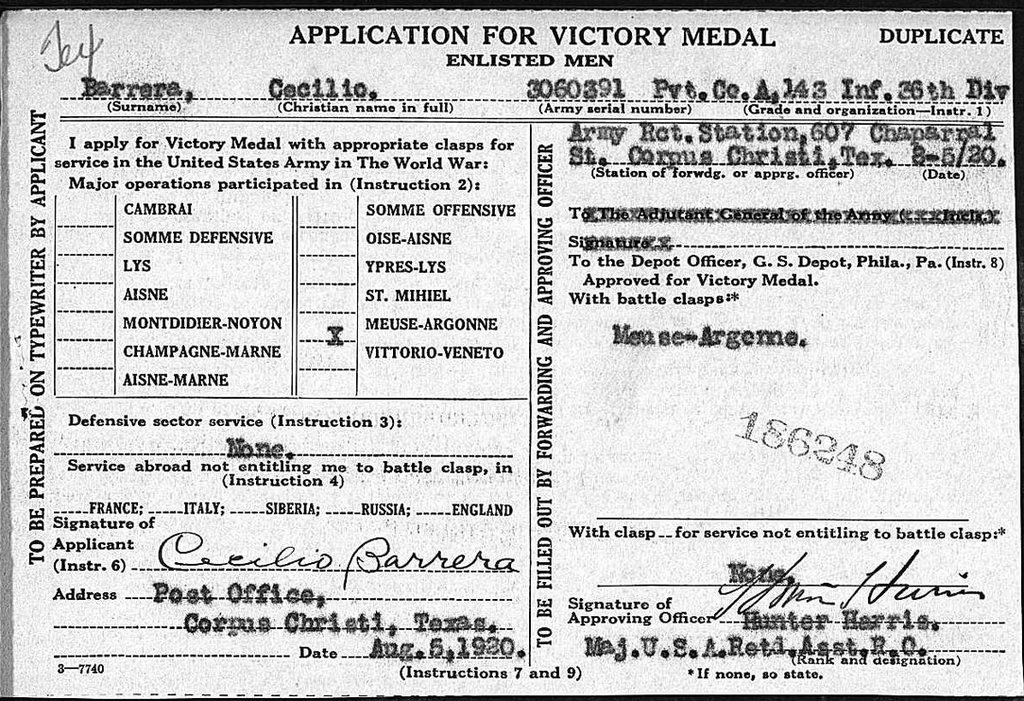
Cecilio became Private Cecilio Barrera, Army Serial Number 3060391, Company A, 143rd Infantry Regiment, 36th Infantry Division.
And the document I found tells us exactly where his military service took him.
Meuse-Argonne.
The war that had been missing from the family
The Meuse-Argonne Offensive was the largest American military operation of World War I. More than a million American soldiers participated during the final weeks of the war.
The 143rd Infantry entered combat in October 1918 as part of the 36th Division. Cecilio’s Company A belonged to the regiment’s 1st Battalion.
The regiment moved into positions north of Blanc Mont Ridge after other American troops had captured the heights. From there, the Texans pushed north toward the Aisne River through artillery fire, machine guns, snipers, and gas.
Cecilio was about 35 years old.
He was not an eighteen-year-old boy going off on an adventure. He was a grown man from a Mexican border family who somehow ended up thousands of miles from home in one of the largest battles Americans had ever fought.
And he survived.
Then he came home
On August 5, 1920, Cecilio went to an Army recruiting station at 607 Chaparral Street in Corpus Christi and applied for the World War I Victory Medal he had earned.
The application identifies his regiment and division and authorizes the Meuse-Argonne battle clasp.
That little piece of paper closed a gap in my family’s history.
Eventually Cecilio returned to the world from which he had come. He died in 1972 and was buried in Fronton, near the Rio Grande and the family whose history I have spent so many years trying to recover.
He crossed an ocean and eventually came back to the river.
One family, generation after generation
Finding Cecilio made me realize that our family’s military history is not a collection of isolated stories.
It is almost a continuous chain.
An ancestor served during the Civil War.
Then Cecilio served in World War I.
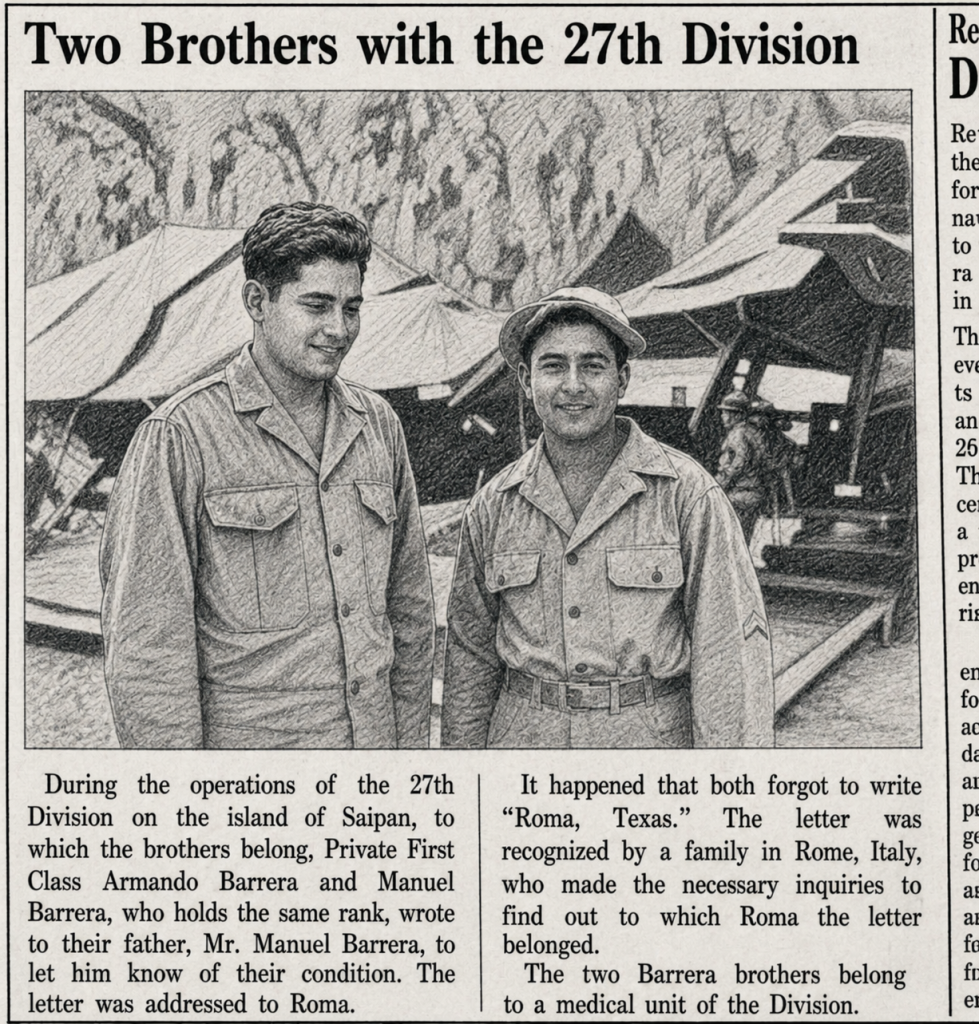
My father, Manuel López Barrera, served in the Pacific during World War II, along with his brother. An uncle on my mother’s side also served during that war.
Another maternal uncle served during the Korean War.
My brother served in the Vietnam War.
Two of my nephews served during the years of the Iraq War.
And now another generation has put on the uniform.
My grandson is presently serving in the United States military.
Civil War.
World War I.
World War II.
Korea.
Vietnam.
Iraq.
Today.
When you write it down that way, the years begin to disappear.
They probably never thought anybody would come looking
Most of these men did not leave memoirs.
They were not generals. Historians did not interview them. Their names are not written across monuments.
They were ordinary men who left families, jobs, ranches and neighborhoods, put on uniforms, went where they were sent, and eventually came home — if they were fortunate enough to come home.
Then life continued.
Children were born. Families moved. Photographs went into drawers. Medals disappeared into boxes. Stories were told once or twice and then stopped being told.
A generation dies, and suddenly nobody remembers what the ribbon meant or where the photograph was taken.
That is how history disappears.
Cecilio was waiting in the records
For years, World War I was the empty space in my family’s military history.
I knew somebody had been there.
I just could not find him.
Now I know.
Private Cecilio Barrera.
Company A, 143rd Infantry.
36th Infantry Division.
Meuse-Argonne.
My great-uncle.
More than a century after he went to France, I finally found him.
And when I place Cecilio beside all the others — the Civil War ancestor, my father and uncles in World War II, the uncle in Korea, my brother in Vietnam, my nephews during Iraq, and my grandson serving today — I see something I had never quite seen before.
It is not simply a military record.
It is a family history measured in generations of service.