History has usually remembered what happened along the South Texas border in 1915 under names such as the Plan de San Diego, the Border War, the Bandit War, or the sedicioso rebellion. For generations, the armed men who fought American authorities were commonly reduced to a simpler word: bandits.
But by the summer of 1915, something much larger than banditry was taking place in the Lower Rio Grande Valley. What began as a cross-border conspiracy developed into guerrilla warfare involving Mexicans from across the Rio Grande and an increasing number of Tejanos from South Texas.
At the same time, Texas Rangers, local officers, posses, and Anglo vigilantes unleashed reprisals that increasingly failed to distinguish between armed rebels and ordinary Mexicans and Mexican Americans. Raids produced reprisals, reprisals produced recruits and revenge, and South Texas descended into something approaching a racial war. (Texas State Historical Association)
The Plan That Almost Went Nowhere
The story began with the Plan de San Diego, a revolutionary manifesto dated January 6, 1915. It proposed an uprising that would separate Texas, New Mexico, Arizona, California, and Colorado from the United States and create an independent republic.
The original document was extreme. Among its provisions was a call for the killing of white males over sixteen, while Blacks, Native Americans, and Mexican Americans were to be recruited into the uprising.
Authorities discovered a copy when Basilio Ramos Jr. was arrested near McAllen in January. The revolution was supposed to begin on February 20, 1915.
February 20 came and went without the promised uprising.
State and federal officials initially dismissed the document as another example of revolutionary rhetoric spilling across a border already destabilized by the Mexican Revolution. That complacency ended in July, when armed raids connected with the Plan began in the Lower Rio Grande Valley. (Texas State Historical Association)
The Shooting Begins
Armed bands began attacking ranches, railroad property, communications, and other targets. Some participants came from Mexico, but the leadership increasingly included men from South Texas itself, most notably Luis de la Rosa and Aniceto Pizaña.
The rebels targeted more than individuals. Railroad lines, irrigation systems, and newly developed farms represented the enormous economic transformation of the Valley as outside capital and Anglo settlement changed land ownership, agriculture, and political power. (Texas State Historical Association)
The raids frightened Anglo residents and brought additional Rangers, soldiers, deputies and vigilantes into the countryside. But even before the rebellion reached its greatest intensity, another kind of killing had begun.
Adolfo Muñoz and the Destruction of Trust
On July 28, 1915, Adolfo Muñoz—identified as Rodolfo Muñiz or Muñoz in different records—was taken from the San Benito jail by Deputy Sheriff Frank Carr and Daniel Hinojosa, a former and future Texas Ranger. They claimed they were transporting him to the Cameron County jail in Brownsville when masked armed men stopped them and seized their prisoner.
The next day Muñoz was found hanging from a mesquite tree south of San Benito. His body had been shot repeatedly, and no serious effort was made to identify or prosecute the men responsible. (Refusing to Forget)
Four years later, during the legislative investigation of the Texas Rangers, State Representative José Tomás Canales treated the Muñoz lynching as one of the critical events that helped destroy Mexican-American faith in law enforcement. Canales argued that after Muñoz was taken from officers and killed, accused Tejanos had reason to believe that surrendering peacefully might mean surrendering themselves to death. (Refusing to Forget)
That is an important part of what happened next.
A government cannot demand that men trust the law when men taken into the custody of that law are turning up dead beside the road.
Los Tulitos
Only days later came the event that transformed one of the most important Tejano figures in the conflict.
Aniceto Pizaña was a Cameron County rancher who had participated in Mexican liberal political activity long before 1915. Although associated with men who eventually supported the Plan de San Diego, Pizaña initially led a moderate faction favoring reform rather than full-scale revolution. (Texas State Historical Association)
On August 3, Rangers and other officers investigating earlier violence went to Pizaña’s Los Tulitos ranch north of Brownsville. A gunfight followed; Pizaña escaped, while his wife, brother, and son were captured, and his son was shot in the leg.
According to the Texas State Historical Association, Pizaña escaped intending revenge and thereafter committed himself to the Plan de San Diego. He became one of the rebellion’s principal military organizers, directing swift guerrilla attacks and imposing greater discipline on forces operating from the Mexican side of the Rio Grande. (Texas State Historical Association)
Canales later went even further. He argued that Pizaña had effectively been pushed into rebellion by what happened at Los Tulitos. (Refusing to Forget)
Pizaña therefore becomes the clearest example of the transformation taking place in South Texas: Anglo authorities went looking for revolutionaries and, through their own methods, helped make another one.
Sebastian: Revenge for Revenge
Three days after Los Tulitos, on August 6, Luis de la Rosa’s men struck Sebastian.
A. L. Austin and his son Charles were seized and killed. Austin had headed the local Law and Order League, an organization that had helped drive people considered undesirable out of the Sebastian area, and contemporary accounts believed that his activities made him a particular target. (GovInfo)
The killing of Austin and his son was not an attack on military forces. It was a deliberate execution.
The Anglo response came almost immediately. Rangers, posses, and vigilantes killed Mexicans in the surrounding country, including men whose actual connection to the Sebastian raid was uncertain or nonexistent.
Now the sequence was becoming unmistakable.
A Mexican was killed, and other Mexicans sought revenge. Anglos were killed, and Rangers or vigilantes sought revenge. The victims of those reprisals supplied still more relatives, neighbors, and friends with reasons to join the fight.
At the same time, the rebels expanded their attacks on the infrastructure of the Valley. Railroad tracks were torn up, bridges burned, communications cut, repair crews attacked, and irrigation facilities targeted.
This was becoming organized guerrilla warfare.
Norias: They Attacked the King Ranch
Then the rebels struck one of the most powerful symbols in South Texas.
At dusk on August 8, between fifty and seventy armed men attacked the Norias Division headquarters of the King Ranch, about seventy miles north of Brownsville. Earlier that day, Adjutant General Henry Hutchings, Ranger captains Henry Ransom, J. M. Fox and George J. Head, other Rangers and soldiers had arrived after reports of armed Mexican horsemen, but the Ranger force rode away toward the Sauz pasture before the attack began. (Texas State Historical Association)
Sixteen defenders remained at Norias, including soldiers, customs inspectors, Cameron County Deputy Sheriff Gordon Hill and ranch personnel. At dusk, the approaching riders opened fire, and a battle lasting roughly two hours followed.
Manuela Flores, a King Ranch employee, was killed. Several defenders were wounded, and at least five raiders were reported killed, with perhaps a dozen more wounded. (Texas State Historical Association)
The raiders apparently expected to find only a few cowboys. Instead they encountered armed resistance and eventually disappeared into the darkness.
The military attack failed.
What happened to the dead afterward produced another kind of victory for the rebellion.
The Postcards
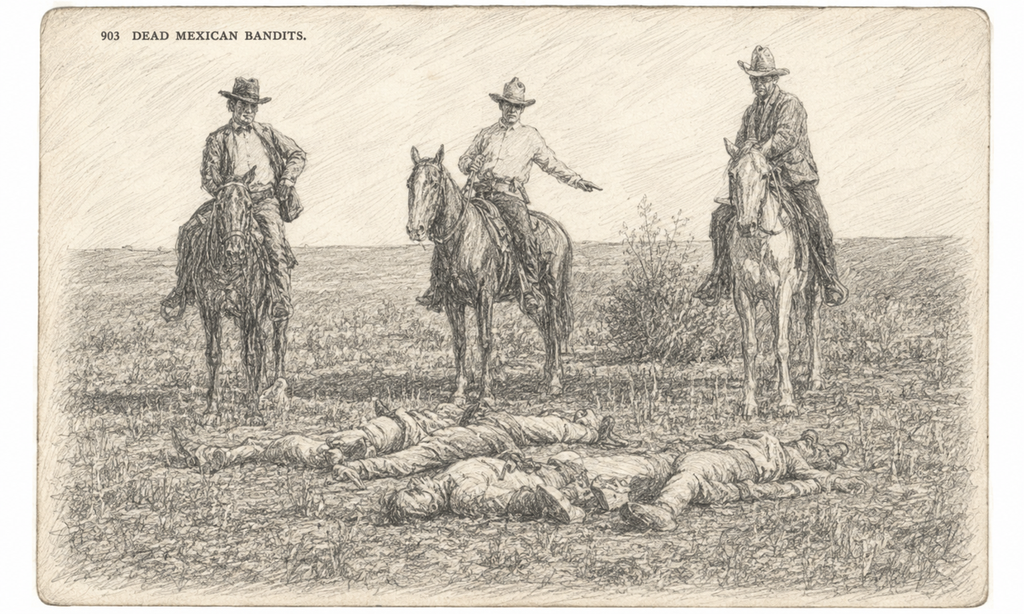
The famous 1915 postcard usually captioned “Dead Mexican Bandits.” It shows three mounted Texas Rangers posed behind four dead Tejano/Mexican men during the violence of the 1915 Border War/Plan de San Diego period.
The Rangers returned after the fighting.
The bodies of three dead raiders were tied to horses and dragged through the brush. Rangers and others then posed with the corpses for photographs.
Those photographs became postcards.
Testimony in the later Canales hearings identified Ranger Captain J. M. Fox and Special Ranger Tom Tate among the men photographed with the bodies. The postcards were sold publicly in stores throughout South Texas. (Refusing to Forget)
The men in the photographs apparently intended the images to demonstrate what happened to “bandits” who challenged Anglo authority.
But propaganda can travel in two directions.
The photographs circulated not only through South Texas but into northern Mexico, where they became visual evidence of how Tejanos and Mexicans could expect to be treated. Federal Immigration Inspector J. W. Berkshire subsequently linked the growing fury of the August raids to anger generated by circulation of the photographs.
The Rangers had not been present for the battle that killed those men, but afterward they helped turn their corpses into trophies.
This Was Now a Revolt
By this stage, “bandit” no longer adequately describes what was happening.
De la Rosa and Pizaña were coordinating organized guerrilla forces. Men attacked transportation systems, communications, irrigation works, ranches, and armed government forces, then withdrew across or along a border that made pursuit difficult.
Recruits came from both sides of the Rio Grande. TSHA describes the uprising as drawing men from South Texas as well as Tamaulipas, Nuevo León and Coahuila. (Texas State Historical Association)
The original conspiracy had become something different.
It had become a Tejano-Mexican revolt.
That does not mean everyone participating had the same motives. Some were committed revolutionaries, some were Mexican soldiers or political operatives, some were criminals taking advantage of disorder, and some appear to have been South Texas Tejanos radicalized by what was happening around them.
Nor does calling it a revolt excuse what the rebels did.
They killed civilians.
The Train North of Brownsville
The most horrifying rebel attack occurred on October 19.
Raiders removed spikes from the tracks and derailed a passenger train north of Brownsville. After the wreck, attackers went through the train and deliberately targeted Anglo passengers while sparing Mexican and Mexican-American passengers. (Texas State Historical Association)
For Anglo residents already terrified by the Plan de San Diego’s racial language, the attack seemed to confirm their greatest fear: that the promised race war had actually begun.
The counterattack again came quickly.
Rangers captured four Mexican men near the scene. Testimony later presented concerning the incident described Captain Henry Ransom taking prisoners into the brush, where they were shot rather than brought before a court. The later Canales investigation repeatedly examined allegations involving prisoners who disappeared after falling into Ranger hands. (Refusing to Forget)
By then, both rebels and forces claiming to restore order had crossed lines that separated combat from murder.
The Blacklists
The violence spread beyond gun battles.
Brownsville attorney R. B. Creager later testified about blacklists circulating through Anglo communities. A Mexican whom a sufficiently influential person considered dangerous could have his name placed on such a list and then simply disappear.
Local land developer Lon C. Hill, himself appointed a special Ranger during the crisis, later acknowledged that officers arrested people broadly on suspicion and that vigilantes sometimes participated in brutal interrogation and intimidation. (Refusing to Forget)
Mexicans and Tejanos therefore faced a frightening problem. They did not necessarily have to participate in a raid to become targets; suspicion itself could become dangerous.
Thousands began leaving.
Families crossed south into Mexico despite the Mexican Revolution because remaining in Texas appeared even more dangerous. The exodus became another measure of how completely civil order had broken down.
La Matanza
Mexican-American memory would eventually give the killings a different name: La Matanza — The Massacre.
The exact number of dead will never be known. Killings occurred in isolated country, bodies vanished, records were incomplete or nonexistent, and those responsible had little reason to document what they had done.
Federal reports cited by the Texas State Historical Association indicated that more than 300 Mexicans and Mexican Americans were summarily executed in South Texas in the atmosphere surrounding the Plan de San Diego. (Texas State Historical Association)
That figure is particularly striking when compared with deaths caused directly by the insurgency. TSHA estimates that approximately thirty Plan de San Diego raids between July 1915 and July 1916 produced twenty-one American civilian and military deaths. (Texas State Historical Association)
Numbers do not excuse murder by either side. The killing of an innocent Anglo civilian did not become less criminal because Rangers had killed Mexicans, and the killing of an innocent Tejano did not become lawful because rebels had murdered Anglos.
But the numbers reveal something essential about the scale of the response.
The counterattack became vastly more lethal than the revolt.
When Anglo Brutality Made More Rebels
For generations, beginning the history with “Mexican bandits attacked Texas” made the rest of the story easy to tell.
The Rangers rode in and restored civilization.
The evidence does not support something that simple.
The Plan de San Diego existed before the worst Ranger violence, and some of the men behind it wanted armed revolution before Muñoz was lynched or Los Tulitos was attacked. The original document contained murderous racial language, and rebel forces later demonstrated that they were capable of putting racial killing into practice.
But the opposite simplification is equally misleading.
Anglo violence was not merely a reaction to a fully formed Tejano rebellion. Extralegal killings, lynching, indiscriminate arrests, vigilante activity, and Ranger violence helped convince some Tejanos that the law offered them no protection.
José Tomás Canales made essentially that argument when Texas finally investigated the Rangers in 1919. He identified the destruction of trust caused by killings such as that of Muñoz and argued that Ranger brutality itself had helped ignite and sustain the border violence. (Refusing to Forget)
And then there was Aniceto Pizaña.
Before Los Tulitos, he favored reform.
After Los Tulitos, he became one of the commanders of the revolt.
That connection is not speculation. It appears in the historical record itself. (Texas State Historical Association)
A War Nobody Could Control
By autumn the United States Army had poured additional troops into the border region, while the government in Washington pressured Venustiano Carranza to restrain activity originating from Mexican territory.
The United States formally recognized Carranza’s government in October 1915. TSHA records that the Lower Valley raids then came to an abrupt halt, and in November Texas Governor James Ferguson and Carranza met at Nuevo Laredo and agreed to take steps to suppress further border violence. (Texas State Historical Association)
That was not quite the end.
Relations between Mexico and the United States deteriorated again in 1916. Pancho Villa attacked Columbus, New Mexico, and General John J. Pershing led an American expedition deep into Mexico. Plan de San Diego raiding revived, particularly farther upriver, while officials on both sides worried that the border crisis might become an outright war between Mexico and the United States. (Texas State Historical Association)
Then American and Mexican troops actually fought at Carrizal in June 1916.
The official history of the United States Army says war with Mexico probably would have followed “but for the critical situation in Europe.” Almost the entire Regular Army became involved in the Mexican crisis, while most of the National Guard was federalized and concentrated along the border. (U.S. Army Center of Military History)
That gives the ending of the Tejano Revolt a much larger context.
America Could See Another War Coming
The United States was still officially neutral in the European war, but Europe could no longer be treated as somebody else’s problem. American leaders were confronting the possibility that they might eventually have to fight Germany while tens of thousands of American troops were tied down on the Mexican border and relations with Carranza remained dangerously unstable.
Washington had powerful reasons not to allow South Texas and northern Mexico to become another front.
By late June 1916, Mexican and American officials reached a peaceful settlement of their immediate differences, and the renewed Plan de San Diego raids came to an end. (Texas State Historical Association)
Events soon demonstrated how dangerous the situation could have become.
In January 1917, Germany secretly proposed that Mexico join Germany if the United States entered the European war. Germany offered financial support and recognition of Mexico’s right to recover Texas, New Mexico, and Arizona. (Office of the Historian)
The infamous Zimmermann Telegram did not cause the Tejano Revolt, which was already over.
But it showed that Washington’s fear of simultaneously confronting war in Europe and instability or war along the Mexican border was hardly imaginary.
The History Hidden Behind the Word “Bandit”
The Plan de San Diego never produced the army that its authors imagined. It did not conquer Texas, liberate the Southwest, or create a new republic.
Instead, something less grand but very real happened.
A relatively small revolutionary conspiracy collided with decades of racial conflict, changing land ownership, political displacement and economic transformation in South Texas. Then lynching, vigilante violence and extralegal killings helped turn resentment into armed resistance.
The rebels answered brutality with brutality.
The state answered rebellion with violence on a vastly greater scale.
Caught between them were thousands of Tejanos who never joined either side but nevertheless discovered that during the summer and fall of 1915 merely being Mexican could place a man under suspicion.
Some fled.
Some disappeared.
Some fought back.
Some were left dead beside South Texas roads.
Calling all of that a “Bandit War” hides too much of the story.
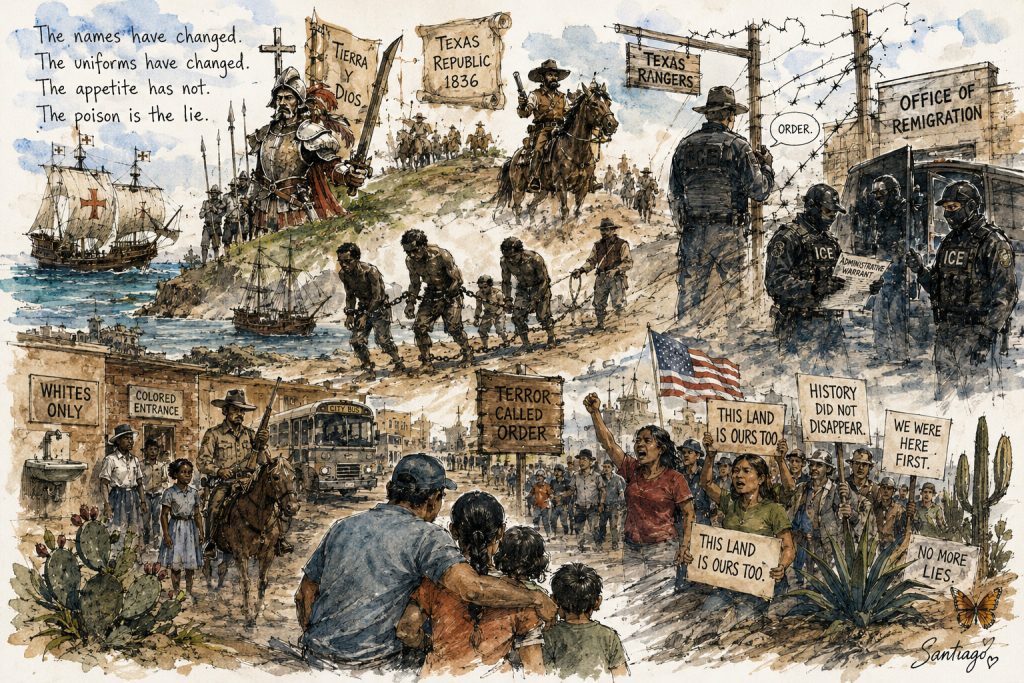
It was a conspiracy that became an insurgency, an insurgency that provoked a counterinsurgency, and a counterinsurgency that deteriorated into racial terror.
It was the Tejano Revolt of 1915.
I think this is substantially stronger than the first version because Muñoz → Los Tulitos → Sebastian → Norias now forms the spine of the story instead of appearing as disconnected incidents.