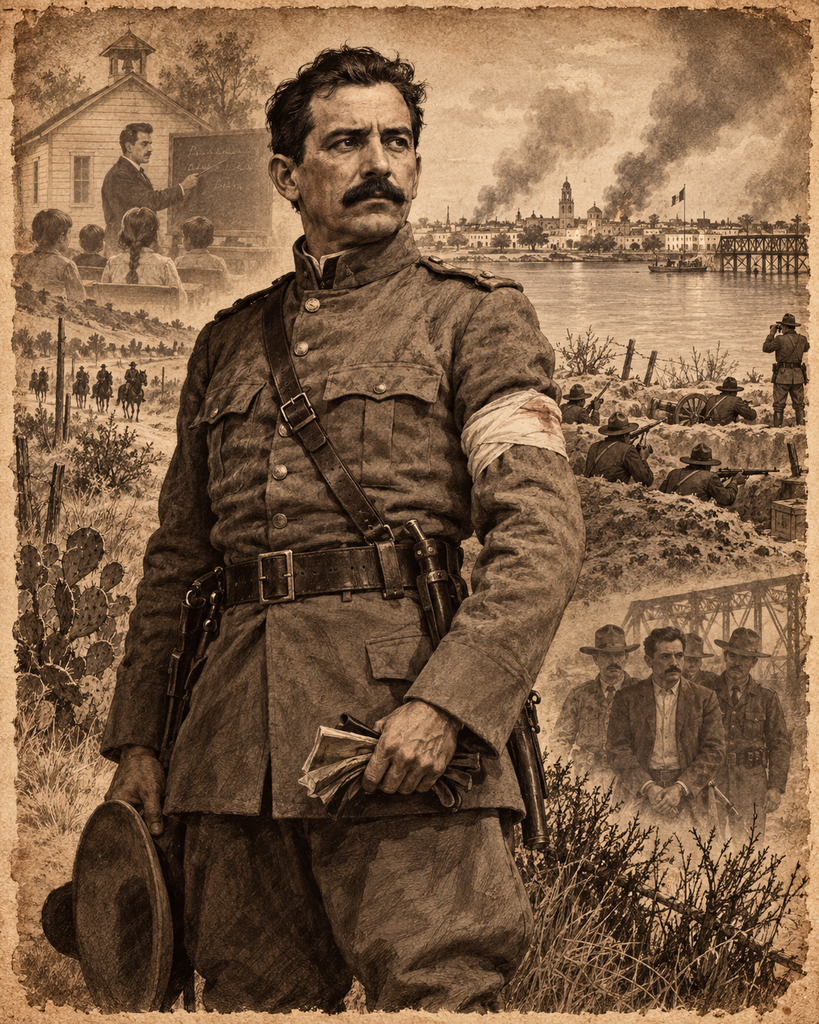
In March 1915, Procopio Elizondo stood on the Mexican side of the Rio Grande defending Matamoros against the army of Pancho Villa. Thirteen years earlier, he had been a schoolteacher in Cameron County, Texas, accused of taking part in an ambush that killed a Texas Ranger. His life had crossed the border more than once. By 1915, that border had become a battlefield.
Elizondo served under General Emiliano P. Nafarrate, commander of the Carrancista garrison at Matamoros. Mexican military records identify Elizondo as one of Nafarrate’s principal officers during preparations to defend the city. The defenders used irrigation ditches as part of their fortifications and positioned machine guns to meet an expected Villista attack. (Inehrm)
The attack came on March 27, 1915. Villista cavalry under General José E. Rodríguez charged the defenses around Matamoros and suffered heavily under machine-gun fire. Contemporary accounts describe Elizondo as one of the officers defending the city. During the fighting, he was seriously wounded. (Wikimedia Commons)
His wounds brought him back across the river.
The Brownsville Herald reported on April 2 that Texas Rangers had arrested General Procopio Elizondo, who had crossed into Brownsville while recovering from his wounds. The headline was blunt: “TEXAS RANGERS HOLD CARRANZA ARMY GENERAL.”
The Rangers were not arresting him for anything that had happened during the Mexican Revolution. They were reaching back to 1902.
According to the newspaper, Elizondo was accused of involvement in the killing of Texas Ranger Emmett Roebuck and an assault on Ranger A. Y. Baker. Roebuck had been killed during an ambush southeast of Brownsville. Baker was wounded. The Rangers claimed Elizondo had been involved and arrested him thirteen years later when he again came within their reach.
The old shooting was itself part of a violent dispute between Texas Rangers and members of the de la Cerda family. Baker had earlier killed Ramón de la Cerda Jr. after accusing him of cattle theft. Ramón’s brother Alfredo de la Cerda fled across the river and was accused of threatening Baker. Then came the ambush in which Roebuck died.
Baker later encountered Alfredo de la Cerda in Brownsville and shot him. The episode became another example of how personal feuds, Ranger authority, racial hostility, and cross-border violence became entangled in the Lower Rio Grande Valley. Baker was prosecuted but acquitted.
Elizondo apparently left Texas for Mexico. The Herald said that he had lived in Cameron County for years and had worked there as a schoolteacher before eventually crossing permanently into Mexico. By the time the Mexican Revolution reshaped northern Mexico, the former teacher had become a military officer.
His arrest in 1915 did not end his career.
Within months Elizondo was again serving Carranza’s government. By September 1915, he was Jefe de las Armas, military commander, in Matamoros, issuing orders concerning the circulation of Carrancista currency. (Paper Money of Mexico) He later served in Tamaulipas as Carranza’s forces consolidated control.
His career also illustrates why the Mexican Revolution rarely offers simple heroes. In 1916, Elizondo was serving as military commander at Tampico when a labor dispute erupted. Carranza had issued a decree threatening death for those who incited work stoppages in important industries. Mexican government historical records state that Elizondo used that decree to execute two striking workers, after which the strike ended. (Inehrm)
The man once pursued by Texas Rangers for an alleged extrajudicial killing had become an officer of a revolutionary government willing to use execution to impose its own authority.
Procopio Elizondo’s story therefore crosses several worlds. He was a Cameron County schoolteacher, an accused participant in a deadly Ranger feud, a Mexican revolutionary officer, a defender of Matamoros, a prisoner of the Texas Rangers and later a Carrancista military commander.
His life also helps explain why the violence of 1915 cannot be understood as something that suddenly erupted along the Rio Grande that summer. When Elizondo was arrested in Brownsville, the Rangers were reopening bloodshed that dated to 1902. Men on both sides of the river remembered who had killed whom, who had escaped, who had been acquitted and who had crossed the river to survive.
Thirteen years later, those memories were still alive.
And this time, the former Cameron County schoolteacher had returned wearing the uniform of a Mexican army.