Texas has always loved to brag about itself; they call them tall tales, maybe sometimes they are just big whoppers of a lie. I read something and decided to look for the Mexican version of the event, and I found some discrepancies. I don’t read Spanish, but my AI assistant can, and he can also access Mexican records, so I can tell the story of what happened in 1842 that led up to the Mier Expedition.
From San Antonio to Mier — The Mexican Side
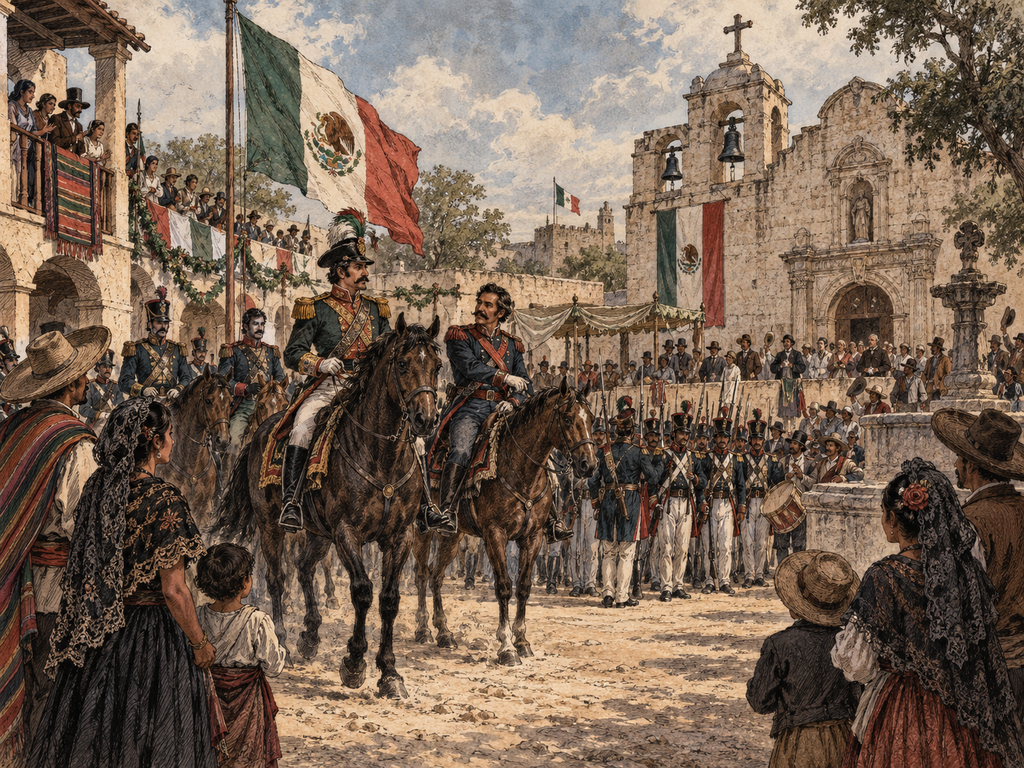
On the morning of September 11, 1842, General Adrián Woll surprised San Antonio.
He had not marched up the familiar road from Laredo. Woll brought his Mexican army through difficult country by a route that avoided the Texas scouts watching the usual approaches. Fog helped conceal the final advance. By the time the people in San Antonio understood that this was not a small raiding party but a Mexican army, Woll’s soldiers were already in the city. The defenders surrendered, and dozens became prisoners.
Among the Mexican officers was Juan Seguín.
Only six years earlier Seguín had fought against Santa Anna and for Texas independence. He had served the Republic of Texas as senator and had been mayor of San Antonio. But threats and accusations that he was loyal to Mexico had driven him from Texas. Now he returned commanding Mexican troops under Woll.
Five days after taking San Antonio, Woll did something that must have been particularly painful to the Texans.
On September 16, the Mexican army celebrated Mexican Independence Day in San Antonio. Woll proudly reported that the anniversary of Mexican independence was again being celebrated in Béxar after having been absent for six years. Mexico had never recognized Texas independence. From Woll’s perspective, he had not conquered a foreign city; Mexican authority had returned to Mexican territory.
But Texans were gathering outside the city.
About 200 men under Mathew Caldwell took position along Salado Creek east of San Antonio. The location mattered. They were not standing in an open field where Mexican cavalry and artillery could dominate them. They waited in broken, wooded ground where their rifles gave them an advantage. John Coffee Hays and a small force rode toward San Antonio and then retreated toward Caldwell.
They were trying to draw Woll out.
Woll apparently knew it.
In his report, he said he suspected the retreat might be a stratagem intended to draw him into an ambush. He went after them anyway. He took infantry, cavalry and artillery toward Salado Creek and discovered Caldwell’s force waiting in the woods. Whatever else can be said about Woll, his own account does not describe a commander frightened of the Texans. He believed he had the force to attack them even on ground they had chosen.
The battle that followed is where the numbers become difficult.
The familiar Texas account says approximately 200 Texans held off a much larger Mexican force while losing only one man killed, and that perhaps sixty Mexicans were killed. Woll reported 29 Mexicans dead and 58 wounded and claimed much heavier Texas losses. Neither account should automatically be accepted simply because it came from one side or the other.
We know Woll could badly overestimate enemy numbers because another Texas force appeared while Salado was being fought.
Captain Nicholas Dawson was approaching with 53 men, hoping to join Caldwell. Woll believed the approaching force numbered perhaps 150 to 200. Mexican cavalry and artillery intercepted Dawson before he reached the main Texas position.
Thirty-six of Dawson’s 53 men were killed, fifteen were captured, and two escaped. Here, unlike many of the battlefield estimates, we can account for practically every man.
Woll returned to San Antonio and soon began his withdrawal toward Mexico.
That retreat deserves more attention than it usually receives.
Woll was not moving only soldiers. He reported more than 150 carts belonging to Mexican families from San Antonio, loaded with furniture and possessions. A large herd of cattle accompanied them. Other accounts estimate that as many as 200 Tejanos left San Antonio with the Mexican army, apparently fearing reprisals after Woll departed.
Woll even stopped his army at the Medina so the families and their carts could get farther ahead under his protection.
That complicates the familiar explanation that heavy rain prevented the Texans from catching him.
The rain was real. Contemporary reports describe weeks of extraordinary rain, flooded creeks and terrible traveling conditions. But those same conditions confronted Woll, who was moving infantry, cavalry, artillery, prisoners, cattle, and a civilian wagon train of more than 150 carts.
The rain therefore cannot by itself explain what happened.
Woll had a head start. The Texans were hastily organized. Their commanders disagreed about what to do. And when they did catch parts of Woll’s force near the Hondo, the Mexicans turned and fought rather than simply running away.
The Texans never destroyed Woll’s army.
Woll crossed back toward Mexico with his prisoners and many of the Mexican families who had chosen to leave San Antonio with him. Mexico promoted him and awarded him the Cross of Honor. Texas remembered Salado as a victory. Both sides found something in the campaign they could call success.
But in Texas there was anger.
Woll had captured San Antonio. Dawson’s company had been destroyed. Texans had been taken prisoner and marched south.
They wanted revenge.
President Sam Houston eventually authorized General Alexander Somervell to organize the volunteers gathering at San Antonio. About 700 men marched south on November 25.
They reached Laredo with 683. There the force began coming apart. After Laredo was taken and plundered, 185 men went home. Somervell continued with a little more than 500 and forced the surrender of Guerrero.
Then Somervell decided enough was enough.
On December 19 he ordered the expedition ended and told his men to return to Texas.
Only 189 obeyed him.
About 308 refused, selected William S. Fisher as their commander, and continued down the Rio Grande.
Those numbers are important because the army that had started from San Antonio was disappearing step by step.
About 700 had left San Antonio.
Only 308 continued with Fisher.
And only about 260 men actually went into Mier.
There they encountered Mexican troops under General Pedro de Ampudia.
On Christmas Day and into December 26, the Texans fought through the streets and buildings of Mier. Once again the casualty accounts from the two sides differed enormously. Later Texas histories claimed hundreds of Mexican casualties. Mexican reports gave far smaller figures.
But one fact was no longer disputable.
The Texans were surrounded, exhausted, running short of ammunition and deep inside Mexico.
They surrendered.
The expedition that had begun as retaliation for Woll’s capture of San Antonio had crossed the Rio Grande looking for revenge.
At Mier, the avengers became prisoners.
____________
From the New Orleans Bulletin
THE TEXIAN EXPEDITION UNDER COL. WILLIAM S. FISHER—THE BATTLE OF MIER.
We received by the last arrival from Matamoros, the subjoined communication, giving a full and certified account of the objects of the “Expedition to the Rio Grande, the events of the march, of the battle of Mier, and its disastrous termination. We take advantage of a leisure day, and a failure of the mail, to place it upon record:
MATAMOROS, Jan. 12, 1843.
**Gentlemen—**You have learned, perhaps, ere this, of the engagement at Mier, on the 25th and 26th December last, between a party of about 260 Texians under Col. William S. Fisher, and a Mexican force from 2700 to 3000 men, (cavalry and infantry, with two pieces of artillery,) under Gen. Ampudia.
The fight was continued for the space of 19 hours, and was at intervals, very warmly and closely contested. It resulted, however, after a desperate charge of the Mexicans had been repulsed by a counter charge, in the sending in a flag of truce by the enemy, which our officers and men at first naturally supposed to be a surrender on their part. A capitulation had never been made a question with us, until a parley was sounded by the enemy.
The entertainment of the question, after the flag was received, gave the enemy’s officers, who came up, an opportunity of ascertaining our number, and at the same time informed our own men of the force opposed to them. We were now informed that their object in sending the flag was to propose quarters. If we would surrender, upon condition that we should be faithfully treated as prisoners of war, our baggage returned to us, and we to be marched to Matamoros, with the pledge that Gen. Ampudia would recommend the Government authorities to permit us to remain at the latter place and to be permitted to work for our support, on parole of honor, until liberated.
An hour’s time was allowed for our decision. A loud and prompt rejection of these terms was immediately indicated by a majority of our men; and a portion seemed disposed to accede to the terms proposed.
The enemy, craftily availing themselves of the apparent discussions and faltering in our ranks, made known, through our Commander, that the time had elapsed when we were to decide upon our course; and that such as felt disposed to avail themselves of the terms offered might go to the Public Square and surrender their arms.
The decision upon this last proposition was required to be instantly made. About one third of the command moved forward and laid down their arms, which so reduced the number as to make certain destruction the alternative of an opposite course on the part of the remainder. So, the entire body surrendered, with the exception of two, (Sinclair and Clark,) who concealed themselves until night, passed the guard, and got safely into our camp across the river.
We are all accordingly in Matamoros, in the same dungeon with the common felons of the country; and are to be marched to-morrow morning, on foot to Monterey—and in irons—in contravention of the express terms of our surrender. You may expect, as we do, that the city of Mexico is our destination.
We have been blessed in meeting with kind friends in this place, who have contributed to relieve the incidental miseries of our situation. I must particularly mention the names of J. D. Marks, Esq., Consul U.S.; A. M. [unclear] Young, Mr. French Strother, Mr. S. P. Schatzell, together [with] many other marked attentions to us.
I have not heretofore examined the relative loss in killed and wounded, on our side; 2 were killed and 26 wounded—on that of the enemy, upwards of 600 in killed and wounded. I [state] these particulars—to subjects which concern a proper vindication of the character and objects of the expedition, of whose misfortunes I have been treating.
The fatal issues of the adventure have caused [some] to harden not [the] real gallantry of my comrades; may impute their attack upon Mier, under the circumstances, to rashness: but the just will determine, that it was an enterprise superinduced by the effervescence of a patriotic resentment altogether natural.
Texas had been three times during that year invaded by Mexican forces, and not one single effort made by the Texian Government to retaliate. The rancorous prejudices of the enemy may endeavor to characterize the expedition as of lawless depredators, acting without the authority and sanction of the Government; but the origin and objects of the expedition, (which alone should stamp its character) do not warrant the aspersion.
These are the facts. Upon the invasion by Woll, in October, the effective military force of the Counties in Texas, was ordered to take the field and to concentrate at San Antonio. The troops ordered out by the President, were authorized to organize themselves and to chastise and pursue the enemy to the Rio Grande, and, if deemed expedient, to cross the river and fight him upon his own territory.
I marched, myself, from the city of Houston, in command of a company composed of the militia of Cyprian [possibly “Cypress”] and volunteers of Houston, having been furnished with Government arms and ammunition. Another company marched also from Houston, under orders to repair to this point of the Executive, having the design to pursue the enemy to the Rio Grande.
An Expedition characterized in General orders as “the South Western Army of Texas,” was then gotten up under the orders and auspices of the Executive, who appointed Brigadier General Alexander Somervell to the command of it; Chief Justice John Hemphill, Acting Adjutant General; Col. Wm. G. Cooke, Acting Quartermaster General; and James R. Cook, Acting [unclear].
The condition on which the President would sanction [the expedition] was that the upwards of 700 men, well armed and equipped, took up the line of march from the Medina for above, with the [unclear].
About the morning, at day-light of the 8th December, the command, under Gen. Somervell, surrounded and captured without firing a gun, the town of Laredo—a town on the Eastern bank of the Rio Grande, and within the limits of the territory claimed by the Republic of Texas, but occupied by men who are the most bitter and troublesome enemies of the western frontier of Texas.
The town was placed at our disposal; but a small, a very small contribution, amounting to a bare subsistence for the troops was exacted. We camped during the night within two miles of the town, where we were to receive the provisions on the morning of the next day—a few of the men without the knowledge or sanction of the General or their company officers, visited the town, and to the disgrace of themselves and the expedition, plundered the citizens.
No sooner was this conduct known than effective steps were taken to detect the plunderers and to restore the property taken by them. As fast as they, the plunderers, came into camp, a guard conducted them to the guard fire, and made them deposit their effects.
A note was in the mean time addressed by the commander to the Alcalde, stating that the plundering to which the town had been subjected had been done without the knowledge or sanction of the officers, and was regarded by a majority of the command with sentiments of indignation.
The General furthermore assured the Alcalde that Texians came not there to war against unresisting citizens—their property, or their religion; and that they might return to their occupations and devotions, assured that they would not again be interrupted in either, by the force under his command.
Texians, he went on further to assure the Alcalde, came to seek and to fight the military of the country—not to distress its defenceless citizens, who offered no resistance.
A feeling of dissatisfaction was produced among the whole, on account of the disgraceful conduct of a few; and we were not in a position, or surrounded by such circumstances, as made a punishment of the insubordinate a practicable measure. The commanding officers therefore determined upon a return to Texas.
On encamping the first night, on the homeward march, it was ascertained by the officers (I mean the field officers) that a large majority of the men could not be marched eastward on a retreat, before having fronted the military of the country. A council of officers was called in the morning, when it was resolved, that if a large majority (say 500) were willing to continue hostilities and cross the river it should be undertaken.
The General, in a short but pertinent address, proposed a division of the men upon the question of crossing the river at all hazards, or returning home. It was decided by an overwhelming vote that the river should be crossed.
Accordingly, the line of march was taken up for Guerrero, by about 510 or 520 men—the balance moved homeward. On or about the 15th (I can’t be particular as to dates, having no memoranda to write from) we crossed the river to attack Guerrero.
When about sixty of the men had crossed, a force of some two or three hundred men, said to have been commanded by Canales, appeared in sight, as if coming to dispute the passage of the river, but a flag of defiance was raised, and they dared not advance to the combat. So we kept them off till the whole force had crossed the river with their horses.
This was not effected until the next morning, when the Alcalde of Guerrero made his appearance and placed the town at the disposition of our commander, with the request that the troops should not be marched into the town. This request was complied with.
The force was encamped within a mile of the town, and the next morning ordered to recross the river. This step, on the part of our commander, inspired some hope that we might have been prompted by fear in our movements; and the requisition, though very limited indeed in its value, was not wholly complied with.
Murmuring among the men ensued at the supposed lack of energy in the officers, and to quiet this, a requisition of $5,000 was made upon the Alcalde, with the assurance that if it was not promptly complied with, a large party of men should be permitted to ravage the town.
This was merely held out, however, as a threat to force the Alcalde into a compliance with the requisition, since, upon a failure of the Alcalde to raise and execute the [unclear], the troops were again assembled by General Somervell, all ready to return home.
In this condition, when the greater cause to be [unclear], he was still opposed by a majority of those who had taken a resolution to continue the expedition. About 600 men remained [unclear] attacking Mier—a town at a distance to Matamoros and [unclear] between San [unclear]—the remainder, about 200 or upward, having returned home with Gen. S.
The party that remained to continue hostilities elected Col. Wm. S. Fisher to the command. They descended the river about 25 or 30 miles by land and water—a party of 30 men, under Thomas J. Green, descending in flatboats and skiffs for the purpose of destroying the boats on the river.
On the 23d of December, leaving a guard in charge of their horses and baggage, about 270 men marched on foot to Mier, took a position on the Public Square, when the town was placed at our discretion by the Alcalde.
A requisition of provisions, and such blankets and clothing as were indispensably necessary was made, all of which the Alcalde cheerfully agreed to furnish. He plead some difficulty in effecting a transportation of the same to the landing opposite to our encampment; and we left the town without having permitted the men to leave the line, taking the Alcalde with us as a hostage for the fulfilment of his promise to have the articles demanded, brought down to us the next morning.
The obstacle, a hog [possibly “large”] drove, had appeared [unclear], a company of spies under the command of Capt. John R. Baker, was sent across the river to scout and ascertain the probable cause. In the meantime two of our men had been captured by him, who stated that Ampudia and Canales were on the river below with a force of 300 men, and were waiting for us to risk an engagement with the infantry.
After a council of officers was called, it was determined that our requisition should be enforced, even at the risk of our engagement. We accordingly crossed the river, having our horses and baggage, as before, in charge of a guard. Some 10 or 12 spies mounted, were sent in advance, [unclear].
We reached the suburbs of the town in the night, [unclear] the enemy. We moved slowly and steadily forward, driving in their outposts, one after another, crossed the river Alcantro, which is within [unclear] of the corporation and near the Public Square, under a heavy fire of musketry, and took a position within gun shot of the artillery and line of the enemy.
We had to force an entry through the walls of the houses to get this position. On firing, by companies, up a street which led to the public Square, the artillery of the enemy was opened upon us, and the big guns and musketry of the enemy were actively employed against us, harmlessly however, during the night.
At daylight we opened upon them with the never-failing rifles of Texians, and soon cleared and silenced the artillery—killing, as has been reported, two entire companies of artillery, with the exception of one captain and one private.
Another piece of artillery was planted so as to rake our position from another direction, (manned by infantry,) which also was soon cleared. The house tops surrounding us in three directions were covered with sharp shooters, protected by a stone wall of some 24 inches in depth. The fatality of our rifles soon thinned the number of those.
And, toward the afternoon, charges of the enemy were repeatedly sounded. One desperate charge was attempted—the enemy coming in numbers almost near enough to put their bayonets in the doors of the house we occupied. This charge was resisted and gallantly repulsed by about 40 or 50 of our men who charged out of the house and drove back the crowds of the enemy in every direction.
It was at this stage of the combat, when death or victory was the watchword with us,—that the flag of truce was sent in by the enemy, which resulted as has been before stated.
We had 11 killed and 26 wounded—whilst we killed and wounded of the enemy more than twice the number which constituted our force.
We have been assured by gentlemen of distinction in this place, (who authorize us to say so,) that the Mexican officers themselves testified to them, “that such an impression had not been made upon the country since the battle of San Jacinto; and that the Texians fought, not as men, but as lions.” I use the language of the Mexican officers.
If it is imputed to us as rashness in detaching ourselves from Gen. Somervell, and crossing the river with a small force, I answer for myself and comrades that we were mainly prompted by disgust and mortification at the fact that the frontier of our country had been three times invaded, and our habitations as repeatedly desolated, and yet no blow of vengeance or retaliation had been struck by Texas.
We crossed the river to stir up the whirlwind of war about the dwellings of the enemy, if their houses should tumble upon our devoted heads.
If we are charged with acting in disobedience of the orders and wishes of the commander-in-chief, in not returning to Texas with him, I answer, that we were more afraid of being branded on our return as recreants, than we were of the worst possible results to be apprehended from such disobedience; and, moreover, we were not supplied with a sufficiency of provisions to take us home from Guerrero, and this fact operated upon many of the men who were willing, had the case been otherwise to have returned.
It was stamped at the time as unofficer-like conduct in Gen. S. to presume to march the command home without adequate supplies and horses; many of the men being on foot and others with weak horses, utterly unable to perform the trip; when, too, we were surrounded by an abundant commissariat department.
I must conclude, and in doing so, I ask for my comrades—not the sympathy of the world alone—more than that: I claim the highest admiration.
And these are their titles. The repeated incursions of the enemy imperiously demand a retaliation on the part of the Texians; and that retaliation has been made with a vengeance greater than their injuries. There needed some daring spirits to blaze the course of Texians across the Rio Grande, and that work has been done, perilous as it was imagined.
The fame of taking San Antonio in ’35 was lost in the shameful surrender of that town in the spring of ’42. The renown of the battle of San Jacinto in ’36 was [unclear] by the disgraceful retreat from the Rio Grande [unclear].
The contest with Mexico gives us our own [unclear]—some of lasting fame, when we consider it to be our duty to [unclear] our independence, by every means in our power.
Our path is now open to all fearless Texians—to them “the field, the fight, and the conquest.”
God.
Your’s truly,
JAMES D. COCKE.
**Note—**I omitted to mention that I was assured by gentlemen of respectability here, that Col. Canales had written to this place from Mier, to the effect, that had the fight continued for half an hour longer, the victory would have been ours.
J. D. C.
We endorse the above as containing, as far as it goes, our own views of the matter treated of.
Captains—Edwin Cameron, John R. Baker, Claudius Buster, Wm. M. Eastland, J. G. W. Pierson, Chas. K. Reese, Wm. Ryan, Israel Canfield.