Pick what you want to believe, because both cannot be true.
We come to honor Davy Crockett, but also to seek the truth as best we can. The two are not enemies. Crockett does not need an invented death to remain an important figure in American history, and the Alamo does not become less significant because some of the stories told about it cannot be proved.
The problem is that the heroic version began forming almost immediately. Within weeks of the battle, newspapers were already describing the defenders as martyrs, comparing them to the heroes of antiquity, and turning uncertain reports into scenes that later generations would repeat as fact. By March 24, 1836, only eighteen days after the Alamo fell, the Telegraph and Texas Register declared that Texas would “never cease to celebrate” the event and said the dead should be remembered as the heroes of the “Thermopylae of Texas.” On the following page, it said the world would hail them like the “demi-gods of old.” (The Portal to Texas History)
That same newspaper gave readers a dramatic death for Crockett. It reported that Crockett and his companions were found surrounded by piles of Mexican soldiers they had killed and said Crockett’s end had been as glorious as his life. That may have been true, but the important point is that the newspaper was not merely reporting an established fact. It was already openly engaged in honoring the dead and teaching Texans how they should be remembered. (The Portal to Texas History)
Joe was there
One of the few men who actually survived the battle was Joe, the enslaved man owned by William Barret Travis. Joe was about twenty-one or twenty-two years old. According to the surviving accounts, he armed himself during the final assault, was later spared after a Mexican officer intervened, and eventually reached the Texas government, where he was questioned about what he had seen. (The Alamo)
Joe matters because much of the traditional account of the battle traces back to what he was reported to have said. But we need to be careful with the word said.
William Fairfax Gray heard Joe being questioned before members of the Texas Cabinet on March 20, 1836. Gray did not claim that he was taking down Joe’s words verbatim. In the version later published under Gray’s name, Gray wrote that what followed was, “as near as I can recollect, the substance of it.” The Alamo itself acknowledges that Gray’s recollection of Joe became the basis of much of the traditional narrative of the battle. (The Alamo)
That means we do not possess Joe’s own written testimony. We possess Gray’s recollection of what Joe reportedly told the Cabinet. Those are not the same thing.
Gray’s version says Crockett and several companions were found dead surrounded by twenty-four dead Mexican soldiers. That statement has often been treated almost as though Joe himself had left a sworn written deposition describing Crockett’s death. He did not. The chain is more complicated: Joe reportedly spoke; Gray heard him; Gray reconstructed the substance from memory; and later writers repeated Gray.
There is another reason for caution. The Texas State Library describes the Gray diary in its holdings as a typescript covering 1835–1837, not the original handwritten manuscript. The diary was published in 1909 as From Virginia to Texas, long after Gray’s death. The original handwritten manuscript of the passage normally attributed to Gray has not been produced for examination in the sources I have found. That does not prove the published version is wrong, but it does mean historians should stop treating the printed wording as though everyone can inspect Gray’s original March 1836 page. (Texas State Library)
Gray himself also deserves examination rather than automatic trust. He was a lawyer and land agent who came to Texas in 1835, attended the Convention of 1836, unsuccessfully sought the position of convention secretary, and carefully recorded the major political figures and events around him. He knew he was living through history. That does not make him dishonest, but it makes him a participant and recorder with his own ambitions and point of view, not a mechanical recording device. (Texas State Historical Association)
The other Crockett story also appeared in 1836
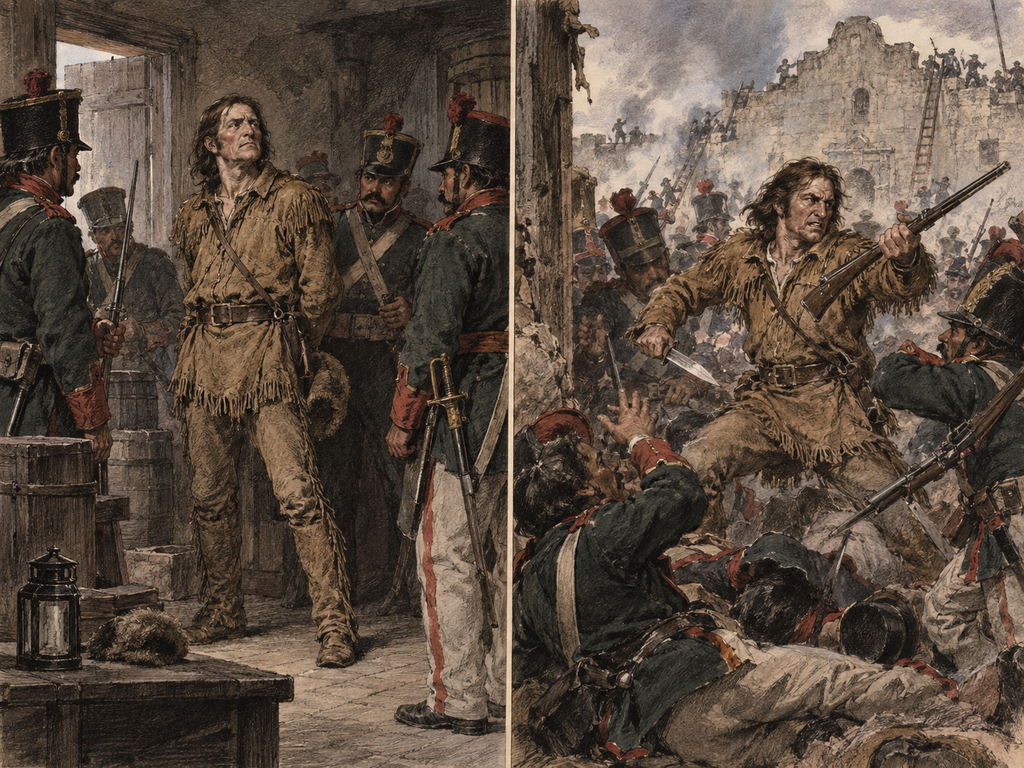
The traditional Texas version is not the only early account of Crockett’s death. Other reports circulating in 1836 said Crockett and several other defenders survived the fighting, were taken prisoner, and were killed afterward on Santa Anna’s orders. Accounts associated with Mexican officers, including Juan Almonte, put a capture-and-execution story into circulation during the same year as the battle. José Enrique de la Peña later recorded a similar version.
That matters because the choice is not between an authentic 1836 Texas account and a hostile story invented generations later. There were competing accounts while memories of the battle were still fresh. The proper historical question is therefore not which story Texans came to prefer, but what evidence supports each version and how directly that evidence connects us to the people who actually saw Crockett’s final moments. (The Alamo)
We should apply the same rule to both sides. Gray’s recollection should not become fact merely because Texans liked the story it told. Mexican reports should not become fact merely because they contradict the Texas legend. A contemporary report may deserve greater weight than a much later recollection, but neither should be turned into certainty when the chain of information remains uncertain.
The hero was being built almost at once
The newspapers show how rapidly Crockett became something more than a dead defender. One report said he had fallen “fighting like a tiger.” Another lamented “Poor Davy Crockett!” and described him mowing down Mexicans before dying. By May, papers were repeating an alleged Crockett speech in which he supposedly promised to die with “Betsy” in his arms and predicted what would happen at the Alamo.
That last story has a serious problem. The supposed Texas adventures of Crockett appeared in Col. Crockett’s Exploits and Adventures in Texas. The Library of Congress describes that book as a pseudo-autobiography, first published in 1836 and generally attributed to Richard Penn Smith. It was not Crockett’s battlefield diary. (The Library of Congress)
Yet material of this kind quickly entered newspapers and popular memory as though Crockett himself had supplied it. This is how legends are built. A secondhand report becomes a quotation, the quotation becomes an anecdote, the anecdote is repeated often enough that people stop asking where it came from.
The March 24 Telegraph and Texas Register is especially revealing because it openly tells us what it is doing. The paper wanted to “consecrate to future ages” the memory of the defenders. It was not pretending to be detached. It was creating heroes for a new republic while the war was still being fought. (The Portal to Texas History)
That does not mean everything it printed was false. It means we have to read it for what it was: a Texas newspaper in wartime, openly committed to the Texas cause and openly interested in making martyrs out of the dead.
And then there was Joe
The treatment of Joe exposes something the heroic version of the Alamo usually leaves on the side of the road. Joe survived the battle, supplied information that became part of the story Texans told about their heroes, and was then returned to the Travis estate as enslaved property. Texas did not free him for fighting at the Alamo or for helping tell the Republic what had happened there. (Texas State Historical Association)
On April 21, 1837, exactly one year after San Jacinto, Joe escaped. He left with an unidentified Mexican man and two fully equipped horses. Travis’s estate advertised a reward for his return. The notice remained in the newspaper for months and was eventually discontinued; there is no evidence in that record that Joe was captured and returned. (Texas State Historical Association)
The original runaway notice does not explicitly tell us where Joe intended to go. Later accounts describe him heading south toward Mexico. That direction made sense for an enslaved Texan. Mexico had moved against slavery beginning in 1829 and abolished it without the Texas exception in 1837. The National Park Service documents that enslaved people in Texas later understood a simple fact: unlike the long journey north, freedom could lie just across the Rio Grande. (National Park Service)
The contrast is hard to miss. Joe fought inside a place that became one of Texas’s great monuments to liberty. His account helped Texans remember the men who died there. Texas then returned him to slavery, and a year later he escaped with a Mexican man toward a country where slavery had been abolished.
What do we really know about Crockett’s death?
We know Crockett went to Texas. We know he entered the Alamo. We know he was there when the Mexican army attacked, and we know he died during or immediately after the final assault. What we do not know with the same certainty is exactly how he died.
One version, carried through Gray’s recollection of Joe and repeated rapidly by Texas newspapers, has Crockett dying amid the fighting and surrounded by Mexican dead. Another early tradition has him surviving the assault, being captured, and then being executed. Both were circulating close to the event. Neither version turns Crockett into a coward.
Only mythology requires that Crockett die in one particular pose.
Nations need heroes, and the Republic of Texas needed them badly in 1836. The evidence shows that Texans were already making heroes of Travis, Bowie, Crockett and the other defenders before anyone had carefully established exactly what had happened during the final hour at the Alamo. The newspapers said so themselves.
Crockett can survive the truth. So can the Alamo.
What history cannot survive is our deciding in advance which story we want to be true and then calling that evidence.