Listen to this story
Molina: Annexed to Stop the “Slums,” Then Told to Pay for Plumbing
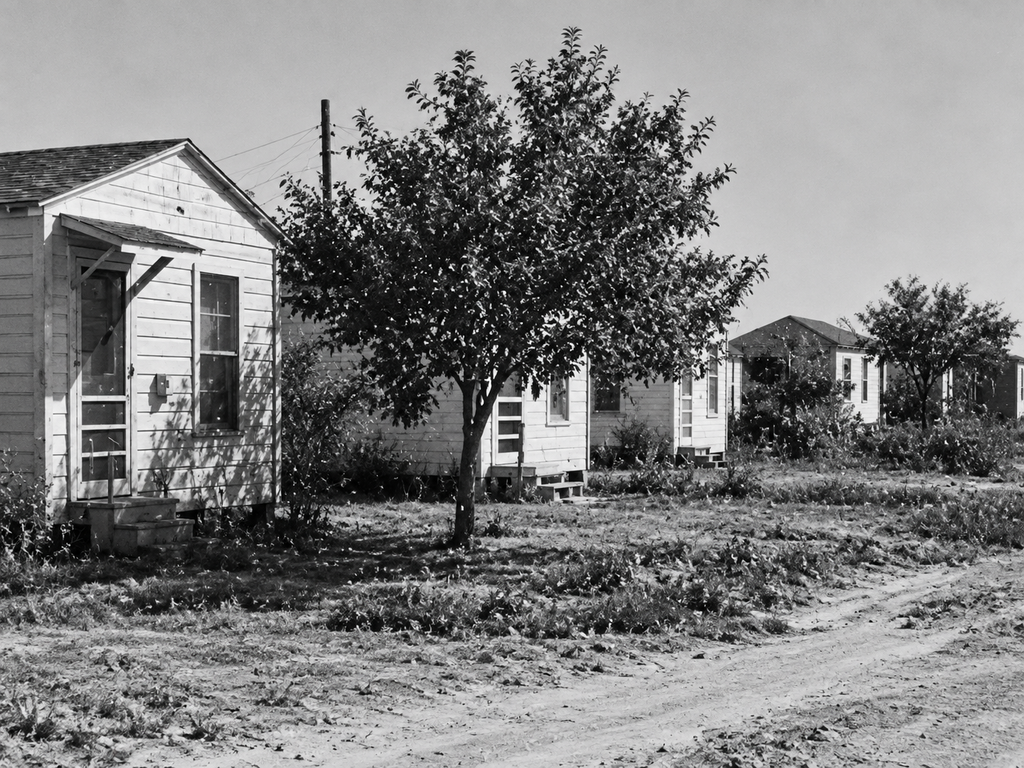
The image on the left is from a photograph in the Corpus Christi Times, 1954. It did not mention the street, but that is how many of the houses looked.
I grew up in Molina, on the west side of Corpus Christi. By the time I was old enough to remember much about city government, Molina was already part of Corpus Christi. What I did not understand as a child was that Molina had not always been inside the city limits, and that becoming part of Corpus Christi created problems of its own.
A 1952 real-estate advertisement helps explain what Molina was like before annexation. A small house in Molina Addition was advertised with “all utilities available but not connected.” In other words, people could buy a house where utility service was supposedly available, but that did not mean the house was actually connected to water, sewer, or the other services a city resident might take for granted.
Then Corpus Christi began looking toward annexation.
The language city officials used at the time was not subtle. In recommending annexation of about nine square miles, including Molina Addition, the Corpus Christi Planning and Zoning Commission said annexation was “primarily intended to stop growth of slums.” City planners worried that subdivisions outside the city limits were being developed without Corpus Christi’s building and development standards.
There was another interesting feature of the proposed annexation: the people living in the territory being annexed did not get to decide whether they wanted to join Corpus Christi. The newspaper reported that Corpus Christi voters would determine the issue. Molina residents would become city residents and would have to follow city ordinances, but they did not have a separate vote approving their own annexation.
City officials understood that annexation would cost money. The newspaper said Corpus Christi would have to spend several hundred thousand dollars providing services to the newly annexed “substandard areas.” It specifically discussed drainage, sanitary sewers, and street paving, the very services neighborhoods like Molina lacked.
That created an unusual situation. Corpus Christi wanted Molina inside the city so it could impose city standards, but Molina did not yet have all of the city infrastructure necessary to meet those standards.
The problem became particularly serious with sanitary plumbing.
In October 1954, the Associated Plumbing Contractors of Corpus Christi proposed a special program to provide inexpensive plumbing to Molina families. The newspaper described Molina as a recently annexed area where many low-income families needed to meet the city’s minimum sanitation requirements.
The plumbers estimated they could provide a commode and kitchen sink for about $138 per house, approximately half the normal cost, if enough homes were done together. Materials could be purchased in large quantities, the work could be performed almost assembly-line fashion, and the city was asked to waive plumbing tap and inspection fees.
The proposal also shows how the public sewer system and the homeowner’s plumbing were divided. The city would make taps on the sewer trunk lines as those lines were laid along the streets. Plumbers would then enter the neighborhood and complete the plumbing installations at individual houses.
I remember the homeowner’s side of that work. At our house, we dug from the house out toward the city easement and laid the concrete sewer pipe ourselves. That was the connection between our home and the public system. My father also had water from the sinks and shower running into the yard to water trees and plants, something he continued doing even after sewer service was available. We had a sink and shower outside the house.
My parents did not borrow money to do the plumbing work. Knowing my father, they probably had the money tucked away somewhere. Other Molina families were not as fortunate.
By February 1955, the estimated cost for minimum household plumbing had risen to about $170. The minimum installation included a sink and commode, with a simple shower recommended when possible. If 100 to 150 homeowners participated together, plumbers believed they could keep the price near that level.
“The $170 minimum plumbing bill would be roughly $2,100 today — a substantial amount for a low-income family already paying for a house.”
But there was already evidence that the city’s plumbing requirements had caused serious financial hardship.
The February 3, 1955 newspaper reported that some Molina homeowners had lost their homes through mortgage foreclosure after borrowing money to finance sanitary plumbing required by city ordinance. Imagine losing your house because the city annexed your neighborhood, required plumbing improvements, and you had to borrow money to comply.
That is where Dr. Héctor P. García became an important part of Molina’s story.
García was a trustee of the Molina Savings Trust Fund, which had been created to give Molina residents another way to pay for plumbing. Instead of mortgaging their homes, residents could save $15 a month until they accumulated enough money to pay for the work.
The money was deposited with Great Western Loan and Trust Company and earned four percent interest. García hoped that the interest earned by the fund could eventually help people who could not afford the entire plumbing bill themselves.
The fund did not hire the plumbers or control the work. Each homeowner would negotiate his own plumbing contract and pay his own bill. The purpose of the fund was much simpler: help families put the money aside before the city was ready to connect them.
By February 1955, 83 Molina residents were already saving through the trust fund, and some had accumulated enough to pay for the minimum plumbing installation.
García explained the strategy plainly. If each resident saved $15 a month, they could have the necessary money ready by the time Corpus Christi was prepared to install the utilities. “If we have our money ready,” García said, “we might even speed things up a little.”
That sentence says a great deal about Molina in the 1950s.
The city had annexed the neighborhood partly because officials said they wanted to prevent the growth of “slums.” Once Molina was inside Corpus Christi, residents were expected to comply with city sanitation requirements. But the sewer lines, connections, and other infrastructure still had to catch up with the ordinances the city was enforcing.
Molina residents did what poor communities have done repeatedly throughout American history. They organized. They pooled their buying power, dug their own trenches, did whatever work they could themselves, and saved a few dollars at a time for the work they could not do.
Dr. Héctor García helped make sure that families had an alternative to mortgaging their homes simply to install a toilet and sink.
The early history of Molina therefore was not merely the story of a poor Mexican-American neighborhood finally receiving city services. It was also the story of a community brought inside the city so Corpus Christi could control its development, then required to spend its own money bringing homes up to city standards while waiting for the city to bring the necessary infrastructure to the neighborhood.
And Molina did not simply wait.
The community organized itself. That same habit of organization would appear again in fights for sidewalks, sewer lines, political participation, and eventually the struggle over the West Oso schools.
The plumbing fight was only an early chapter.