American history remembers Francis Marion as the “Swamp Fox,” a Revolutionary War hero who used surprise attacks, informants, hidden routes, and the protection of difficult country to frustrate a stronger enemy. The British probably had less flattering words for him. One nation’s guerrilla hero has always been another nation’s bandit.
Texas had its own forgotten guerrilla captain. His name was Manuel Leal.
Leal was born Manuel Antonio Santiago Tarín in San Antonio in 1811. Rebellion already ran through his family. His father, Vicente Tarín, had been an officer in the Spanish military before joining the Gutiérrez-Magee expedition against Spanish rule. After the rebels were defeated at the Battle of Medina in 1813, Vicente fled, the government confiscated the family’s property, and Manuel’s mother was imprisoned while he was still a small child.
Manuel initially followed a military path, serving in the Mexican army before becoming dissatisfied and joining the revolt against Mexico. He fought at the Siege of Béxar in 1835 and later enlisted in Juan Seguín’s company of Tejano volunteers. He accompanied Seguín during the San Jacinto campaign, although illness reportedly kept him from participating in the final battle. He remained in Texas service until July 1837 and received bounty warrants and land grants for helping secure the new republic’s independence. The Texas State Historical Association remembers that part of his life.
The more interesting part came afterward.
Texas had been won in large part by men like Seguín and Leal, Tejanos who opposed Santa Anna without believing that Texas should become an Anglo republic in which Mexicans were treated as foreigners. Once independence had been achieved, many of the newcomers who seized political power did not distinguish between the Mexican government and the Tejano families who had lived in Texas for generations.
Seguín endured threats, accusations of treason, and growing Anglo hostility. In 1842, while serving as mayor of San Antonio, he fled Texas because he feared for his life. He later returned under the Mexican flag, accompanied by other Tejanos who had once fought for Texas independence.
Manuel Leal was among them.
In September 1842, a Mexican army commanded by General Adrián Woll entered and occupied San Antonio. Seguín commanded the Defensores de Béjar, composed partly of Tejano exiles and refugees. A Mexican military report identified Manuel Leal as one of Seguín’s captains and praised the “important services” he rendered during the campaign. This was not a later family legend or a newspaper rumor. It appeared in an official Mexican account sent through the military chain of command. Woll’s reports identify Leal repeatedly as a captain.
Leal left no known diary explaining why he returned under the Mexican flag. He was probably forced from the country he had helped create and concluded that his former enemy might treat him better. Mexico accepted him despite his having fought against it, restored him to military service, and entrusted him with men. Texas, which he had helped win, soon called him a brigand.
By early 1844, Leal was operating with an armed party in the disputed country between the Nueces River and the Rio Grande. Texas claimed the Rio Grande as its boundary, while Mexico continued to recognize the Nueces. To Leal, remaining west of the Nueces may not have meant entering Texas at all.
A newspaper report said Leal and his men were disrupting trade, taking horses and property, and moving around the approaches to San Antonio. The report called them marauders and robbers, but it also acknowledged that Leal reportedly held a captain’s commission from Mexico. Texian newspapers wanted their readers to see a criminal, yet the details described a military officer conducting irregular warfare against the economy and communications of an enemy.
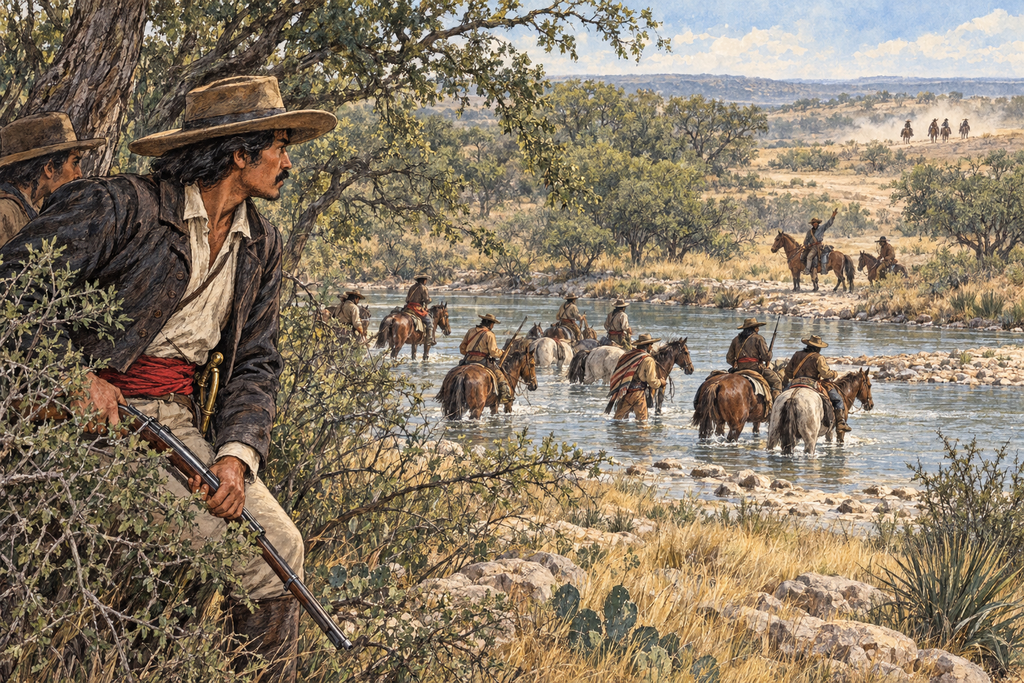
Leal apparently maintained an intelligence network. According to one account, three of his spies entered a traders’ camp shortly before the traders reached Béxar. They reported that Leal was waiting with approximately forty men at a Nueces River crossing, apparently preparing to capture the party when it returned.
Captain Jack Hays and a company of Texas Rangers went after him. Hays pursued Leal for three days, but the record does not say that he caught him or defeated his men. The newspaper remarked that Hays held an “old grudge” against Leal and would probably pursue him all the way to the Rio Grande if necessary.
That description reveals Leal’s methods. He watched the roads, used scouts and informants, selected a river crossing where travelers would be vulnerable, and withdrew rather than give the Rangers the open fight they wanted. He operated from disputed territory and could retreat toward Mexican protection when pressured. Those were guerrilla tactics, whether employed by Francis Marion in the Carolina swamps or Manuel Leal along the Nueces.
The newspapers accused Leal’s party of theft, robbery, interference with trade, horse stealing, and the destruction of cattle. They did not accuse Leal personally of killing anyone. That does not mean he was a peaceful man. He was a military officer who had participated in combat, and men died during the campaigns in which he served. But the surviving reports of his 1844–45 operations emphasize economic warfare, surveillance, threatened ambush, and evasion—not murders attributed to Leal.
The distinction matters. The word “bandit” allowed Texas newspapers to strip Leal of his military identity and erase the political conflict behind his actions. If he was merely a thief, readers did not have to ask why a veteran of the Texas Revolution was now fighting under the Mexican flag. They did not have to consider what had happened to the Tejanos who helped create the republic.
Another report, published in August 1845, provides the clearest evidence that Leal remained within a Mexican military structure. Quoting the Houston Telegraph, the New York Herald reported that Leal’s party had not been seen for some time. It offered two possible explanations: traders had driven the men into one of the Mexican garrisons, or Leal “had been recalled by order of Arista.” The report appeared on August 20, 1845.
Mariano Arista commanded Mexican forces along the northeastern frontier. An outlaw did not have to obey his orders. A captain did.
After that, Manuel Leal largely disappeared from the historical record. The Texas biography of Manuel Tarín remembers the young Tejano who helped win independence but says nothing about Captain Leal’s return with Seguín, his service under Woll, his operations along the Nueces, or the unsuccessful pursuit by Jack Hays. Texas preserved the acceptable half of his life and discarded the half that raised uncomfortable questions.
We cannot know exactly what Manuel Leal thought when he changed flags. Perhaps he still believed Texas belonged to the Tejanos whose families had settled and defended it long before the arrival of most Anglo colonists. Perhaps he no longer recognized the Anglo-controlled republic as the country for which he had fought. Perhaps, like Seguín, he simply decided that remaining in Texas had become too dangerous.
What we know is enough. Manuel Leal fought for Texas, and Texas rewarded him as a revolutionary hero. Within a few years, he returned as a Mexican captain, using spies, ambush positions, disputed territory, and quick retreats while Jack Hays tried unsuccessfully to catch him.
Francis Marion used those methods and became the Swamp Fox. Manuel Leal used them and became a bandit.
History usually allows the winners to choose the name.